Community Corner
Golden History Museum & Park Shared White Ash Mine Disaster
This is the single gravestone for ten miners who drowned in the White Ash Coal Mine.

October 10, 2020
Art Lowther, detail of 1953 Kiwanis Club photo.
Find out what's happening in Goldenfor free with the latest updates from Patch.
This post is part of a series on the history of Golden and the Golden Cemetery. It’s based on a blog created by onetime (1950s) Golden City Manager Arthur Lowther. Each entry was written by a member of Debra Pearce’s AP history class of Golden High School in 2008.
Lowther is the author of The History of Golden and its Golden City Cemetery. Read more about this project here.
By Matt Miller, Ali Senz, Hayden Taylor, and Spencer McIntire, 2008 Golden High School students
On the end of 12th Street, near the Colorado School of Mines football stadium, there is a red granite marker stating, “White Ash Mine Disaster, Dedicated to the Memory of…(names of miners) who lost their lives here on September 9th, 1889, and are entombed in this plot.” This is the single gravestone for ten miners who drowned in the White Ash Coal Mine. Mining has always been a major part of Golden’s history, but this disaster marked the end of an era. Water flooded the mine at a rapid speed, and despite rescue efforts, none were saved. After inspection, it is believed that a fire caused a weak spot in the mine wall. Newspapers covered the disaster for the most part; however, some hardly mentioned the event at all. The victims were numerous and came from many walks of life. The tragic story of these local miners mining in the Far West was the first economic boom, and the first areas to be settled were the mineral rich regions of mountains and plateaus where precious metals enticed fortune seekers. In the days of the gold rush, Isaac Wistar, a forty-niner, said, “Although in rags, almost barefooted, without provisions and almost without tools…we can raise the color ourselves everywhere, even on this very creek.” This was a sign of the hope that most miners had in discovering riches and achieving the American Dream. Gold was first discovered in Golden in 1858, and the area was settled as a Gold Rush Town by Welch Coal Miners called Cousin Jacks. However, the winter was harsh enough to cause most of the miners to leave.
Find out what's happening in Goldenfor free with the latest updates from Patch.
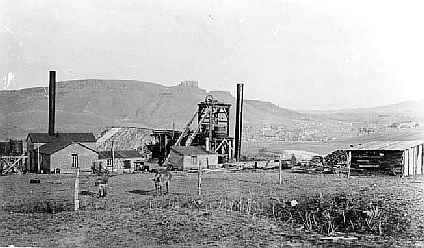 Others decided to seek a profit in other ways, and the Golden area was filled with outcrops of lignite coal, which was very valuable. Within a few months, the countryside was filled with mines for coal. Soon, coal was discovered on Ralston Creek, and Dr. L. W. Frary discovered the White Ash seam about three and a half miles north of Golden in 1860. The coal in White Ash was declared superior to the rest in the county by blacksmiths. By the early 1860s there were six mines along the White Ash seam, including the Loveland Mine. By 1864, the difficulty of delivering the coal caused it to sell for fifty dollars a ton in the Denver market. This was a very high price. The first full scale mining operation started in the White Ash seam in 1870 by Mr. J. Hodges and Evan Jones. The shaft was called the Pittsburg drift, but was eventually lost due to a fault in the mother rock. In 1879 the Loveland Mine had to be closed because of “black damp” a poisonous gas that could be deadly. By 1885, only three of the original six mines were producing coal.
In Colorado, work in the mines was dangerous, and the death rate in mines was very high. The job itself tended to cause discontent among the workers, which led to strikes, and ultimately, the strikes were dismantled. These strikes also sometimes caused disasters such as the Ludlow Massacre in 1913. In the mines at the time, workers used only picks and shovels to get coal. “They rarely used explosives because it’s coal! They might have gotten a bigger explosion than they wanted.” Mining remained a major industry in America for a long time.
The White Ash Mine was established in the spring of 1874 by Mr. John Hodges. Hodges and his men followed a 160-foot vertical outcrop until it leveled out and headed north for Clear Creek. The seam was mined for 800 feet before they reached “black damp” and had to abandon the mine for some time. The mine tunneled under Clear Creek, and about 30 men were employed there at the time. The mine produced approximately 50 tons of coal daily, along with coal oil. In 1881, a nearly perfect body of coal was discovered 450 feet underground, naming the White Ash Mine as the “producer of black diamonds.” White Ash Mine produced about 6,500 tons of coal per year and in 1887 the mine became modernized with the technology that was steam-driven and not worked manually.
On September 9th at about 4 p.m., around when the new shift was getting ready for work, a fire that was sealed off years before burned its way through to the Loveland Mine several hundred feet northwest of the White Ash Mine. The problem was that parts of the Loveland Mine were flooded and the water gushed right into the White Ash. There were ten miners at the 730-foot level where the water was seeping in at the 380-foot level. Two of the miners, David Lloyd and John Morgan, signaled for the cage to come down at 3:45 p.m. The other eight miners were probably finishing working the drift located about 600 feet under Clear Creek when the accident happened. Workers at the surface and at higher levels in the mine tried to save the miners, but everything went wrong for the rescuers. In a matter of minutes these men faced a terrible death and drowned.
The mine inspector came to the mine that evening and tried to save the men with the help of the other miners, but they found that the water level was rising too fast. They pumped air into the mine hoping that some miracle would happen, according to the Golden Globe newspaper. Evan Jones, the mine foreman, desperately tried to reach the miners from the top side, to no avail. Thus, the White Ash Mine became the third cemetery of Golden. Evan Jones is buried in the Golden Cemetery across the roadway from the Cemetery office. Information regarding Evan Jones was given to me by Michael Jones, his grandson.
“Probably a thousand people visited the place during the night, among which were relatives of those who had met such a terrible fate. Many were crazed with grief and almost prostrated while others were only nerved on to do all in their power for the relief of those below. It was however, soon determined that nothing could be done, as they all drowned.”
The next morning the water was within 65 feet of the surface in the shaft. Even though this happened over 100 years ago, the situation and newspaper description seems so familiar with the Crandel Canyon Mine in Utah and Sago Mine in West Virginia, the accidents that happened, and rescues in the past couple of years.
The miners that are buried forever under the Colorado School of Mines practice field are:
- David Lloyd who was thirty years old,
- William Collins who was forty five years old,
- John Collins (his brother),
- Richard Roe who was twenty two years old,
- Joseph Allen aged forty seven years,
- Joseph Hutter aged forty four years,
- Henry Haussman aged forty,
- William Bowden, aged thirty seven,
- Jack Morgan who was twenty one years old, and
- John Murphy who was forty five years old.
Near the site of present-day Brooks Field, this marker and stone commemorates the site of the White Ash Mine disaster.
The mine disaster was actually an accident waiting to happen. The mine operated for nine years until the disaster. A surface fire spread into the White Ash Mine and smoldered in the mine for years. The coal vein that was being mined in the Loveland Mine was the same one that was mined in the White Ash and probably the same coal seam that stretched from Littleton to east of Boulder. This seam was probably the same deposit that is horizontal and has outcrops east of Denver. The fire eventually burned towards the Loveland Mine, which was located north of Clear Creek. The Loveland Mine was an abandoned mine at the time and was flooded. When the fire broke through into the Loveland Mine, the water from the Loveland Mine broke through to the White Ash Mine, flooding the lower level of the mine where the men were working. Since coal was in such high demand in the late 1800s, both mines were eventually reopened.
In the September 11 issue of the Denver Republican that year, headlines proclaimed the disaster in a variety of different ways, all of them contained on the front page or close to it. A few of the many included: Buried Forever, The Bodies of the Miners Beyond, Possible Recovery, All Victims Caught in the Mine’s Lowest Level, and That Level Taken by Flood. The Rocky Mountain News called it “The Greatest Disaster Recorded in the History of the State.” Surprisingly, the White Ash story was hidden in the back pages of the Golden Globe under the headline: Possible Disaster. Copies of the Transcript for the weeks after the incident could not be recovered, possibly because all copies were sold and kept as souvenirs or reminders.
The effects of this catastrophe were astronomical. Ten miners died, but this affected all of their families and gave a new reputation to the White Ash Mine, producer of black diamonds. The red granite marker does not do this tragedy justice, and it is a story that must be known. At this point, the Colorado School of Mines and Women in Mining are planning a move of the monument to create more athletic fields on the campus. These two organizations are thinking of moving the actual monument for the victims to the north side of Clear Creek. The monument itself was paid for by Burt Jones, mayor of Golden, and his family. On the north side of Highway 58, there is a large plaque telling more about the White Ash and Loveland Mines. The location is called White Ash Park.
This press release was produced by the Golden History Museum & Park. The views expressed are the author's own.