Community Corner
Golden History Museum & Park Shares The Women Of The Colorado School Of Mines
Even with the school being open to women and minorities, only four women would graduate from the school in the next seventy-five years.

October 2, 2020
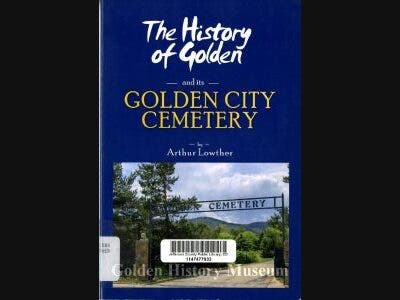
This post is part of a series on the City of Golden Cemetery, located at 755 Ulysses Street, Golden, Colorado. Originally published online by onetime Golden City Manager (1950s) Arthur Lowther, each entry was written by a member of Debra Pearce’s AP history class of Golden High School in 2008 and is now copyrighted by Golden History Museum & Park.
Find out what's happening in Goldenfor free with the latest updates from Patch.
Lowther is the author of The History of Golden and its Golden City Cemetery. Read more about this project here.
The Colorado School of Mines has long been known as a male school, but it has always been open to women. In 1874, the Territory of Colorado passed a law stating, “The School of Mines shall be open to any inhabitant of the Territory of Colorado without regard to sex or color.”
Find out what's happening in Goldenfor free with the latest updates from Patch.
Even with the school being open to women and minorities, only four women would graduate from the school in the next seventy-five years. The women who attended CSM within those first seventy-five years were highly intelligent women and made an impact on the engineering community. A number of women attended CSM as normal students between 1880 and 1950 but did not graduate. However, it was the women who graduated from Colorado School of Mines in the first seventy-five years after the school opened that truly made a difference to women in engineering, women’s higher education, and the state of Colorado.
Florence H. Caldwell was the first female graduate of the Colorado School of Mines. Photo: CSM HISTORY ARCHIVE, COLLECTIONS: CSM 01.03 CLASS & GROUP PHOTOGRAPHS.
The first woman to graduate from Colorado School of Mines was Florence Caldwell. She graduated in 1898 with a degree in Civil Engineering. Before coming to CSM she attended two other colleges. The first was Adelbert College in Cleveland, but shortly after enrolling, the school repealed its policy on coed education. The second college Caldwell attended was Ohio Wesleyan University where she received her bachelor’s in science. In 1895, Florence Caldwell changed her path and enrolled at Colorado School of Mines. While attending Mines she was at first disrespected by the other students, but soon they learned that she deserved to be at the school and accepted her as a fellow miner. After leaving Colorado School of Mines, Florence Caldwell married a man she had met at CSM and adopted his son. She would spend the rest of her life as a wife, mother, teacher, and assisting her husband with his work as an engineer. Her graduation from an all-male school opened the doors for the hundreds of women to follow in her footsteps in the years to come.
The 1903 class includes Grace McDermott (bottom row), second female graduate of the Colorado School of Mines. Photo: CSM HISTORY ARCHIVE, COLLECTIONS: CSM 01.03 CLASS & GROUP PHOTOGRAPHS.
The next woman to graduate from CSM was Grace McDermott (also appears as McDermut), who graduated in 1903. She attended the school after being urged by her family to receive a degree that would help her manage the family gold mine. Before she could finish her education at Mines, the family lost the gold mine, so Grace McDermott was required to find a job, and in 1904, she became the first woman ever employed by the National Bureau of Standards. McDermott spent the next forty-four years working for the National Bureau of Standards. Florence Caldwell may have opened the doors for women to graduate from Colorado School of Mines, but Grace McDermott opened the doors for women to be successful in engineering.
Seventeen years after Grace McDermott, Ninetta Davis graduated from CSM with a degree in Engineer of Mines. She was a well-liked student and was more readily accepted by her peers than the women before her. One of the most impressive things about Ninetta Davis was that, not only did she graduate from an extremely hard, all-male school, she entered CSM at the young age of sixteen. Only two other students have ever matched this achievement. Ninetta Davis had a variety of jobs after graduating, all of which were in engineering. She fit well in the engineering community; she even became the first female president of the Rocky Mountain Association of Petroleum Geologists.
Jacquelyn Borthick graduated from the Colorado School of Mines in 1949 in one of the hardest new fields; she used her degree to start a strong career. Jacquelyn Borthick attended CSM so she could pursue her passion for mathematics and chemistry. The hardest challenge that she met on campus was the lack of women’s restrooms. Jacquelyn Borthick met her husband at Mines and married him the day after graduation; she balanced her career with a family, something that only today has become a common occurrence.
These women made an enormous difference for women around the country. They entered school and received degrees in subjects that were seen as unfit for women. Even with a large number of women receiving a college education, these women were trend-setters because they earned their degrees in areas that are still today seen as male subjects. After 1920, women began to flood into colleges, but most of the time they majored in fields that dealt with other women and children. Engineering has never been seen as a women’s subject; these women defied society and entered the world of men, allowing hundreds of women to follow.
The graduations of Florence Caldwell, Grace McDermott, Ninetta Davis, and Jacquelyn Borthick show more than the engineering community’s openness to minorities and women; they also bring light upon the state of Colorado’s view on human equality. The state of Colorado passed the vote on women’s suffrage in 1890; it was the third state to grant suffrage and the first to do so by popular vote. In 1874, the territory passed an act stating that the School of Mines would always be open to women and minorities. Colorado was a radical state; it gave opportunities to almost all who wished to find them. Many states offered similar rights, but at one point or another discontinued them.
In 1964, enough women were enrolled at CSM that the school built a number of women’s restrooms and turned an old fraternity house into Caldwell Hall, the first women’s dormitory on campus. Colorado School of Mines still remembers its first brave women who graduated from its halls. In 1998, Women in Science, Engineering, and Math held a centennial celebration in honor of Florence Caldwell.
Many women have decided to pursue a career in engineering. Florence Caldwell and the other early women graduates from Mines all made their impact on history, be it opening the doors for women to enter the field of engineering or proving that women could be highly successful in a man’s field. Florence Caldwell, Grace McDermott, Ninetta Davis, and Jacquelyn Borthick all proved that women could be engineers. Colorado welcomes women, and believes that anyone can become what they dream of being if they simply strive for it.
This press release was produced by the Golden History Museum & Park. The views expressed are the author's own.