Community Corner
Mutant Enzyme Eats Plastic: NREL Discovery In Golden
An accidentally mutated enzyme that dissolves plastic may help solve the world's waste problem, NREL scientists believe.


GOLDEN, CO -- Biologists at National Renewable Energy Laboratory, working with a team in the United Kingdom, stumbled on a mutation of an enzyme that dissolves plastic. Scientists believe the enzyme could lead to technology that could break down plastic waste and help solve the world's pollution crisis.
More than 1 million plastic bottles are sold in the world every minute and only about 14 percent are recycled. Petroleum-based PET (polyethylene terephthalate) plastic is cheap to manufacture but doesn't biodegrade for centuries. More than 87,000 tons of plastic waste floats in the Great Pacific Garbage Patch alone.
The study, published this week in Proceedings of the National Academy of Sciences, built on the 2016 discovery of a bacterium that could eat plastics in a Japanese dump. Scientists believed the bug had created an extra-strong enzyme found in nature used by bacteria to break down cutin, a protective coating on many plants.
Find out what's happening in Goldenfor free with the latest updates from Patch.
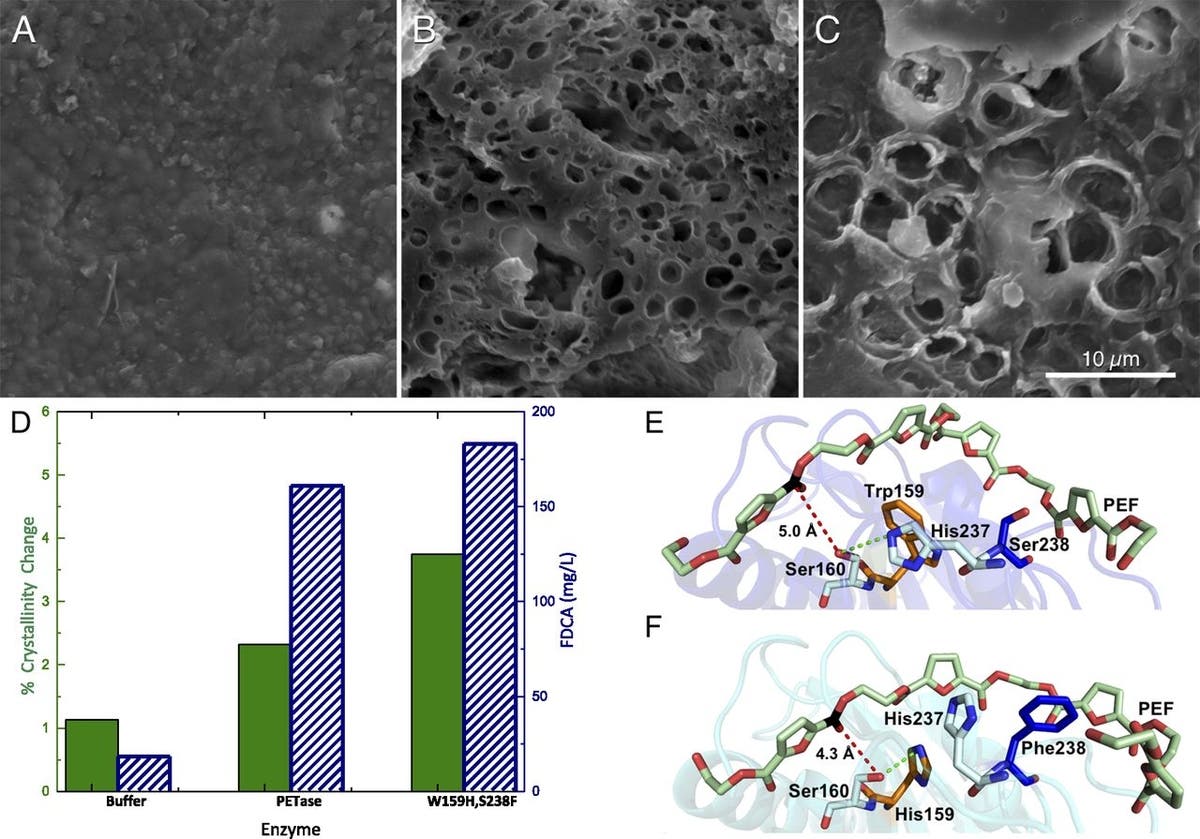
Collaborating researchers at NREL and University of Portsmouth tweaked the enzyme with super-strong X-rays and discovered they boosted its effectiveness by 20 percent. Scientists believe the enzyme could possibly be refined even more and made into a process for biodegrading of plastics on an industrial scale.
“[We tried to] break [the enzyme], to take it back to evolutionary time and we accidentally made it better,” said Gregg Beckham, NREL senior research fellow and study leader, in an interview on CBS2. Researchers think a pile of plastic could be broken down into recyclable components "in a few months" as opposed to a few centuries, said NREL Senior Scientist Bryon Donohoe.
Find out what's happening in Goldenfor free with the latest updates from Patch.
Enzymes have been designed for industrial use in other cases, such as detergent and biofuel production.
Both universities have a patent on the process and hope to refine the enzymes even further to break down plastic faster.
“What we are hoping to do is use this enzyme to turn this plastic back into its original components, so we can literally recycle it back to plastic,” Prof John McGeehan, at the University of Portsmouth, told the Guardian. “It means we won’t need to dig up any more oil and, fundamentally, it should reduce the amount of plastic in the environment.”
Image via YouTube
Get more local news delivered straight to your inbox. Sign up for free Patch newsletters and alerts.