Business & Tech
3-D Printing: Coolest Bike Frame Ever Designed In Littleton
Local Littleton and Longmont-based designers at StudioWest Concepts helped create a 3-D printed bike frame to be produced in California.


LITTLETON, CO -- Just in time for Bike to Work Week, local bike designers Doug Golenz and Bill Stephens have a surprise they've been waiting to unveil. The two have been creating cycle designs at StudioWest Concepts for decades, including high-end carbon-fiber bike frames for Schwinn, Raleigh, Diamond and Yeti.
But Thursday, the company released photos of a new bike design, built with a 3-D printer by California-based Arevo, a company that uses the new technology for mass manufacturing.
Bike designers have used 3-D printers before, as a way to make prototypes, Golenz said, but creating a design that can actually be used to produce rideable bikes is a breakthrough they're excited about.
Find out what's happening in Littletonfor free with the latest updates from Patch.
The Arevo bike is described as a "commuter bike" and the design has removed a seat stay between the seat and back wheel which adds "strength and new simplicity," a press release said.
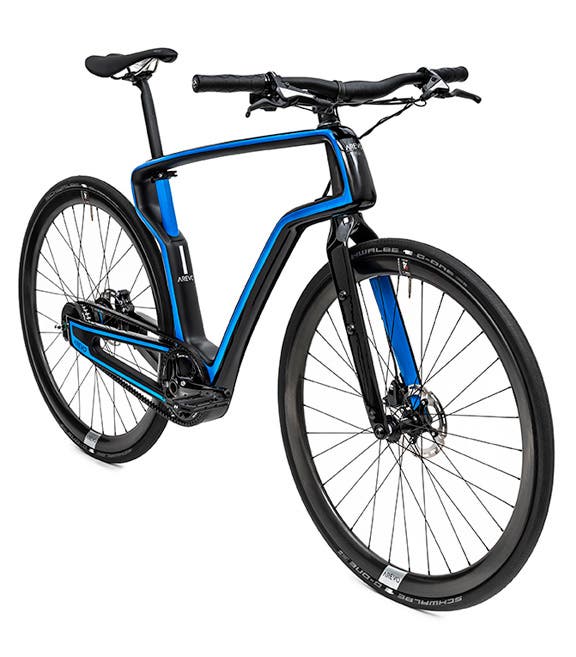
Cyclists love the lightweight feel of a “composite” carbon fiber bike frame, but the costs to create them are labor-intensive. The 3-D printed bike frames are disruptively cheaper to make, Golenz said.
Find out what's happening in Littletonfor free with the latest updates from Patch.
The frames cost about $300 to make according to Arevo. "It takes about four hours to print," Golenz said.
Building with thermal plastic on a 3-D printer also makes the frames more flexible and shock resistant.
Current carbon-fiber bikes use thermal-set plastics that are put into a form and then set, Golenz said. "It's so hard that it's brittle, like the mighty oak," he said. "Imagine mountain biking and you go over the bar. Your bike lands on a rock, and with traditional carbon fiber you shatter your frame," Golenz said.
Frames made with the 3-D thermal plastic technology are more resilient against impact. "It's like willow, there's a little bend in it," Golenz said. The frames are also heat tolerant, environmentally stable and recyclable.
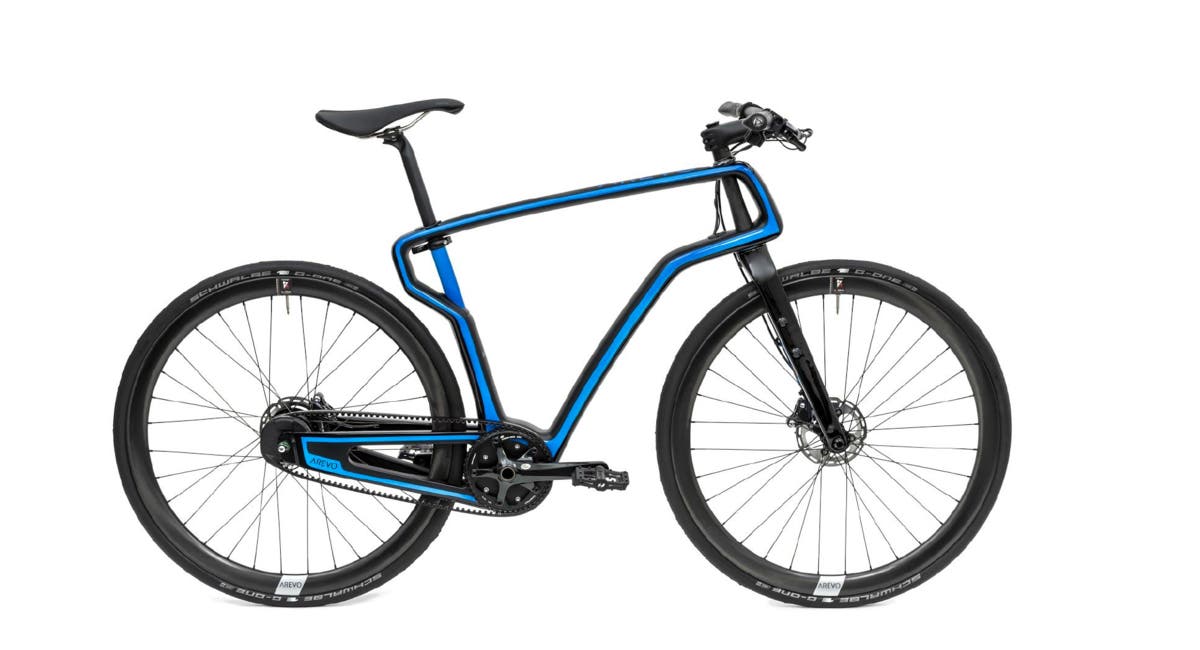
Arevo’s 3-D printer uses a plastic-squirting head mounted on a robotic arm to print out the bicycle frame. Carbon fiber strands are melted into a thermoplastic material with almost no human labor, according to the company.
Hemant Bheda, chairman co-founder said creating parts on a atomic scale with the 3-D printer can make materials that are stronger than metal, but at a significantly lighter weight and for less cost. The time to design and produce a new bicycle with 3-D printing has shortened from 18 months to 18 days, Bheda said.
The company's new CEO, Jim Miller helped Amazon and Google ramp up to increase operations. Arevo hopes to do the same with mass-produced consumer electronics, sporting goods, medical devices and even aerospace printing.
“We can print as big as you want - the fuselage of an aircraft, the wing of an aircraft,” Miller told Reuters.
"We chose the bike because it captures the imagination," said Miller in a video. "Industrial parts are one interesting, but most people can relate to a bike."
StudioWest is also helping Arevo develop prototypes for other consumer goods such as a child carseat and stroller, Golenz said.
The local designers have been mum about the new bike frame until now. "We've been sitting on our hands and unable to talk about it until today," Golenz said.
Image via Arevo
Get more local news delivered straight to your inbox. Sign up for free Patch newsletters and alerts.