Schools
Lamont Issues New Guidelines On When Schools Should Open
The DPH will provide weekly, county-by county evaluations of coronavirus infection risk to help superintendents make the right decisions.


CONNECTICUT — The agencies that oversee Public Health and Education in the state have put down on paper the metrics local school districts need to determine whether they offer in-person or distance learning this fall.
After originally mandating a full return to in-person schooling, Gov. Ned Lamont dialed it back to allow the local districts to chart their own courses for how and where they would schedule classes. Schools could open their doors to students so long as the risk of COVID-19 infection was "low," or "moderate" and choose between full in-person learning or a hybrid combining that and remote learning.
But how would that all-important infection-level be determined, and how frequently would it be updated?
Find out what's happening in Across Connecticutfor free with the latest updates from Patch.
This week Lamont said the DPH will provide weekly, county-by county evaluations of the infection risk based upon certain key metrics to enable the schools to make their decisions. The metrics will include indicators of the spread and prevalence of COVID-19 in the community, as well as the physical and operational ability of schools to implement strategies to mitigate spread.
Each week, the state Department of Health and state Department of Education, along with local health departments, will review the public health data and make any recommended changes between the "low," "moderate," and "high" categories by county. Leading and secondary indicators will also be updated by DPH on a weekly basis.
Find out what's happening in Across Connecticutfor free with the latest updates from Patch.
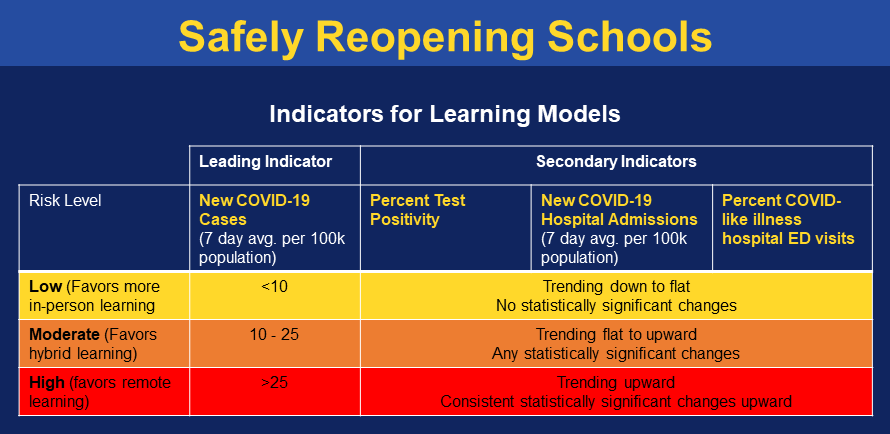
The primary metric is the number of the number of new cases, adjusted for population. The return-to-school risk in a county with less than 10 confirmed new COVID-19 cases per 100,000 residents on a seven-day average will likely be deemed "low," unless offset by higher aggravating secondary indicators, such as new hospital admissions. The state will be strongly encouraging districts in those counties to conduct in-person classes for all students.
More than 25 new cases in the same infection percentile is going to be viewed as "high," and the district will likely keep all students home. In between those goalposts, the risk is considered "moderate," and many districts may opt for the "blended" mix of in-person and remote learning.
Districts in the "low" or "moderate" categories that decide not to provide an in-school option will have to pass a review board from a panel with representatives from various state health and education agencies.
The state has encouraged superintendents to develop an advisory group consisting of their school medical advisor, local health director, and school nurse leader to consult and inform decision-making.
The guidelines were adapted from recommendations by the Harvard Global Institute and supplemented by existing DPH measures.
"These COVID levels provide a map that helps decision-makers and community members know where they are,"according to a whitepaper from the Harvard Global Institute, "Key Metrics for COVID Suppression."The levels do not in themselves provide information about how to respond, given where a community is. The levels do, however, communicate the intensity of effort needed for control of COVID at varying levels of community spread."
Don't miss local and statewide news from all across Connecticut. Sign up for free Patch alerts and daily newsletters.
See also: Iconic National Retailer Closing 3 Connecticut Locations
Get more local news delivered straight to your inbox. Sign up for free Patch newsletters and alerts.