Health & Fitness
Coronavirus Delta Variant on Rise In CT, Other Variants Drop
The overall number of variant cases reported in the state is down, even as the number of cases of the Delta variant continues to climb.


CONNECTICUT — As the coronavirus has mutated, so too have its symptoms.
The now famous signs you may have contracted COVID-19 have changed from cough, fever, and loss of smell to headache followed by sore throat, runny nose and fever, in that order. Researchers in the UK chalk up the new indicators to the prevalence of the Delta variant as well as the higher percentage of young people, who have always strayed from the coronavirus norm symptomatically, now testing positive.
The Delta variant has been in the news in the U.S. as well, with the Centers for Disease Control and Prevention upgrading it to a "variant of concern." Originally from India, the Delta is more transmissible than the version that sparked the pandemic in the U.S. and the Alpha variant that gave the U.K. so much trouble in the beginning of the year. That country is now delaying its "Freedom Day" celebration and the easing of pandemic restrictions as it wrangles with the Delta.
Find out what's happening in Bethelfor free with the latest updates from Patch.
The CDC has identified three types of coronavirus variants: variants of interest, variants of concern and variants of high consequence. The agency has also recently introduced a new category, "substitutions of therapeutic concern," which can be found across all variants, and may be more resilient against certain man-made antibodies.
Instances of the Delta variant are on the rise in Connecticut, even as variant cases overall are dropping — down 22 cases this week — in the state. Delta cases are up three, to 35, according to the most recent data from the state Department of Public Health.
Find out what's happening in Bethelfor free with the latest updates from Patch.
Among the state's other variants of concern, B.1.1.7/Alpha is up from 3,191 to 3,229 cases. Instances of variant B.1.427/B.1.429/Epsilon dropped nine cases, from 200 to 191. Variant P.1/Gamma is down 81 cases in the state, from 123 to just 42. Cases of the Beta variant, B.1.351, rose by one case, to 39.
Among the variants of interest currently found in Connecticut, incidents of variant P.2/Zeta have stayed steady at nine. The variant B.1.525/Eta, climbed by two cases to 21. Cases of the variant of interest B.1.526/Iota climbed 18 cases, from 1,006 to 1,024. Instances of B.1.526.1 climbed from 253 to 259.
One substitution of therapeutic concern, E484K, was found in 1,051 variant cases, up from 1,014 last week. The other, L452R, was detected in 538 cases, up from 527 previously.
Lost amid all the pearl clutching over reports of the Delta variant is the fact that it, and every coronavirus variant discovered so far, are treatable by the three vaccines available to residents.
As of Thursday, Connecticut residents who have received at least one vaccine dose by age group include 94 percent of those over the age of 65, 84 percent of those between 55-64, 73 percent of those between 45-54, 69 percent of those between 35-44, 60 percent of those between 25-34, 55 percent of those between 18-24, 62 percent of those between 16-17, and 41 percent of those between 12-15. As of Friday, Connecticut is behind only Vermont and Massachusetts in the rate of total doses administered per population size, according to the CDC.
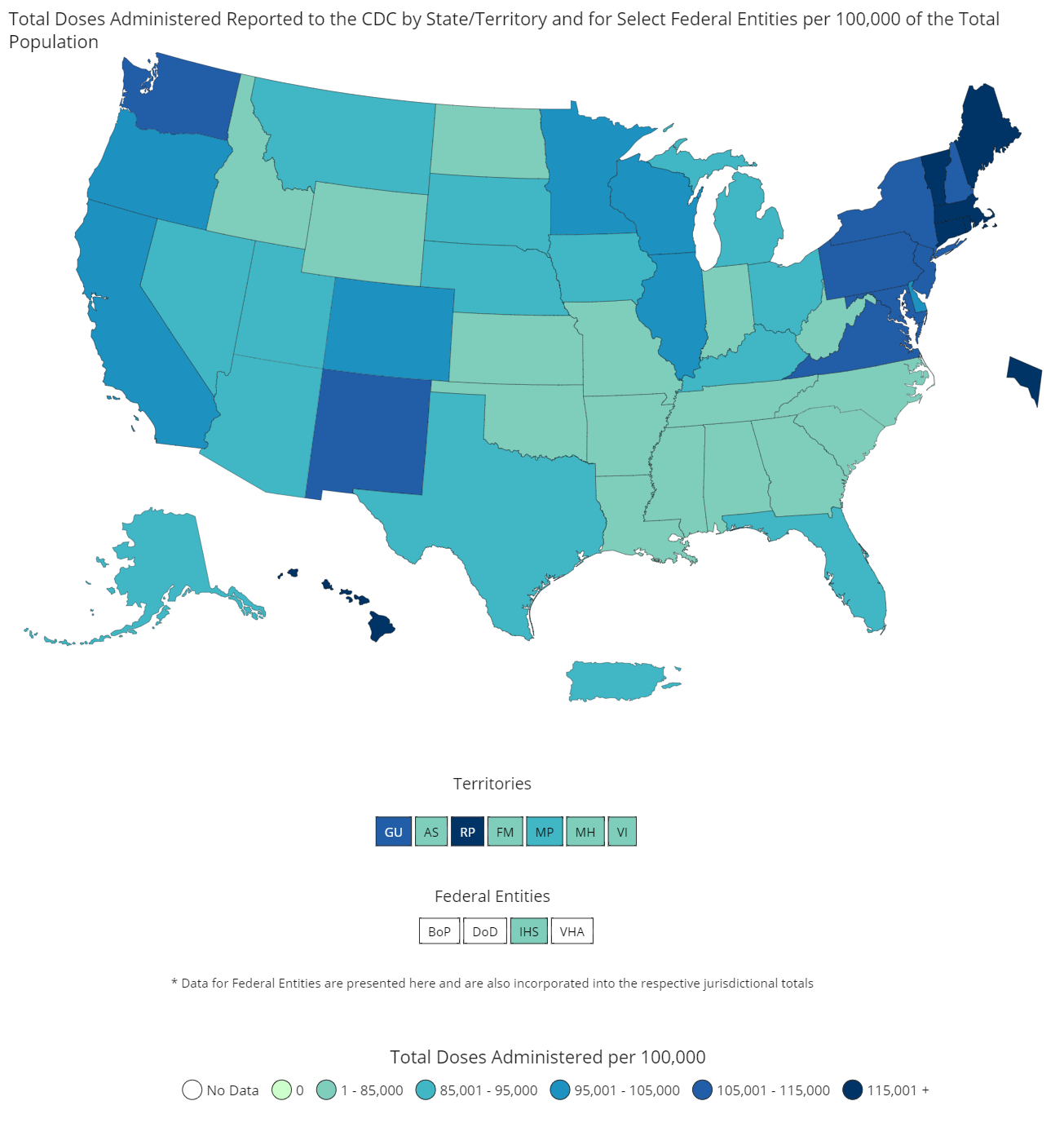
Demand in the state for the vaccine has waned, based upon the latest numbers from the Department of Public Health. It may be reasonable to assume that just about every adult in Connecticut who wants the vaccine has gotten it. The percentage of those vaccinated in each age tier has been rising just 1-2 percent per week over the past two weeks in each age group. The exception is the youngest tier, and the last to be approved for the vaccine.
As of Wednesday, the most vaccinated town in the state is Canaan, with 85.75 percent of the population fully vaccinated, and 97.44 percent with their first dose.
There were four more coronavirus-related deaths reported overnight. The death toll for the pandemic is 8,270.
There was only case of coronavirus this week among residents in a Connecticut nursing home, at the St. Mary Home in West Hartford. No deaths were reported in any nursing home nor assisted living centers located in the state.
Bolton was the only Connecticut town five categorized any hotter than "gray" in the latest update of municipal alert levels issued by the state Department of Public Health. It remains in the yellow zone, with 7.3 cases of coronavirus per 100,000 population during the last 2-week reporting period.
Towns fall into the yellow zone when average daily cases are fewer than 5-9 cases per 100,000 population over a two-week average. The color codes correspond to guidance from the state Department of Public Health.
An additional 70 cases of the coronavirus have been confirmed in the state since Thursday, bringing that total to 348,665. With 15,695 tests reported, the daily positivity rate now sits at 0.45 percent.
The number of Connecticut residents hospitalized with COVID-19 is 33, the lowest it has been since the start of the pandemic.
See Also: Mother, 7-Year-Old Daughter Found Dead In Westport Home: UPDATE
- Firefighters Save Numerous Pets During House Fire
- Early Morning Shootout Near Elementary School Under Investigation
The total of new Connecticut student cases of COVID-19 reported this week was 27, which is 16 fewer than the week before. The total of new staff cases was five, down one from the previous week.
The number of schools with students attending in-person fell by 34.3 percent, to 23.
Get more local news delivered straight to your inbox. Sign up for free Patch newsletters and alerts.