Community Corner
A Bobcat Prowls in Brookfield [VIDEO]
A Powder Horn Hill neighbor spied this large feline interloper in her backyard on Saturday


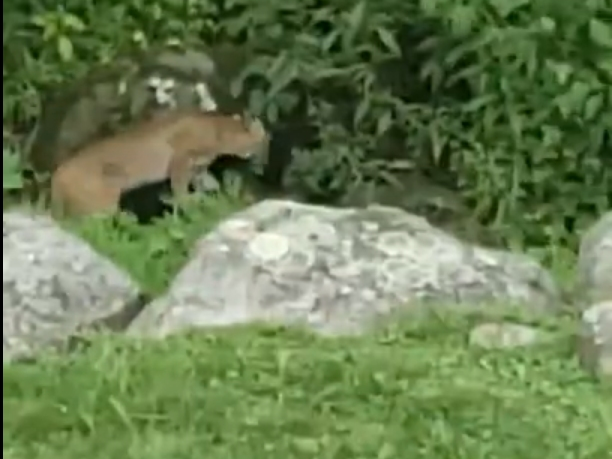
BROOKFIELD, CT — Residents of the Powder Horn Hill neighborhood are no strangers to wild turkeys, deer, foxes, and even coyotes and bears, but bobcat sightings are still something to write home about.
Or at least post on social media.
Melissa Dos Santos spied this large feline interloper in her backyard on Saturday and grabbed a quick video on her smartphone (see below).
Find out what's happening in Brookfieldfor free with the latest updates from Patch.
"I just happen to look out my window quickly and saw him standing there on rocks in our backyard," she told Patch.
The bobcat came 'round for his close-up at about 11:30 in the morning, but didn't stay very long.
Find out what's happening in Brookfieldfor free with the latest updates from Patch.
"He was a good size," Dos Santos said. "He was scared off after he saw me on the porch."
That's par for the course, for bobcats, according to the state Department of Energy and Environmental Protection. They're happy to prey upon cottontail rabbits, woodchucks, squirrels, chipmunks, mice, voles, white-tailed deer, birds, and, to a much lesser extent, insects and reptiles. But they'll avoid humans if they can.
Bobcats are now regarded as a "top predator" by DEEP scientists, having made a valiant comeback in the past couple of generations. The 'cats were facing extirpation until 1972 when unregulated exploitation was halted and the species was reclassified as a protected furbearer with no hunting or trapping seasons.
The DEEP Wildlife Division initiated a bobcat study in 2017 to investigate bobcat habitat use in different housing densities in Connecticut. Biologists want to determine how the state's bobcats meet their needs in both rural and suburban areas, as well as how successful bobcats are at reproduction and survival.
With the assistance of local trappers, the Wildlife Division completed two seasons of live-trapping bobcats from late 2017 to early 2019, according to the DEEP website. All live-trapped bobcats were marked with yellow ear tags. Biologists also collected important data from each bobcat, including weight, age, and sex. Fifty bobcats were fitted with global positioning system collars in the 2017-18 season. All of those collars were programmed to automatically detach from the animals on Aug. 1, 2018. Another fifty bobcats were collared during the 2018-19 season.
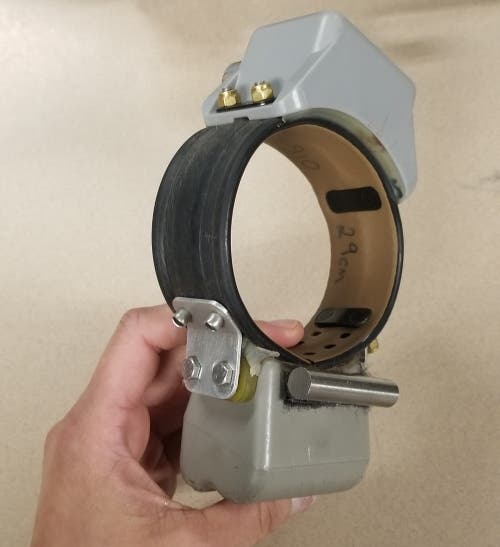
Bobcat Collar. Credit: Melissa Ruszczyk/DEEP Wildlife Division
All of these collars are programmed to automatically detach from the animals after 300 days from when they were deployed. These collars for the 2018-2019 season began detaching this month, and continue through January of 2020. Bobcat project staff will then use radio telemetry equipment to locate and recover the detached collars.
If you find a detached collar before project staff can retrieve it, DEEP is asking that you collect it and call 860-424-3211.
Get more local news delivered straight to your inbox. Sign up for free Patch newsletters and alerts.