Community Corner
Weaving A Life At The Craft Center
Christa Shaw is a serial crafter who gives courses at the Brookfield Craft Center... and is married to a BCC teacher, too. Making things is in their blood... and her blood, at least, is also in the things made.
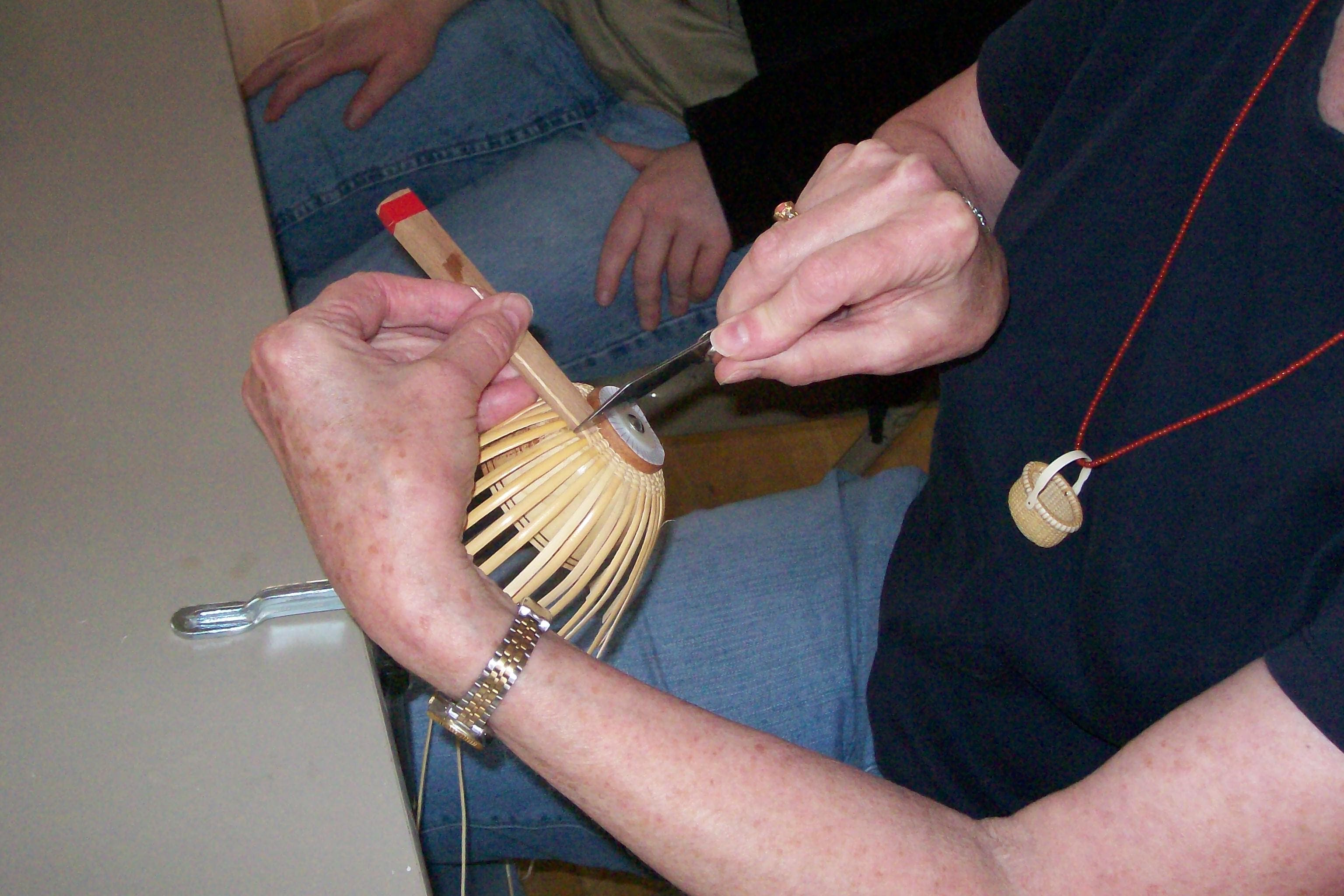


"Hold the stave down," says Christa Shaw, only slightly exasperated at having to say the same sentence eight or 10 times. "And keep it at 12 o'clock — don't go to 1 o'clock, or you'll get crooked."
There are six of us attending her Nantucket basket-weaving class at the Brookfield Craft Center (BCC), but if there's a "natural" among us, I haven't identified her (I'm the only male in the room). And in truth, it's hard to hold the stave down, because the baskets we're working on are tiny, would fit inside a teacup. My fingers suddenly seem fat, uncoordinated — a feeling which lets up, fortunately, because the more we weave, the easier the work gets. Partly from experience, yes, but mostly because the staves intersect at the base of the basket, where there's little "play in the joints." Six, eight rows done, and you don't feel quite so wiener-fingered... that you might actually finish the body of the basket by lunchtime.
And that, of course, is Shaw's plan. This is the first Brookfield Craft Center course she's given, but she's taught basket-weaving elsewhere, and knows it's important for students to feel a sense of completion, that they've actually done something. Not being a good craftsman myself — I lean toward rough carpentry, not finish — I expected basket-weaving to be hard, but Shaw makes it seem straightforward, even easy. Yes, at one time or another each of us is reduced to "backweaving" — the dreaded moment when Shaw spots an error, pulls on your "weaver" (the long strip of cane that gets woven in and out of the staves), and 20 minutes of work vanishes in the blink of an eye... but hey, that's how you learn, right? At one point Shaw does say, "Don't say 'oops,' it's not allowed," but she's kidding. We think....
Find out what's happening in Brookfieldfor free with the latest updates from Patch.
Shaw has been weaving Nantucket baskets for 15 years, starting with Shaker basketry but wanting, eventually, to move beyond its self-imposed simplicity. She's taken courses with John McGuire — "He's renowned, a real basket artist," she says — and other Nantucket "basket masters" (Karol Lindquist, Nap Plank, Tim Parsons), and likes the idea of passing on her knowledge. She's certainly not into basket-weaving to sit at craft-fair booths — "You should see the house!" she says, rolling her eyes. Her home in Bethel — which she shares with Buster Shaw, who regularly teaches wood-turning at the BCC — is crammed with her baskets, which she occasionally sells through Scrimshanders, a scrimshaw store in Newport, Rhode Island... but only when the baskets at home start falling onto the floor.
"Most of my baskets have my DNA in them," Shaw says, "just look at my hands!" She is showing another student how to thread a new piece of weaving-cane — it can't be more than two millimeters wide — into the staves. She takes an eight-foot length of weaver from a nearby table, scrapes two inches off one end with a small knife, reducing its thickness by half. Such a trimming would have seemed impossible an hour before, because cane is so thin, but cane is also tough, says Shaw, backweaving a short length of weaver from the student's basket, and repeating the scraping, so that — when the new weaver is woven — the two scraped pieces overlap. It works; only a slight change in color, once Shaw has trimmed the weaver, betrays the hidden "joint."
Find out what's happening in Brookfieldfor free with the latest updates from Patch.
Shaw is a serial crafter, unable to keep her hands still — which was fine with the school system in her hometown of Bamberg, Germany, where she learned to knit, crochet, embroider, sew and darn (girls only, of course — this was the 1950s). After moving to Long Island with her family in 1958 (and helping her father build a garage — "I was the one holding the transit"), doing a stint in the Women's Air Force ("A pilot? God, I wish!!"), meeting Buster (an Air Force metrologist — no, not "meteorologist," but a specialist in precise measurements), and going where the military required (Massachussetts, Colorado, Labrador, California, Germany, New York), the couple returned to Buster's hometown, Bethel. He, now retired, ended up working at Perkin-Elmer, she at Cendant... but her crafting career had barely begun. She took a furniture-making class at Danbury High School — "everything was dovetailed" in the chests she made — then moved on to basket-weaving... and now, jewelry-making. She planned just to make shoulder straps for baskets, but that's evolved into bracelets and necklace-making... and weekend trips to the Elephant's Trunk in New Milford with BCC teacher and jewelry-maker Pat Segar, looking for old ivory.
Being a cream-skimming journalist, I duck out at lunchtime, and Shaw, naturally, volunteers to finish the basket for me (hey, I did most of the weaving!!). She delivers the finished product a few days later, when we meet for coffee at Panera. It's beautiful — see photo, I've added a quarter on the handle for scale — and could sell, says Shaw, for as much as $120. Buster joins us, and I learn he turned most of the wooden bases for these baskets — Shaw can usually identify his handiwork, she says, because Buster's precision-engineering background means his work rarely needs sanding.
I'm about to leave when the conversation turns to budget issues, and how schools are cutting back on art, home economics and shop programs. Buster notes he met a school principal recently who said, "Children who are using their hands aren't using their minds." The Shaws are horrified at the statement, as am I, because we know from many "building" experiences that using your hands often causes you to think, to reconsider, to imagine new approaches.
The Brookfield Craft Center's "Bowlfest" fund-raiser takes place Sunday, June 13, at Town Hall. For more information — or to become a sponsor, or advertise in the journal — call 203-775-4526.