Politics & Government
Darien RTM Approves Sump Pump Ordinance With $250 Fines
Darien passed a sump pump ordinance with $250 fines that officials say will curb illegal sewer connections and reduce rising costs.


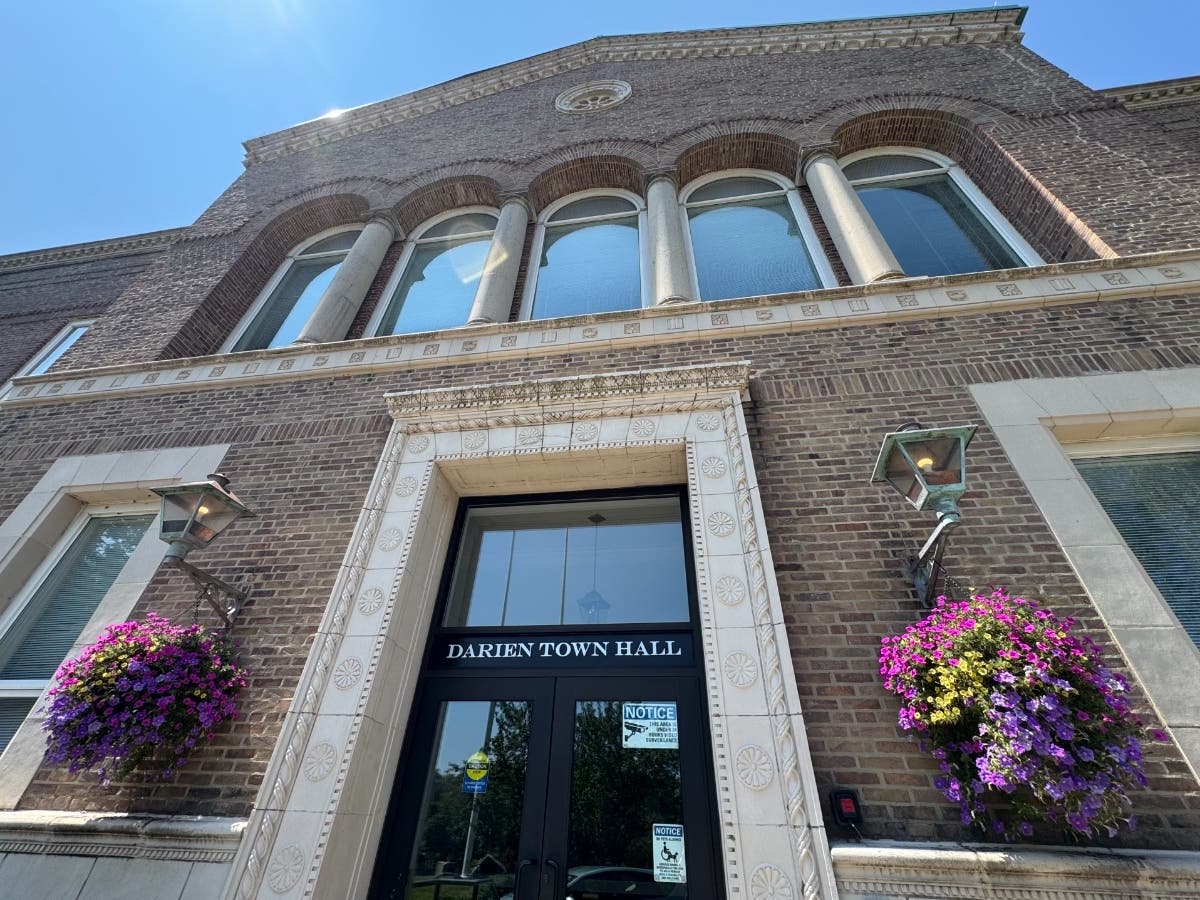
DARIEN, CT — In an effort to gain a better understanding of sump pump usage in town and to help improve sewer capacity and lower sewer costs, the Darien Representative Town Meeting on Monday approved a sump pump ordinance that could result in fines of $250 for residents who don't comply.
An ordinance for the abatement of illicit sump pump discharge into public sewers originally went before the legislative body last October, but the proposal faced criticism from some residents who cited concerns with unnecessary costs, fairness and intrusiveness, with some suggesting descriptions of a "sewer police." A vote was tabled while officials worked to address concerns.
The RTM on Monday voted 67 in favor, 10 opposed, and two abstentions to pass the ordinance this time around. The meeting can be viewed on demand on DarienTV.
Find out what's happening in Darienfor free with the latest updates from Patch.
According to the Darien Sewer Commission, inflow and infiltration, or I&I, into the town's sanitary sewer is adding clean water to the system that should not be there, and illegal sump pump connections to the system are contributing to the problem.
Inflow comes from direct connections like sump pumps, downspouts and curtain drains. Infiltration occurs when water enters through cracks or breaches in sewer lines or leaky manhole covers. Inflow and infiltration to the sewer system is largely contingent on the amount of rainfall received.
Find out what's happening in Darienfor free with the latest updates from Patch.
Flow effluent is sent to the Stamford Water Pollution Control Authority (WPCA), where it is treated and processed. Darien is charged for every gallon sent to Stamford.
Sump pumps that are hooked up to the system and discharging water compromise the capacity of the sanitary sewer system and increase Darien's payments to Stamford, the commission has said in the past.
"In the past five years alone, Darien has pumped over 2.1 billion gallons of clean water to the Stamford sewage treatment plant for processing. Clean water makes up 44 percent of total flows over the past five years. This I&I is costing Darien sewer users over $1 million annually just in processing fees," explained RTM District I member Patrick Kane, who also serves as vice chair of the legislative body's Public Works Committee.
First Selectman Jon Zagrodzky noted in his March newsletter to the community that at its peak, the town estimated that 58 percent of the wastewater pumped to Stamford for treatment came from I&I rather than household or business effluent.
"That estimate is based largely on comparing the amount of effluent treated with the amount of water delivered to Darien by Aquarion," Zagrodzky wrote. "In other words, more than half of the money being spent by the Town was going toward treating stormwater or groundwater that did not need treatment in the first place. That is a pretty expensive proposition."
Since 2019, the town has worked on the rehabilitation of its sanitary sewer system to analyze and correct the infiltration problem.
In 2022, the Darien Sewer Commission launched a parallel program to identify sources of inflowing water from illegal direct connections from sump pumps and downspouts. As part of that program, in each of the last four years, the commission has sent information requests included in sewer bills to each sewer user, asking if they had a sump pump and if it was connected to the sanitary sewer system.
"Unfortunately, less than 1 percent of those who receive those requests return them. Less than 55 people out of 5,470. This is why the sewer commission has requested the town's assistance through the ordinance we're discussing tonight," Kane said.
"The working thesis is that somewhere between 10 and 20 percent of sewer users may have sump pumps or illegal connections dumping into the sanitary sewer system, but this is just an estimate. We don't know. That means, conversely, that 80 to 90 percent of sewer users are funding the illicit behavior of the other 10 to 20 percent. That's simply not fair."
The Sewer Commission recently adopted new regulations requiring all sewer users to complete "sump pump compliance statements,” confirming whether their systems discharge into the sanitary sewer. Kane said the move is aimed at identifying illegal connections, after past outreach efforts yielded responses from less than 1 percent of users.
Residents who return the form on time but disclose an illegal connection will be given a six-month grace period to disconnect their sump pump or downspout without penalty. Additional time may be granted by the superintendent if needed, Kane said.
Those who fail to return the form would face a $250 penalty, while residents found to have undisclosed illegal connections would have 30 days to correct the issue or risk additional daily fines.
Kane said on-site assistance will be available, with the property owner’s permission, to help determine whether a sump pump is connected to the sewer system. They also emphasized that the ordinance does not allow entry onto private property without consent and that a financial assistance program may be developed once the scope of the issue is better understood.
"To be clear, the overriding objective of the new sewer regulations, and this proposed ordinance, is to obtain information from sewer users to significantly reduce the excess clean water flowing into the sanitary sewer system, not collect fines," Kane said. "With or without this ordinance, sump pumps connected to the sanitary sewer system violate both local law and state plumbing code."
Kane went on to say residents are "very lucky" to live in a town like Darien where sewer officials are "benevolent and hard-working."
"They do not want to assess fines. They are simply focused on reducing the amount of clean water flowing into the sanitary sewer system, to protect that system and save users money," Kane said. "If you lived in a city like Stamford, or Bridgeport, or Brooklyn, the process of addressing illicit connections to the sanitary sewer system would likely have a very different and less empathetic tone."
Some RTM members said they couldn't remember seeing information requests about sump pump connections, although some said they had noticed the yellow piece of paper in their sewer bills.
"I have gotten calls back, I've gotten people responding to it, so obviously it did go out," said Darien Public Works Director Ed Gentile.
RTM member Amy Zebatakis, of District V, called the issue of illicit sump pump discharge not just a financial problem, but an environmental one. She also said the RTM could lead in getting the word out to residents and fix any communication problems.
Another RTM member, Jim Cameron, of District IV, praised the Sewer Commission and Gentile for their work on a variety of town issues, but he objected to the proposed ordinance, as he did last October.
"Inflow and infiltration is a serious problem, but this ordinance, although it is much better than the one we saw last in October, I don't think is the solution. We are trying to impose a townwide penalty on people who are not part of the problem," Cameron said. "Public Works knows very well which parts of town, based on the pumping that occurs after a major rainstorm, they know where most of those sump pumps are. They're not in my district, or at least in my immediate neighborhood."
Cameron noted he has older constituents in his district who have lived in town for over 30 years, and reported that their sump pumps have turned on at most three times over that period.
"Those years when we saw the heavy rainfalls and the increased flow going to Stamford, those were not years when their sump pumps went on. But, we're going to impose upon them what is, in effect, a tax. They're going to have to go out and find somebody to remediate this situation, and we're talking somewhere between $500 and $1,000... to solve a problem that is not of their creation," Cameron added. "They're not part of the problem, but they're going to have to pay for this."
RTM Finance and Budget Chair Jack Davis reiterated the sump pump sanitary sewer connections are illegal.
"It's been illegal for 50 years," he said. "This isn't something we're dropping on people. My understanding is 85 percent of people in the RTM are connected to the sewer system. That means eight of you are potentially illegal, and the rest of us are paying for it. And I don't find that to be fair."
Rolf Obin of District IV reminded the RTM to keep in mind the town's contract with the Stamford WPCA expires at the end of June 2028.
"We have roughly two years to try and demonstrate that we are controlling and hopefully in fact reducing our I&I to that facility, which would give the Sewer Commission a great position for them to be in to negotiate a contract that can hopefully bring down the amount of our participation in contributing dollars to their operation," he said.
View Monday's RTM meeting in full on DarienTV.
Get more local news delivered straight to your inbox. Sign up for free Patch newsletters and alerts.