Business & Tech
Holiday Taste Tour at Darien Cheese & Fine Foods: First Course
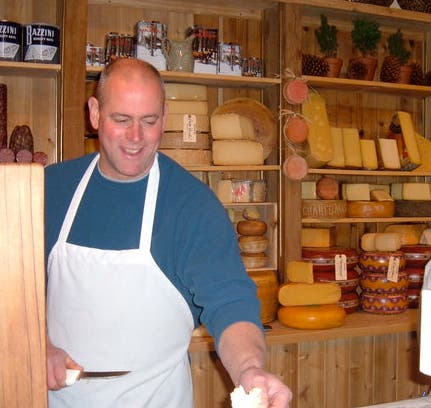
The first of a two-part "taste tour," I meet with cheese monger Ken Skovron for inspiration as to what I might serve when I entertain this holiday season.



Several years ago, I was introduced to a Swiss cheese called Tête de Moine. I adored the sharp, nutty cheese, but I particularly enjoyed the Griolle from which it was served.
The best way to describe a Griolle is a cheese board with a metal spike that pierces through a wheel of cheese. The spike holds a blade in place on top of the cheese that, when rotated around the spike, scrapes a layer off the cheese to form beautiful ruffles or "rosettes," hence the "Girolle" gets its name.
Inspired, I purchased both the Tête de Moine and the Girolle, and several more since then for my food-enthusiast friends. While I hate to give up my source, there's only one place in Fairfield County that carries such items: Darien Cheese and Fine Foods.
Ken and Tori Skovron opened the shop in 1986. The business was originally part of the 1967 Fairfield County franchise "Cheese Shop International," where Ken-age 15-found his passion for cheese.
"I was instantly taken with the sight, smell, taste, and process," Ken recalled. "I knew this was it."
The shop has since evolved since opening over 20 years ago. Ken and Tori have added a charcuterie filled with meats, olives, dried fruits and nuts, compotes, pasta, coffee. The list goes on.
Looking for holiday-gift ideas, as well as inspiration as to what I might serve when I entertain, I met Ken for a two-course, Darien Cheese & Fine Foods tasting tour.
First Course: A Selection of Cheeses
Raw milk cheese, no longer a controversial issue in the industry (for now), is what Ken refers to as "the truth of cheese." The FDA backed off the topic, and the industry simply abides by healthy, safe and responsible standards. Unpasteurized, raw-milk cheese must be aged a minimum of 60 days from where it originated, before shipping. The "truth" of the cheese is imparted through its terroir, a term used to describe the characteristics that geography bestows upon the flavor of the cheese. The soil, weather conditions, and farming techniques all contribute to the unique qualities of the milk.
Ken steered me towards a soft ripened cheese wrapped in spruce bark, from the Jura region of France. The rustic look alone was quite appealing, and the bark was indeed an indication of a slightly woodsy finish.
A 20-month-old hard cheese from the same region called Comte, had a nuttier, but smooth profile.
Next was a five-year-old Parmigiano-Reggiano. It had a wonderful nutty, salty combination with a hint of graininess, but not pungent and chalky like some more commercial brands you find in a supermarket. Ken explained how the October-December cheeses yield a better cheese due to the thicker, richer milk that is higher in protein and fat that is needed to produce such a robust cheese.
I like "stinky" cheese. It goes with my flavor palate that favors spicy food. So it's perhaps no surprise that I loved the Stichelton, a delightful pasteurized semi soft cheese from England. Real Stilton is made with raw milk and in turn evokes more of the flavors of the terroir. I enjoyed the subtler Stilchelton, taking time to savor the creamy pungency of the cheese, while not missing what I was expecting to be a more "biting" flavor profile.
Shame on me for declaring that I don't care for Gruyere.
"I find it to be an overrated, over priced version of Swiss cheese," I say to Ken.
Out comes the Vieux from Switzerland. Okay, now I'm a believer. This hard cheese offers the richness of a soft cheese, but with a slight tangy overtone that Gruyere is known for. I'm a believer.
Ken deals primarily with small production cheese makers. Cheeses are imported every few weeks and ripen in-house until ready for sale in their best "eating condition." Price points are in keeping with the quality of the product with average prices per pound ranging $16.99 to $32.99.
Still hungry? The taste tour continues tomorrow with the Second Course: Samplings from the Charcuterie