Arts & Entertainment
1830s Classroom: A Different Time
William Augustus Hart of Durham, a tireless advocate for education, gives us a glimpse of 19th century schools in Connecticut.

William Augustus Hart of Durham was born on April 26, 1806, and died on March 10, 1879. He was a man who devoted himself to a number of causes. One of his passions in life was education. He was a well-respected itinerant teacher as well as a longtime member of the school committee. Examining his experience with area schools in the early to middle decades of the 19th century provides a good window to observe what going to school was like nearly 200 years ago.
Public school students in Middlesex County in 2011 will attend school for about nine months. Public school students in Middlesex County in the early to middle decades of the 19th century usually attended school for only two months per year—if they were fortunate. It was William Hart’s great frustration as a young man to be able to attend school for only two months. This frustration was compounded by his family’s inability to buy him more books to study; nevertheless, Hart prepared himself as best he could to become a teacher.
His first school was in the Candlewood Hill District of Higganum, where he taught for five months at $15 per month while boarding with various residents. His yearly salary was $75. Here’s what Jesse Spencer of Higganum had to say about his teacher, Mr. Hart:
Find out what's happening in Durham-Middlefieldfor free with the latest updates from Patch.
I, Jesse Spencer, of Higganum, remember going to school to Mr. Hart in 1826. The schoolhouse was 50 or 60 years old then and unfit. It has since been sold at auction, removed, and not a vestige of it remains. I was 10 years old. Everyone liked him. He was very popular with every family in the district. There were about 50 scholars in the school. He was a good teacher and a good man, opened school with prayer, an exception by teachers while I attended school. I think I am the only person living who attended his school, and my recollections of that school term are among the most pleasant memories of the past.
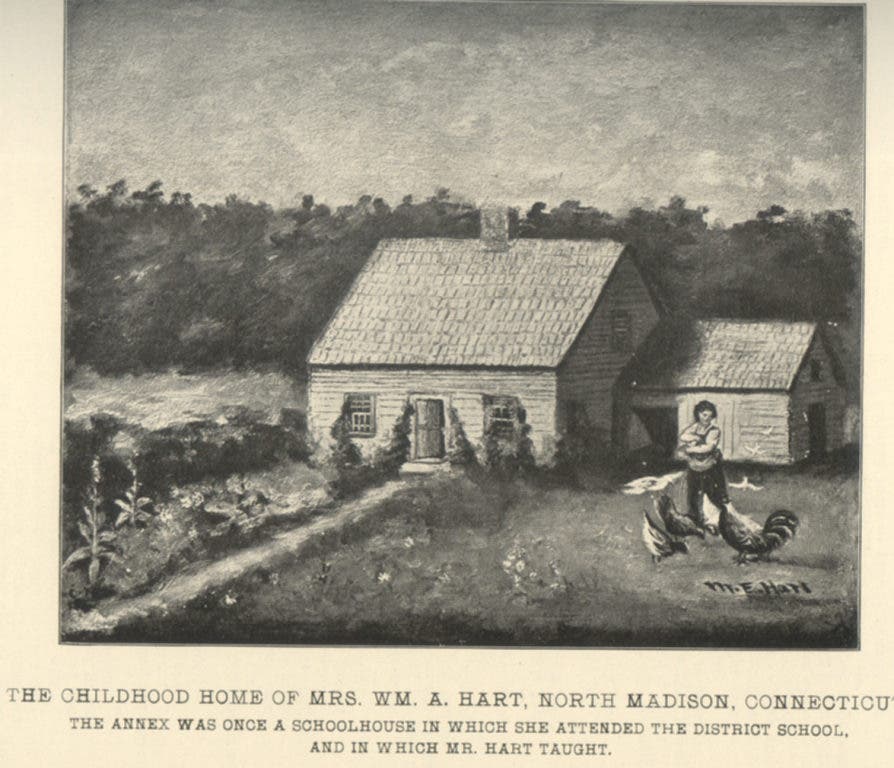
In the winter of 1827-28, William Hart taught school in North Madison. It was here that Hart met his future wife, Sally Maria Jones—eldest daughter of school committeeman Joseph Jones. The two were married on June 23, 1828, and moved to his family’s home in Durham until 1832, when they moved into their own home. At the time (1830) the population of Durham was 1,116 and growing. Among the new residents were the nine children of William and Sally Hart—three of whom would go on to fight in the Civil War.
Find out what's happening in Durham-Middlefieldfor free with the latest updates from Patch.
William Hart continued to teach and to advocate for a longer school year, as well as for a new school building. He was aided in his goals by a fund that the state had set up after the sale of Connecticut’s land holdings in the Western Reserve section of Ohio. Through a state formula, each town was allowed to tap the Western Reserve fund each year to defray local expenditures for education. In 1838, Durham’s share of the fund amounted to $1.20 per pupil.
By 1868, the number of students in the Durham schools totaled 245. Hart noted in his 1868 school report that the total cost of educating those students that year was $811.51 or $3.31 per pupil!
His 1868 report also pointed out a number of problems with the local schools. One major problem was attendance:
One great fault is the irregularity of attendance; of 245 scholars enumerated we find the average attendance but 105-- less than one half. Many that pretend to attend school are so irregular in their attendance that they derive little benefit themselves, derange the classes, and embarrass the teacher. Whether this is owing to truancy on the part of the scholars, or selfishness or inattention on the parents, it is a serious evil and means should at once be taken to correct it.
Another problem was parental apathy:
Another evil is parents seem to take so little interest, seldom if ever visiting the schools, usually more ready to look after their horses and cattle than the education of their children.
William Augustus Hart was an educational activist who believed in confronting problems head-on. As a teacher, he inspired the love and respect of his students. As a father and a member of the local school committee, he was a tireless worker in expanding the length of the school year, improving the teacher selection process, designing and building new schools, and actively addressing the chronic problems of attendance and parental apathy. He was the first to propose building a high school for the town of Durham. His tireless work on behalf of Durham’s schools provided many expanded opportunities for the youth of his town—quite a legacy.
Notes and Sources:
1. Beers Commemorative Biographical Record of Middlesex County (1903)
2. In 1830 the population of CT was 297,711; of New Haven, 10,180; of Middletown, 6,892; of Durham, 1,161.