Arts & Entertainment
Connecticut Highway Names And History: William Beaumont
A medical pioneer, Beaumont's breakthrough was generated by a gunshot wound.


The role that chance can play in influencing the course of history cannot be underestimated. The “Father of Gastric Physiology,” Dr. William Beaumont, came by that title largely as a result of a hunting accident in Michigan and the unexpected consequence of a partially healed stomach wound.
Beaumont who was born in Lebanon in 1785, had state highway Route 289, from Lebanon to the junction of Route 87 in Willimantic, named after him in 1935, the sesquicentennial year of his birth and the tercentennial of the founding of Connecticut. Beaumont died on April 25, 1853, 158 years ago this week.
After growing up in Lebanon, Beaumont set out for Champlain, N.Y., near the Vermont border, where he became a young schoolteacher . He soon changed careers after serving an apprenticeship and studying medicine under the supervision of a nearby doctor, Truman Powell, in St. Albans, VT.
Find out what's happening in Durham-Middlefieldfor free with the latest updates from Patch.
Vermont certified him as a doctor in 1812. Beaumont immediately became an Army surgeon in the War of 1812, serving near the Canadian border until the end of the war in 1815. For nearly 5 years following the war, Beaumont ran a private medical practice in Plattsburgh, N.Y. In 1819, however, he rejoined the Army and was sent to Mackinac Island, Mich. His assignment there would prove momentous for the course of medical history.
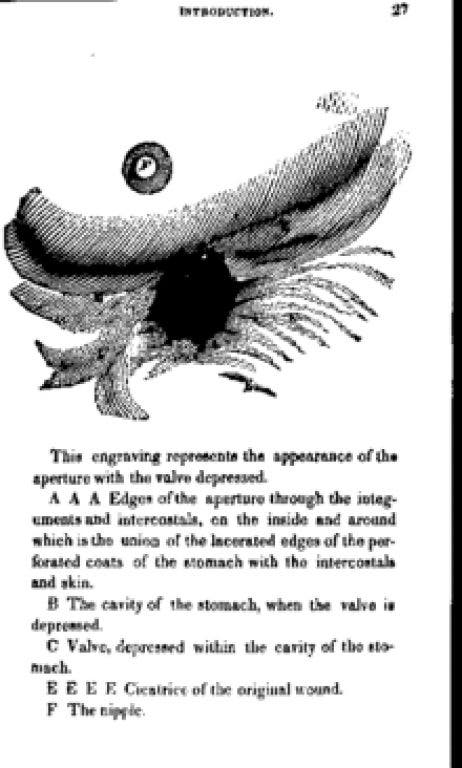
While serving with the Army on Mackinac Island, Beaumont treated an employee of the American Fur Company, a 28 year-old Canadian named Alexis St. Martin. St. Martin had been shot in the stomach with duck shot in a hunting accident. Miraculously, he survived the surgery. Beaumont, who seemed to keep notes on everything, described the wound in this way:
Find out what's happening in Durham-Middlefieldfor free with the latest updates from Patch.
The whole charge, consisting of powder and duck shot, was received in the left side at not more than two or three feet distance from the muzzle of the piece … carrying away by its force integuments [skin of the organs] more than the size of the palm of a man's hand. *
St. Martin lived another 58 years to the age of 86 but with a fistula (hole) in his stomach. Dr. Beaumont hired him as a handyman and at various times was able to observe the effects of gastric juices on the food that St. Martin consumed; furthermore, Dr. Beaumont would occasionally tie some food to a silk string and dangle it in St. Martin’s stomach to observe the effects of gastric acid in digestion!
An assiduous note keeper, Beaumont expanded his findings into a book that revolutionized medical thought regarding the digestive process. That book, which was first published in 1833, was entitled Experiments and Observations on the Gastric Juice and the Physiology of Digestion.
Basically, Beaumont’s findings refuted the prevailing belief that digestion was a mechanical process carried out in the stomach and showed the important role of gastric juices in the digestive process. The first edition of this book remains one of the most sought after collectible books in modern medicine. At a 2008 Christie’s auction, a nice copy of the first edition brought $1,250.
Today, the William Beaumont Homestead is located at 16 West Town St. in Lebanon. It is open from the 3rd Saturday in May until Columbus Day weekend each year. Tours occur each Saturday afternoon during that time and by appointment. Purchased in 1970 by the Beaumont Medical Club of Yale University, the home was completely restored by Leon Lewis of Norwich.
One of 9 children of a Revolutionary War veteran, Beaumont went on to distinguish himself both as a veteran of the War of 1812 and, quite by accident, as a firsthand observer of the digestive process. His findings marked a major medical breakthrough. No wonder one of our state highways bears his name!