Schools
CRHS Yellowstone Trip Exceeds Expectations
Students share their experiences of a 9-day trip out west with Patch.
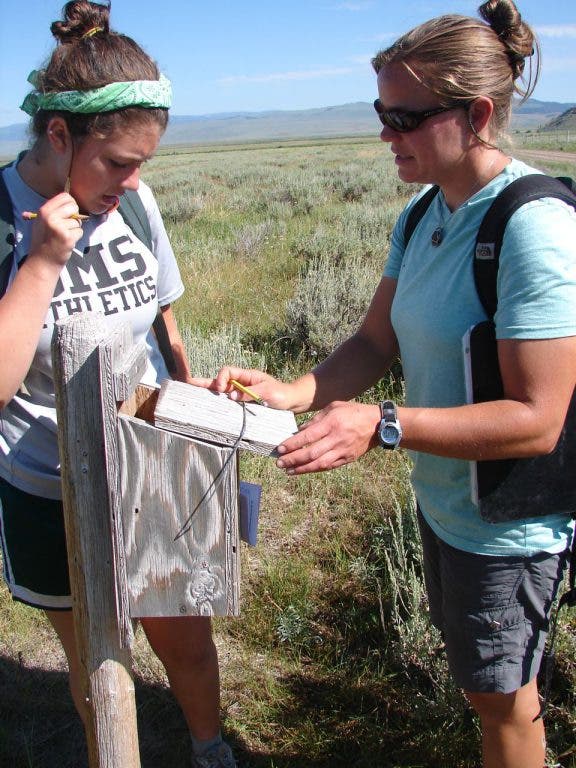


The consensus among a group of students that recently spent nine days at Yellowstone National Park in Wyoming was that the week was way too short, but the trip exceeded their expectations by leaps and bounds. The group of ten students and one faculty adviser took part in an Ecology Project International ( EPI) trip to the Greater Yellowstone Ecosystem.
It was earlier this year that I first learned about this exciting opportunity being offered to students at Coginchaug Regional High School. Some of you may remember back in January sharing some of the details of the upcoming trip.
The trip was organized by CRHS science teacher Susan Michael. She "put it out there" to students and nine from Coginchaug jumped on board. The tenth student, Matt Kinkead, is a soon to be senior in Wallingford and a family friend of Michael's.
Find out what's happening in Durham-Middlefieldfor free with the latest updates from Patch.
This past Thursday evening, I attended a lovely presentation put on by Susan and some of the students who took the trip. Having just arrived home a few days ago, they pooled their pictures and knowledge of the nine day excursion and presented a great slide show and explanation of their time exploring Yellowstone and the surrounding areas.
I spoke with a few of the students' one on one and here is what they had to share. Julian Oshana, an incoming junior at CRHS, said the trip was "pretty awesome!" Although it was his second time visiting Yellowstone, he enjoyed this trip camping with fellow students and seeing the area in the summer.
Find out what's happening in Durham-Middlefieldfor free with the latest updates from Patch.
Julian's favorite part of the trip was when the group went on a wolf watch early one morning. They met with a ranger who studies the wolves. They were fortunate to see about five or six wolves, along with some pups. This was done through binoculars from about 1/4 mile away.
Wolves were reintroduced in Yellowstone in 1995. Prior to that they had been killed off by farmers, ranchers and others in the area who considered them dangerous. Wolves actually play a very important role in the eco system of Yellowstone. Presently the wolf population has grown to about 100 in the park.
Another student who gave me her perspective of the trip was 2011 CRHS graduate Aubree Keurajian. Aubree also said the trip "thoroughly exceeded her expectations!" One of the highlights for her was the time the group spent in Centennial Valley, which is located west of the park. While visiting the valley the students did service work, which included removing barbed-wire fencing from land that had been obtained by the Nature Conservancy. They removed about seven strands over about a 1/2 mile.
The students hiked and camped the valley, setting up base at Warm Spring Creek, which remains at a constant 75-80 degrees. Aubree will be studying Environmental Science this fall at Cornell University and shared that the trip reinforced her love of nature and the world around us.
The group also worked on various research projects in and around Yellowstone. The first was helping the National Fish and Wildlife Service collect data from 28 bird boxes over a four mile area. The data collected is used to study three different species of birds; Bluebirds, Tree Swallows and Mountain Chickadees. The boxes are continuously monitored by EPI groups about every week.
Another research projected the students assisted with was helping the Cook City Forest Service collect samples from a bear hair snare. The group collected hair samples from a snare that had already been installed. The snare consisted of barbed wire strands that run around four trees about knee-height. A cedar plank baited with Anise oil and a motion camera is put into the center. As the bears are attracted towards the plank they go under the wire, rubbing their backs and leaving hair samples. When collected, the hair samples give valuable information involving DNA analysis, which allows researchers to better understand the bears' health and diet.
In addition to the service and research the group assisted with they also learned about the geothermal activity taking place within Yellowstone and how fragile the area is.
They learned about how the White Bark pines are dying off due to Pine Bark Beetles, as well as the tree rust that is now attacking the trees. Since the beetles are not an invasive species, but rather native to the area there is little that can be done. The trees are a key food source for the bears in the area and extensive damage is occuring, so this continues to be an area of concern.
Overall, the group particiapted in 25 hours of service learning, practiced "leave no trace" camping, and was fortunate enough to see Bear, Prong Horn, Bison, Wolves, Elk, Otter and Bald Eagles.
Susan Michael said that after many hours of fundraising and planning, the trip went off with out a hitch and was a wonderful experience.
Through EPI, future groups will hopefully be able to travel to explore and aid in field research in many other areas and many other locations.