Business & Tech
Killingworth Transfer Station: Recycling 101
You may be surprised at what can and cannot be recycled at the Killingworth Transfer Station
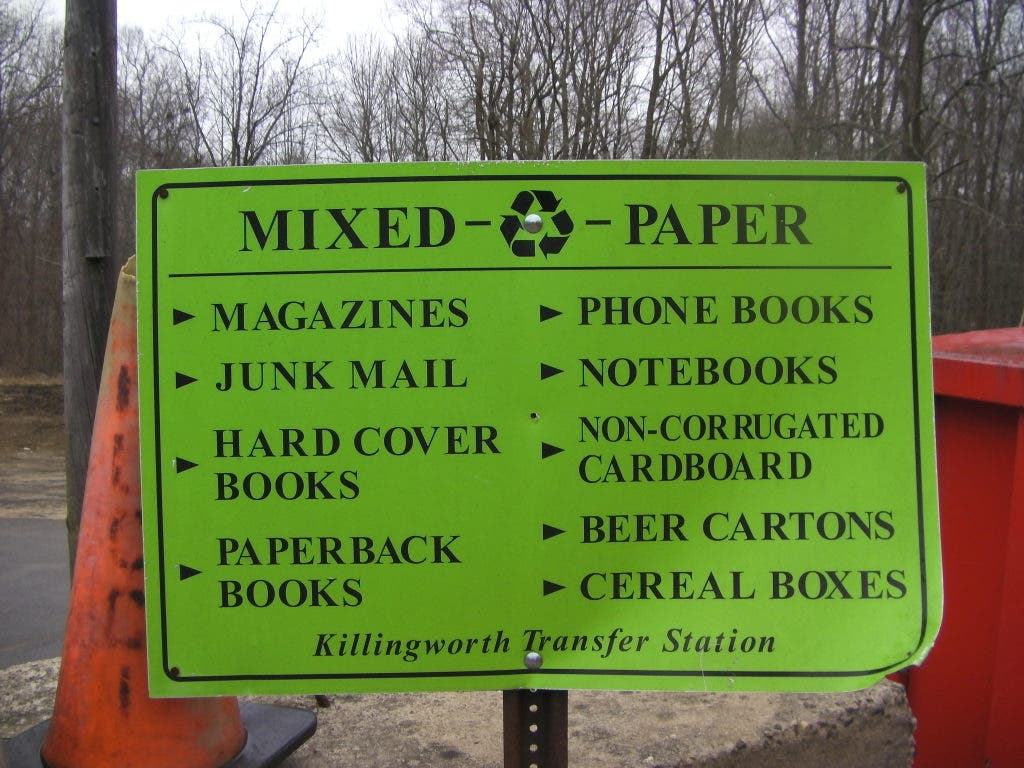


What better way to honor Earth Day than to get a good handle on what can and cannot be recycled at the . You may be in for a few surprises.
There are many "trash" items that can be recycled including “aluminum foil, clean paper egg cartons, lids from glass jars (separate from the jars), toilet paper and paper towel tubes, plastic tubs for yogurt or margarine and snap-on plastic lids,” according to the findings of Paul Nonnemacher, director of public affairs for the Connecticut Resources Recovery Authority, which serves Killingworth and other towns in Connecticut by developing and implementing solutions for recycling and solid waste disposal.
Sneakers and athletic shoes, Nonnemacher notes, should not go into the regular recycling bin but to a collection point for a program such as Nike Reuse-a-shoe. The store in just so happens to be a drop-off location.
Find out what's happening in Durham-Middlefieldfor free with the latest updates from Patch.
Donald Berry, who oversees the operation of the Transfer Station on Recycle Way says, “Most anything can be recycled – even wood is being recycled.”
Berry said that one of the biggest recycling issues residents face is what to do with hazardous waste and electronics.
Find out what's happening in Durham-Middlefieldfor free with the latest updates from Patch.
“They only have a few days to recycle any of that stuff, and a lot of people have to keep it stored somewhere – either in their house or their garage,” he explained and added, “A lot of your batteries have mercury in them. Your thermostats have mercury in it, and people don’t like to have it hanging around their property.”
What to do with those old appliances is a dilemma as well.
“All that stuff – batteries, electronics, household appliances, hazardous waste – can be recycled but they have to have a place to put it, and we at the Transfer Station don’t have a place to store it,” Berry said.
“It’s a big problem. They don’t want it in the landfills or the bulky waste so I’ve been after the town to get storage facilities for electronics.
“Another thing I’d like to see them do is recycle the peanuts used for packaging and the big styrofoam you see with a lot of the stuff you buy," Berry said. "It could all be recycled and used over and over again.”
Surprisingly, something as simple as a lightbulb cannot be recycled in Killingworth because many contain mercury, “so there’s a lot of things people have to keep stored until the hazardous waste days come up.”
Not only do lightbulbs have mercury, but most batteries do as well, Berry points out.
Some transfer stations do recycle batteries but Killingworth does not. There used to be an old barrel to put the batteries in “but we can’t do that anymore because of the mercury,” he said.
“People have to store them and when the recycle days come up, they’ll have to take them to Essex or wherever the recycling station is set up. This could be Clinton or Old Saybrook, but usually it’s in Essex.
“People don’t like to drive all the way down to Essex for four or five batteries,” he said.
Instead, batteries are often tossed in the garbage.
“You can’t see that stuff in a black plastic garbage bag. They hide a lot of stuff in those bags and we never know what’s in them," Berry admits.
While there is no law prohibiting doing so, “it’s not a good thing to do,” he said.
You can bring plastics numbered 1 to 7 to the recycling bins at the Transfer Station. These numbers are found within the triangle on the bottom of the containers. Please remember to rinse your containers. The town pays lower tipping fees the more we recycle, which equates to more money in the taxpayers' wallets.
For a list of what can be recycled, please visit http://www.crra.org/pages/member_towns_recycling_table_g-k.htm