Neighbor News
"Saving Mr. Banks" at Durham Library this Thursday
The Durham Library's Movie Matinees "For Adults" features "Saving Mr. Banks" this Thursday, Sept. 4, 1:30pm. Admission and snacks are free.
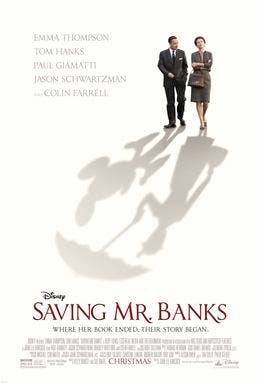
Movie Notes by Don Bourret (donb41@comcast.net)
Saving Mr. Banks is a thoroughly enjoyable movie about the making of a movie, Disney Studio’s 1964 Mary Poppins. It centers on two weeks that author P.L. Travers, creator of the Mary Poppins series, spent in 1961 Los Angeles as Walt Disney attempted to persuade her to sell him the rights to her books and, in return, to participate in the development of the film. It was a tough row to hoe for Uncle Walt.
Find out what's happening in Durham-Middlefieldfor free with the latest updates from Patch.
As the story goes, Travers (as played by the splendid Emma Thompson) is unrepentantly irascible, ill tempered and churlish. Walt on the other hand (played superbly by Tom Hanks), is low key and courtly with the patience of a saint. We learn that he has been trying to obtain the rights to the Poppins stories for twenty years, ever since he promised he would to his daughters, who were enraptured by the tales of this remarkable nanny. Travers’s reasons for refusing to sell seem insurmountable. She hates animation and music in films and feels Mary Poppins is the antithesis of sentiment and whimsy, all of which of course are the core of the Disney brand. Furthermore, she is disgusted with LA’s unreality, overt friendliness and optimism.
Walt and his scriptwriters and songwriters struggle doggedly to show Travers what they could do with her stories, pitching songs and dramatic segments right and left, but she is the ultimate tough sell. We also see flashbacks to her youth growing up in Queensland, Australia. In her devotion to her handsome alcoholic father (strikingly played by Colin Farrell), we begin to understand the inspiration for the Poppins tales and come to see the significance of this film’s title.
Find out what's happening in Durham-Middlefieldfor free with the latest updates from Patch.
The movie has much to recommend it in addition to Thompson’s, Hanks’s and Farrell’s performances. It has a delightful soundtrack, interweaving portions of many of the original Mary Poppins songs with cute ditties the persevering songwriters (Oscar winning Richard and Robert Sherwood) constantly come up with for their pitches to Walt and Travers. It has beautiful period detail of both 1960’s LA and Queensland decades earlier. And it gives us some interesting glimpses behind the scenes in the making of a major blockbuster. It may not be historically spot-on accurate (this is a Disney film after all), but it is very engaging and entertaining.
Released in 1964, Mary Poppins was hugely popular and Disney’s most successful film to date, garnering international acclaim and numerous awards. But by all reports, in contrast with this film’s “Disneyfied” ending, Travers was not won over by Poppins’s final cut and the accolades it received. In fact it is reported that she was disgusted with the final product and felt betrayed by Walt and his team for “butchering” her characters. I have not read the Poppins stories, but based on what she says in this movie and on other interviews, I think she has a point. The film is awash in all that sentiment and whimsy that Travers did not want; and the movie’s Mary is appealing, perky and tuneful, and pretty much one-dimensional. Which leads to …
The rest of the story: The two big noises in the 1964 Academy Awards with more than a dozen nominations each were Mary Poppins and My Fair Lady starring Audrey Hepburn as Eliza Doolittle, the role Julie Andrews had originated and starred in on Broadway for years. Warner Bros. studio head Jack Warner wanted a bigger movie name for the lead opposite Rex Harrison and hired Hepburn and an uncredited Marnie Nixon to do her singing. Nixon already had dubbed for Deborah Kerr in The King And I and Natalie Wood in West Side Story among others. Unfortunately there was considerable antagonism within the film community and among fans directed at Hepburn, accusing her of “stealing” Eliza from Andrews. Consequently, when Oscar nominations were announced, Hepburn was not even nominated. On awards night, Julie Andrews won Best Actress for Mary Poppins, beating out Ann Bancroft (The Pumpkin Eater), Sophia Loren (Marriage Italian Style), Debbie Reynolds (The Unsinkable Molly Brown) and Kim Stanley (Séance On A Wet Afternoon).
Many, myself included, see this as a consolation prize rather than an award on merit. Julie Andrews did a fine job as Mary, but the role itself lacked depth and was not Oscar-worthy. I have little doubt that if Andrews had played Eliza Doolittle in the movie, delivering George Bernard Shaw’s celebrated lines with all those years of stage experience behind her, she most certainly would have been nominated and likely even won. But for Mary Poppins? Forget it. Anyway, that’s my story and I’m sticking to it.
Enjoy Saving Mr. Banks; then check out Mary Poppins, see what all the fuss was about and be sure to enjoy it on its own considerable merits.