Arts & Entertainment
The Wit and Wisdom of New England Epitaphs
Gravestones of Killingworth residents prove to be fertile ground
As a grade school child in the middle decades of the 19th century in Amherst, Massachusetts, Emily Dickinson lost a dear friend to typhus in 1844, Sophia Holland, and several other schoolmates at various times in her young life. The early encounters with death most likely influenced her preoccupation with the theme of death in her poetry. In fact, Dickinson’s encounters with death at an early age was typical of her time; it was not uncommon for all families to lose friends and relatives in those years, as the average life expectancy for a person living in America prior to 1900 was only 46 years of age! This harsh reality undoubtedly influenced the various expressions of memorials that can still be found today in older cemeteries around New England, especially the lengthy, elaborate, candidly refreshing, and, often, humorous epitaphs* that can be found on graves in any of the original thirteen colonies, such as Connecticut.
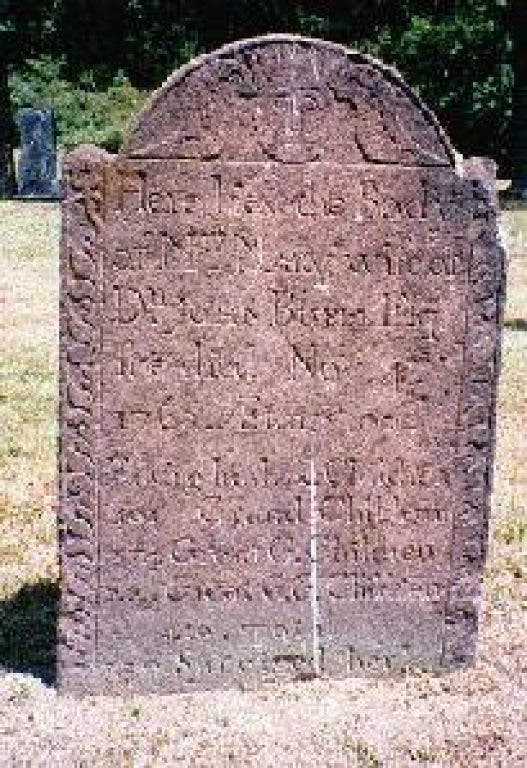
The Buell family, formerly of Killingworth and later of Litchfield, gives us a good example of an interesting early epitaph. Born on Feb. 17, 1671, in Killingworth, Deacon John Buell, son of Samuel Buell and Deborah Griswold, was a selectman in Killingworth in 1717 and 1718. With many other people, he petitioned the state legislature in 1719 to establish the town of Litchfield, Connecticut. After buying two lots in Litchfield, Buell relocated there in 1721 from Killingworth. Buell married Mary Loomis of Windsor in 1695. The couple had 13 children— six boys and seven girls. Mary outlived her husband by 16 years, dying at age 90 on Nov. 4, 1768. Both she and her husband are buried in the West Burying Ground in Litchfield. Her epitaph will grab your attention (See photo). It reads as follows:
Here lies the Body
Find out what's happening in Durham-Middlefieldfor free with the latest updates from Patch.
Of Mrs. Mary, wife of
Dea. John Buell, Esq.
Find out what's happening in Durham-Middlefieldfor free with the latest updates from Patch.
She died Nov. 4th, 1768
Aetat 90
Having had 13 children, 101 grand-
Children, 274 great grandchildren, 22
Great-great grandchildren. Total 410.
336 survive her.**
Put another way, 74 of her offspring died before her—pretty amazing! Imagine what the Buell family would have done to the population of Killingworth had they not moved to Litchfield!
Sometimes epitaphs were written and displayed before people died as a means of embarrassing someone, as the following story –also with a Killingworth connection—well illustrates. It is taken from a nineteenth century Connecticut newspaper, the date and name of which is unknown.
Mrs. Alecia Miller of Fairfield, a widow, has brought suit against her former son-in-law, John Goodale. Not long ago, Goodale’s wife charged him with neglect and intemperance and got a divorce. During the trial, Mrs. Miller, with great positiveness and apparent delight, corroborated her daughter’s testimony against Goodale, who made no defense. “Well, I’m rid of the Miller tribe anyway,” he exclaimed, after the decision against him.
But this ex-mother-in-law’s testimony must have rankled in Goodale’s bosom.
He returned to his farm at Killingworth, nailed together some boards, and shaped them like a tombstone. On the boards he painted this choice piece of elegiac poetry:
Here lies the body of Mrs. Miller,
Sound asleep on her pillow;
She was Alonzo Miller’s wife.
She raised the devil all her life.
The Baptist folks they tolled the bell,
To tell Old Nick she was coming to hell;
Old Nick, he swore, and his imps did squall
“Don’t let her in; she will kill us all!”
Then Goodale set up the tombstone so close to the road that all wayfarers could read the inscription. The indignant Mrs. Miller directed a Middletown lawyer to promptly bring suit against the farmer poet of Killingworth!
It may well be the only case in legal history involving libel via an epitaph on a tombstone!
Epitaphs in some cemeteries seem to be carrying on a conversation of sorts. Consider these two epitaphs located near to each other in a rural Vermont cemetery:
Here lies the body of
Miss Arabella Young
Who, on the 21st of May
Began to hold her tongue!
The other nearby tombstone reads as follows:
Here lies the body of Hannah Thurber
Once she talked none could curb her.
Three husbands had she; all are dead.
They died of earache, so ‘tis said!
Since epitaphs seem to be modeled after epigrammatic poetry, this installment of “New England Epitaphs” will close with an epigram about an epitaph from the woman who saw things “New Englandly”—Emily Dickinson from Amherst:
An Epitaph upon Husband and Wife
To these whom death again did wed
This grave 's the second marriage-bed.
For though the hand of Fate could force
'Twixt soul and body a divorce,
It could not sever man and wife,
Because they both lived but one life.
Peace, good reader, do not weep;
Peace, the lovers are asleep.
They, sweet turtles, folded lie
In the last knot that love could tie.
Let them sleep, let them sleep on,
Till the stormy night be gone,
And the eternal morrow dawn;
Then the curtains will be drawn,
And they wake into a light
Whose day shall never die in night.
Notes and Sources:
- “epitaph” is from the Greek epitaphion meaning “ (written) over a tomb.”
- The fact that life expectancy for Americans has increased to an average approaching 80 years in the last 100 years may be considered the single greatest human achievement of the 20th century.
- aetat is an abbreviation for the Latin aetatis (genitive form) which means “at the age of.”
- Might it be that Mary Loomis of Windsor was related to the family that founded Loomis School?
- Poems of Emily Dickinson