Community Corner
Brownstone Gravestones Have a Story to Tell
The Stancliff stone carvers had distinct style.
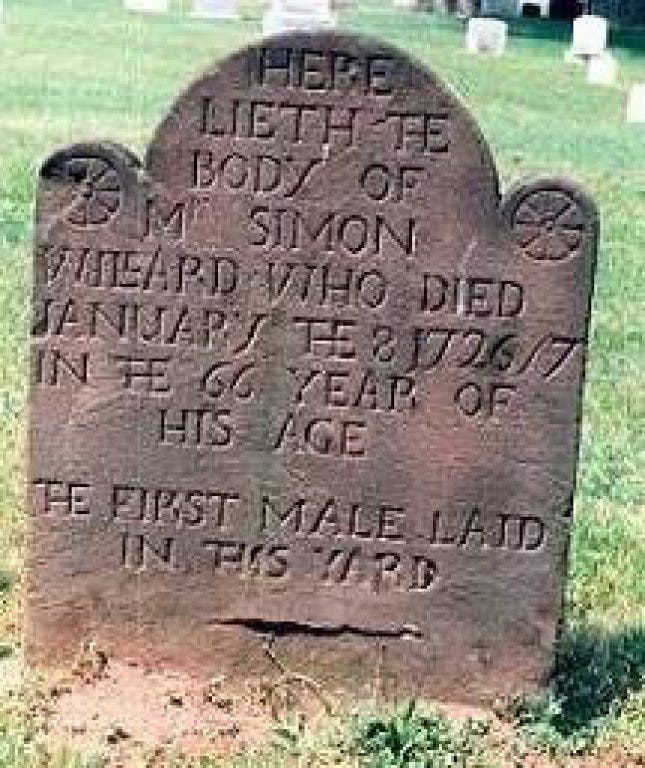


The next time you are walking through your local graveyard stay alert for the old brownstone gravestones. They have quite a story to tell, and not just about the person buried beneath.
Portland was home to a family of gravestone carvers that plied their craft for several generations. This family was among the most well-known craftsmen, not only in Portland but also throughout Connecticut. The Stancliff family, who settled in East Middletown in the early 17th century, was among the most prolific grave carvers in the state for many generations. Their preferred material, of course, was Portland brownstone.
Their gravestone can be identified by key characteristics, but more on that in a minute.
Find out what's happening in East Hampton-Portlandfor free with the latest updates from Patch.
James Stancliff emigrated from England and built the first house in Portland in 1690, according to his descendants. He is also credited with starting the first quarry operation in town. He was a mason and stonecutter, which included carving gravestones. His first stone is often identified as the one on Hannah Summer's 1659 plot in Riverside Cemetery, Middletown.
The next five generations of Stancliffs ran the Portland quarry and carved gravestones. In 1847, they sold the quarry to the Brainerd Quarry Company, at which time the business was enlarged to provide stone for houses, foundations and sidewalks throughout the East coast.
Find out what's happening in East Hampton-Portlandfor free with the latest updates from Patch.
While studying the Stancliff stone carvers, your brain will spin from all the James Stancliffs who lived in Portland, and it is very challenging to keep track of who is who. Basically, the prominent carvers were James (?-1712) who first settled Portland; his son William (1686-1761) whose stones can be found all over the Connecticut River Valley, even into Massachusetts; James II (1692-1772), the original James’ son and William’s brother, who didn’t carve until late in his life; James III, a son of James II; and James Jr., the son of William, whose work is abundant in Southington and Simsbury.
Over time, the grandsons and great-grandsons of the original James Stancliff moved to different parts of Connecticut and continued the trade of stone carving and their particular carving styles were passed down to successive generations. Some descendants changed their name to Standclift, as was the case with James Jr. when he lived in Simsbury.
Let’s look at the stones produced by the Stancliffs and some of the characteristics that help historians identify a stone carved by a Stancliff. Most of them used only capital letters in their carvings (until about 1760). James I, used a characteristic line across the top of his A. The letter R often has a leg gracefully curving out. “The” is usually used instead of “ye,” and the H is sometimes created with just a line connecting the T and E. The lines meeting in the middle of the W were sometimes crossed. See the examples in the photographs included here.
Interestingly, these same indentifying marks can be found on 17th century graves in St. Mary’s Elland, West Yorkshire Church back in England, carved by the Stancliff ancestors.
Of course, there were many other stone carvers in central Connecticut - including members of the Loomis, Johnson and Buckland families. But few were around for as long as the Stancliff/Stanclift clan.
Take a stroll through ancient burial grounds in Portland and look for these distinctive gravestones by the Stancliffs. It is a lovely way to spend a spring day. And, remember, no grave rubbings ... it damages the stones.