Arts & Entertainment
“Sholem Aleichem: Laughing In The Darkness" Shines Light On Forgotten Humorist
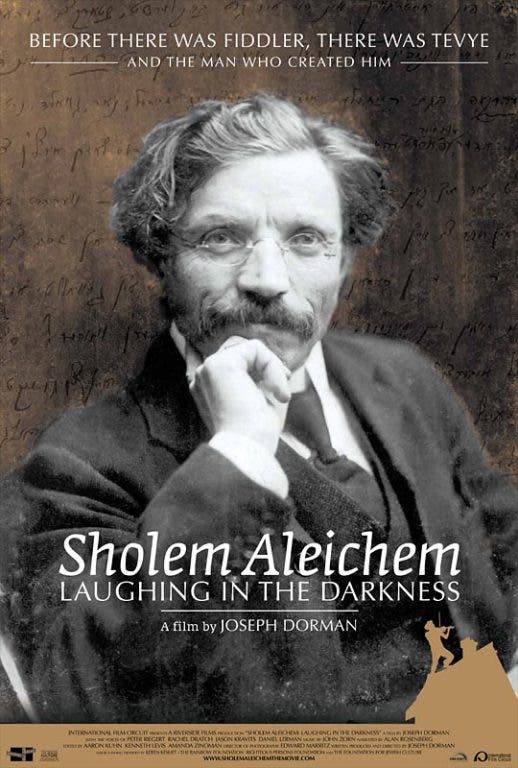
This documentary in limited release tells the story of the man once called "The Jewish Mark Twain."

School is in session!
I felt the full weight of that sentence on Monday, while going for my first day of my senior year and, after five days and ten classes, there is no escaping it: the school year has begun.
I very much enjoy school, the clubs, the activities, the people. But I can’t say I’m one of those students who find classes “fun.” Although I do well in school, I’m not usually one of those students who sit in the front row, look forward to lectures or takes pleasure in note-taking or underlining. I’m a hands-on kind of guy.
Find out what's happening in East Havenfor free with the latest updates from Patch.
I also felt that school was in session while watching “Sholem Aleichem: Laughing In The Darkness,” a documentary by Joseph Dorman. While the stories told here are interesting, I couldn’t help but feel like I was watching a PowerPoint lecture rather than a film. A good PowerPoint, but many people go to the movies for an escape, not for a 90-minute lecture.
“Laughing in the Darkness” follows the life and career of Aleichem, a Yiddish humorist, writer and humorist who wrote hundreds of stories and novels during his 57 year on earth and was once called the "Jewish Mark Twain."
Find out what's happening in East Havenfor free with the latest updates from Patch.
Aleichem, whose real name was Solomon Rabinovich, was born in a small Eastern European shetl, a small, provincial town populated mostly by orthodox Jews. From a young age, as the child of a successful businessman, Aleichem wrote little stories, starting with a Jewish parody of “Robinson Caruso” (I’m guessing his Caruso complained about the lack of good restaurants on the island).
He continued writing after his father lost his fortune and into adulthood when he moved to a bigger Russian city, started a family and became a stock-market trader and bourgeoisie. More then a century later, he is the only Yiddish writer still read today.
Unlike other Jewish writers, Aleichem wrote in Yiddish, a German/Russian/Hebrew hybrid (once described by Billy Crystal as a mixture of “German and phlegm”). While Hebrew was spoken at school and work, Yiddish was the language of the streets.
While Hebrew was considered the more academic, serious language, it wasn’t until he started writing in Yiddish that his work took off. It helped bring his working class characters to life and made his stories available to the masses.
Besides that, Yiddish is a quirky, expressive language full of great, humorous sayings (My favorite being, “Az di bobe volt gehat beytsim volt zi geven mayn zeyde! meaning: "If my grandmother had testicles she would be my grandfather"). If it is true that Eskimos have 50 words for snow, than Yiddish has 50 ways to call someone an idiot: there’s a fat idiot, an unlucky idiot, a stupid idiot, a poor idiot, etc., etc., etc.
The best parts of the film are when actors, including "Saturday Night Live” cast member Rachel Dratch, read aloud sections of some of Aleichem’s best work, including those featuring some of his most famous character including Menachem Mendl, Mottel the Cantor’s Son and Tevye The Dairyman (who is mostly known as the “biddy-biddy-bum-ing” hero of “Fiddler On The Roof”). The readings, done with humor, warmth and spirit, gave the film a much-needed shot in the arm.
There is not much cinematically to say about this documentary. It’s very much your standard PBS-style biography. The stock footage of 19th century Eastern Europe is beautiful and rare, the interviews passionate and quirky and Aleichem’s life story has many twists and turns. If you’re interested in Aleichem or a fan of academic documentaries, then “Laughing in the Darkness” will be a hit.
But if you’re like me and enjoy documentaries a little more entertaining, you’ll find yourself fidgeting even with the 90-minute running time. I mean, it’s a well-made documentary, but one that feels like it was made for a classroom rather than a movie theater.
What I'd see this week:
- For some action — “The Debt”
- For some drama — “The Help”
- For some laughs — “Our Idiot Brother"
- For a scare — “Don't Be Afraid Of The Dark”
Get more local news delivered straight to your inbox. Sign up for free Patch newsletters and alerts.


