Neighbor News
Draining Paradise Pond: Process and Impacts
An overview of the dredging of Paradise Pond, and of whether its dam should be removed.

Anyone who's visited Smith College's campus is probably familiar with Paradise Pond. It’s one of the campus’s best-known features, home to a variety of flora and fauna. Students take canoes out on the pond in warm weather, and walk or skate on its surface when it freezes over. When the sun sets, the water’s surface shines with golden light. Not surprisingly, many students and alums find the pond picturesque and welcoming, and have fond memories attached to it.
However, the pond is not a natural water body, and its existence comes with ecological consequences. It is formed by the damming of the Mill River at the southern end of the campus. The dam predates the college’s founding. It was used in the late 19th and early 20th centuries to provide power to the Clement and Hawks Manufacturing Company, which later became the Maynard Hoe Factory [1].
As part of its maintenance, the pond periodically has to be dredged. Sediment builds up on the bottom of the pond over time. This reduces the pond’s depth, making it less safe for recreational activities, such as boating. While hydraulic extraction was sometimes used to dredge the pond in the past, these days it’s mechanically removed using construction equipment. Up through the 1998 dredging [2], the sediment was taken to a landfill. In more recent years, it has instead been moved further downstream to be washed away by the river [3]. The sediment’s safety is somewhat questionable, to say the least. It has been found to contain hazardous materials, such as mercury and lead [4]. Redistribution to ecosystems further downstream means that those ecosystems also have to deal with the harmful substances within the sediment. After excess sediment has been moved, the dam's sluice gate is closed, causing the pond to slowly refill.
Find out what's happening in Enfieldfor free with the latest updates from Patch.
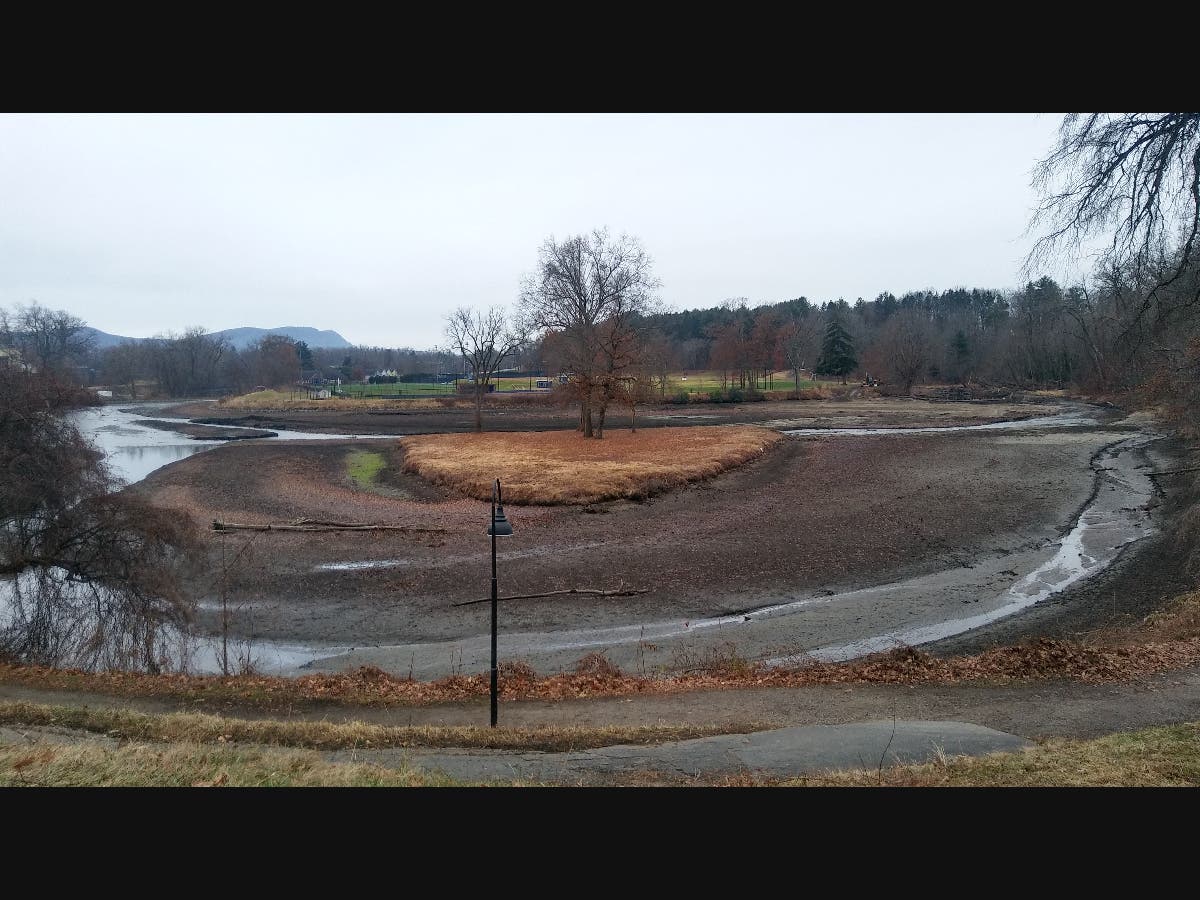
It used to be that the dredging only happened once or twice per decade. Lately it’s been happening every year, typically in winter. In fact, it’s being dredged again as of this writing. The bulk of the Mill River’s water is running in a stream past the athletic fields. A smaller stream follows around the pond’s northern bank. A layer of grayish, muddy substrate is visible where the water has been drained, interspersed with dead leaves, stones, and debris. Construction vehicles are parked on the shore by the athletic fields. Over the course of the next several weeks, they’ll be digging up the top layer of sediment to return the pond to a desirable depth.
A lack of water in the pond, even for a few days or weeks, renders it less habitable to its usual denizens. Organisms that are known to live there include fish, mussels, otters, and beavers [5], as well as a whole host of other micro- and macroscopic aquatic creatures. Removing the pond’s water is likely to hinder the species richness and abundance of its aquatic community. If the dredging is happening every year, that isn’t very much time for an ecological community to re-establish itself between disturbances. What’s left is a community that is sparse in terms of population, one mostly composed of species which either are hardy enough to survive a disturbance, or are able to move elsewhere until it passes. Even for those species able to survive, the draining of the pond is likely to result in reduced quality of life. It’s safe to say the pond’s current maintenance plan is far from ideal for the survival of more sensitive species.
Find out what's happening in Enfieldfor free with the latest updates from Patch.
Seeing the pond in its drained state is also disconcerting to us humans on campus. After living here for three years, it still throws me when I look at the pond and find that the water is gone. To those of us who are familiar with the pond’s background, it serves as a reminder that the current state of affairs is, in many ways, incompatible with the Mill River as a healthy ecosystem. Since the dredgings have become more frequent in the past several years, they’ve also been more prominent in the public eye. In an effort to bring attention to this issue, articles were written in the campus newspaper in February of 2020 [4] and March of 2023 [5] reporting on the dredging process and its negative effects on the river’s ecosystem.
Although removing the dam and restoring the river to its natural course would eliminate the need for periodic dredging and allow for a more stable aquatic ecosystem, the college has historically been reluctant to take steps in that direction. As opinions on the pond have changed in recent years, however, the dam’s removal is beginning to look like more of a possibility. When input was being gathered [6] to inform the college’s 2020 Landscape Master Plan, many respondents mentioned removal of the dam as something they would like to see take place. In response to this input, the college did include an undammed Mill River as part of its twenty-year plan [7]. However, no apparent action has been taken to advance that part of the plan thus far.
It is true that a large amount of time and effort would be required to safely remove the dam. One of the main complications is that the pond forms part of a flood control system for the Mill River, constructed in the 1930s and 40s. The college is now required to maintain that flood control system, as per a 1945 agreement made between the city of Northampton and the Army Corps of Engineers [6]. Any major changes to the hydrologic infrastructure of the campus would require careful assessment of potential flood risks. Study of downstream ecosystems would also be required to take stock of potential ecological effects.
Despite these barriers, I am very much in favor of the dam’s removal. It’s been doing more harm than good to the river’s ecology since before anyone living can remember. And the frequency with which the dredgings have been taking place makes it difficult for the pond to support a stable ecological community. And in my view such a project is feasible to carry out, considering the academic and monetary resources at the college’s disposal.
There’s an argument to be made that the sentimental value of the pond to those affiliated with the college makes it inherently worth preserving. But if the college has to pour so much time and money just into keeping the pond in its current state, and if its existence comes at the expense of its wildlife’s wellbeing – is Paradise Pond really so important that those impacts can be overlooked? I would argue that a restored, healthy riverine ecosystem would be even more desirable, and well worth the cost of making it a reality. To that end, I would urge college administration to take steps toward undamming the Mill River.
Cited Sources
1. “Paradise Pond to South Street,” Mill River Greenway Initiative, Aug 2020, https://millrivergreenway.org/wp-content/uploads/2020/08/Northampton-MRG....
2. Weld, Eric Sean. “The Stuff Paradise is Made Of,” NewsSmith, 23 Sep 1998, https://www.smith.edu/newssmith/NSFall98/pond.html.
3. “Bringing Back Paradise,” Smith College, 2016, https://www.smith.edu/video/bringing-back-paradise.
4. Haug, Oliver Claire. “Where Did The Pond Go?” The Sophian, 28 Feb 2020, https://thesophian.com/where-did-the-pond-go/.
5. Quallen, Brooklyn. “The Price of Paradise,” The Sophian, 25 Mar 2023, https://thesophian.com/the-pri...
6. “Landscape Master Plan Discovery,” Smith College, Feb 2020, https://www.smith.edu/sites/default/files/media/Documents/Sustainability....
7. “Landscape Master Plan Executive Summary, Volume 1,” Smith College, Jan 2022, https://www.smith.edu/sites/default/files/media/Documents/Sustainability....