Neighbor News
Gypsy Moth Caterpillars!
2 years of infestation has done an enormous amount of defoliation damage to CT's trees. The UConn H&G article has info on what you can do.
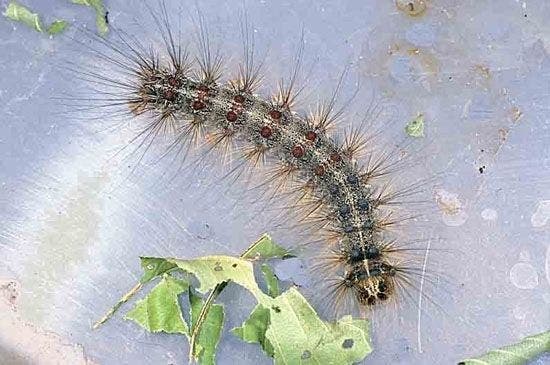

Gypsy Moth
Lymantria dispar
The gypsy moth periodically becomes a serious pest of woodland and shade trees. It was accidentally introduced to the United States in 1869 in Massachusetts. Repeated defoliation by the larvae or caterpillars can retard growth and stress trees resulting in increased susceptibility to two other pests, shoestring rot fungus and the two-lined chestnut borer. The effects of either of these can kill trees.
Life Cycle
The winter is passed in tan colored egg masses that contain from 300 to 500 eggs that usually hatch about the first of May. The very young caterpillars often undergo airborne dispersal (ballooning) before settling down to feed. Up to the time they are about ¾ of an inch long they cause so little damage to foliage that they generally go unnoticed. This is unfortunate because the caterpillars are easiest to control with insecticides at and below this size. During light to moderate infestation the larvae generally feed at night and hide under bark, ground litter and other places during the day. During severe infestations, however, the caterpillars stay in the tops of trees and feed continuously.
In their larval development females normally have six caterpillar stages and males, five. The full grown caterpillars are 1 ½ to 2 inches long. Each body segment, except the first, bears a pair of hair tufts. The first five pairs behind the head are blue and last six are brick red. The full-grown caterpillars cause the bulk of the defoliation and are very difficult to control with insecticides. The larvae complete their development between the third week in June and the middle of July and crawl about seeking a protected place for pupation. The pupa is naked, but may have a few strands of silk wound loosely around it. Adult moths emerge from 10 to 14 days. The stout-bodied female is dirty white with faint brown markings, and the abdomen is covered with buff-covered hairs. The male is smaller and much darker in color with a small abdomen. The female is too heavy for flight: therefore, the eggs are laid near the place where she emerged from pupation. Eggs are deposited on trees, stones, buildings or other objects nearby. The adults usually live less than two weeks. There is only one generation per year.
Host Plants
Gypsy moth caterpillars prefer to feed on the foliage of oak, white and gray birch, apple, willow, linden, basswood, hawthorn, sweet gum and aspen. Older larvae will also feed freely on needled evergreens such as hemlock, white pine and varieties of spruce. The caterpillars often show a decided preference for the older and larger hemlock trees and the tops only of spruces, especially Colorado blue spruce. A few larvae may mature on less favored trees such as black and yellow birch, cherry, elm and hickory. Other less favored hosts include maple, horse chestnut, dogwood, beech, sassafras and witch hazel. They least prefer and usually do not feed on ash, walnut, sycamore, honey locust, tulip, yellow poplar, holly, fir, rhododendron and mountain laurel. Under severe outbreak conditions, however, the larvae will feed on most any plant. Two or more successive severe defoliations can lead to the death of oak, birch, poplar, willow, linden, apple and other hardwoods and pine, especially when trees are stressed as during periods of drought. A single defoliation may kill hemlocks. Deciduous trees will refoliate to some extent the same year.
Control Measures
Although a number of parasites, predators and diseases attack various stages of the gypsy moth, they do not control it in outbreak situations. They help, however, in keeping certain sparse populations at low levels and assist in extending the period between outbreaks. The major reason for the end of gypsy moth outbreaks is a combination of starvation and disease. Following at least two or three years of severe defoliation, populations increase to tremendous numbers. The stresses of crowding and especially starvation, after all available food is eaten, increase the susceptibility of the caterpillars to a virus wilt disease which can cause a rapid and dramatic crash in the population. A naturally occurring fungus known as Entomophaga maimaiga, will kill the gypsy moth larva. During wet springs this killing fungus keeps the population of gypsy moth low. Dry weather during May suppresses the fungus.
Banding and Barrier Strips
Since the caterpillars sometime crawl up and down trees, banding and barrier strips may be useful means of reducing populations on isolate trees or on trees so spaced that their branches do not touch.
• Banding
From late May to early June tie a piece of burlap (about a foot wide) around the tree at chest height so that it
forms a skirt or apron. Migrating caterpillars may hide under the skirt. For best results, they should be
destroyed daily.
• Barrier Strips
The most common barriers are home-made and involve the use of Tanglefoot, axle grease and other sticky
substances. These materials should never be applied directly to trees, especially thin-barked varieties
because they may be absorbed and cause considerable injury to some trees. Instead, first attach tar paper
or some similar material to the tree and spread the sticky substances on them; cleaning the substances from
the trees after the caterpillar season will be much easier. Commercially produced sticky tapes are available;
they are easy to use and remove.
Traps
Traps baited with the female sex attractant are useful in monitoring for the presence and abundance of male moths.
Traps put up by individuals have no value as a control measure, but will alert you to the adult moth’s presence in the area and the present stage of life at that time.
Egg Mass Treatments
Collecting and treating egg masses may be useful in small populations but most are deposited in places that are inaccessible and/or hidden from view and thus go untreated. In addition, ballooning larvae can re-infest areas after egg masses have been treated. However, commercial products containing insecticidal soap, mineral oil, or soybean oil can be used to treat egg masses. Read the label for use directions and precautions. Egg masses scraped from trees and other objects should be collected and destroyed.
Chemical and Biologic Controls
Chemical control is difficult for the individual property owner because so many trees are too tall to be sprayed
efficiently with home equipment. One spray application will not provide season-long control but one properly timed application can prevent severe defoliation in most cases. Two applications spaced about 7 to 10 days apart should be used where the least defoliation is desired. The best time to spray is about May 20 when most airborne dispersal is over; trees sprayed after this date are less likely to be re-infested. Since caterpillars become increasingly more difficult to kill as they increase in size, sprays should be applied as close to the recommended date as possible for good control. Repeat treatments may be required, especially if more than a half inch of rain falls a day to two after application. As of the date of this publication one microbial and a few chemical insecticides are available to property owners.
Bacillus thuringiensis var. kurstaki (BtK) the microbial insecticide, causes the death of the caterpillar when the bacteria are ingested. It is harmless to humans, animals, wildlife, beneficial insects and plants. However, it is effective only against young caterpillars. Therefore, for best results, it must be applied before June 1; results after this date are erratic.
Despite good cultural practices, pests and diseases at times may appear. Chemical control should be used only after all other methods have failed. READ THE LABEL on each pesticide container before each use. Apply as directed. Heed all warnings and precautions. Store pesticides in their original labeled containers out of reach of children, irresponsible people and pets, preferable under lock and key. Dispose of empty containers safely.
For pesticide information please call UConn Home and Garden Education Center weekdays, in Connecticut call toll free 877-486-6271. Out of state call 860-486-6271.
Revised by UConn Home and Garden Education Center 2016.
The information in this material is for educational purposes. The recommendations contained are based on the best available knowledge at the time of printing. Any reference to commercial products, trade
or brand names is for information only, and no endorsement or approval is intended. The Cooperative Extension system does not guarantee or warrant the standard of any product referenced or imply
approval of the product to the exclusion of others which also may be available. All agrochemicals/pesticides listed are registered for suggested uses in accordance with federal and Connecticut state laws
and regulations as of the date of printing. If the information does not agree with current labeling, follow the label instructions. The label is the law. Warning! Agrochemicals/pesticides are dangerous. Read
and follow all instructions and safety precautions on labels. Carefully handle and store agrochemicals/pesticides in original ly labeled containers immediately in a safe manner and place. Contact the Connecticut Department of Environmental Protection for current regulations. The user of this information assumes all risks for personal injury or property damage. Issued in furtherance of Cooperative Extension work, Acts of May 8 and June 30, 1914, in cooperation with the U.S. Department of Agriculture. Gregory J. Weidemann, Director, Cooperative Extension System, University of Connecticut, Storrs. The Connecticut Cooperative Extension System offers its programs to persons regardless of race, color, national origin, sex, age or disability and is an equal opportunity employer.