Politics & Government
Kiner's Korner: Redistricting 2011
Local Senate and House boundaries changing slightly.

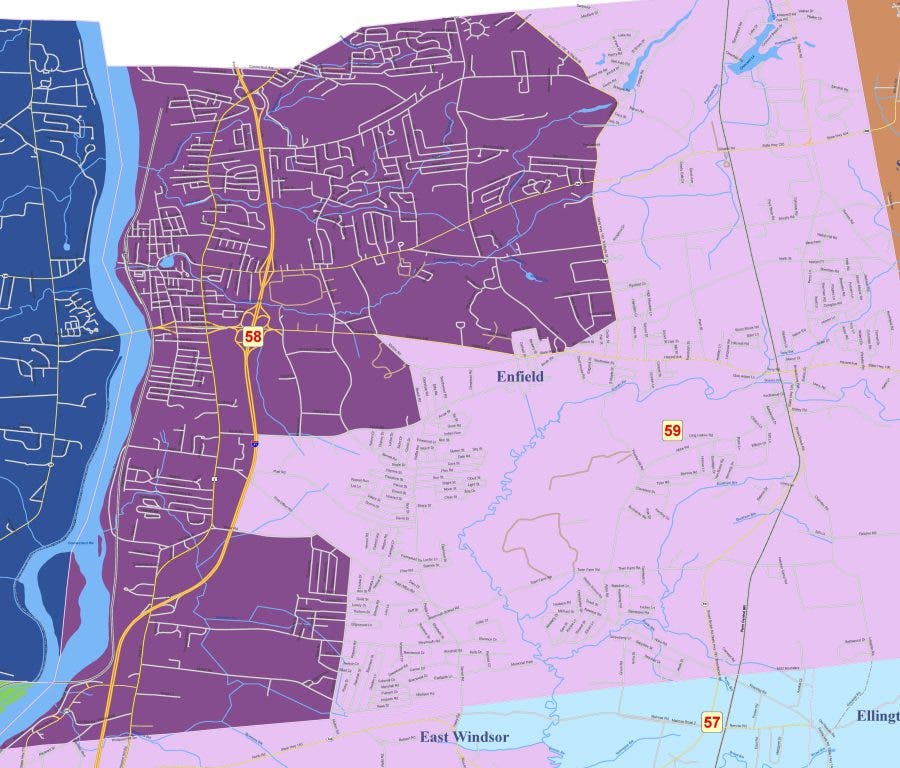

Connecticut's state constitution requires that general assembly districts be redrawn every ten years. This mandate reflects the census data and provides for legislative districts to have substantially equal population. The Commission chosen to draw these lines was successful in fulfilling their mandate - well at least somewhat so (the redistricting of Congressional districts is still a work in progress).
Following is information that comes directly from the Connecticut General Assembly. Please be advised that the following information was taken directly from the CGA website. The frequently asked questions about this process and the answers to these questions follow.
Political wonks might want to read this. The average voter, however, is probably more interested in their own towns and would like to know what streets are included in their legislative districts.
Find out what's happening in Enfieldfor free with the latest updates from Patch.
The seventh Senatorial district, currently represented by John Kissel (R-7), has essentially remained the same, with one or two small exceptions. The population represented in this district is approximately 102,000 people. The district includes all of the following towns: East Granby, Enfield, Somers, Suffield, Windsor Locks and parts of Granby and Windsor.
Enfield's two legislative districts are the 58th assembly district, represented by Kathy Tallarita (D-58), and the 59th assembly district, represented by David Kiner (D-59). Both districts contain approximately 24,000 people.
Find out what's happening in Enfieldfor free with the latest updates from Patch.
The 58th Assembly District is totally within the town of Enfield. Geographically it runs approximately from the Massachusetts line south to East Windsor and from the Connecticut River east to North Maple/Middle Beech/Steele Roads.
The 59th Assembly District runs from the Massachusetts line to the northwest corner of East Windsor and from North Maple/Middle, Beech/Steele Roads to Somers.
For an accurate map, you can go to http://www.cga.ct.gov/red2011/
Q: Why is the General Assembly redrawing Congressional and legislative district lines?
A: Federal and state laws require it. Federal law requires districts to have about equal populations so that everyone's vote has equal importance ("One person, one vote"). State law requires that Congressional and legislative district lines be redrawn every 10 years. The districts must be based on the federal census and consistent with federal constitutional standards.
Q: Who draws the lines?
A: A bipartisan Reapportionment Committee is charged with preparing the plan and the General Assembly must approve it by September 15, 2011 with a two-thirds vote in each chamber. The committee is made up of eight legislators (two from each party's caucus in the Senate and House of Representatives).
If the General Assembly does not approve a plan by the September 15 deadline, a nine-member Reapportionment Commission is formed. The commission must prepare a plan by November 30, 2011. The four top legislative leaders designate eight members (two each) to the commission, whom the governor appoints. The eight appointees select the ninth member.
The 2011 committee members were: Senate President Pro Tempore Donald Williams (Co-chair), House Minority Leader Lawrence Cafero (Co-chair), Senator Majority Leader Martin Looney, Senate Minority Leader John McKinney, Senator Leonard Fasano, House Speaker Christopher Donovan, Representative Sandy Nafis, and Representative Arthur O'Neill.
The 2011 commission members are the same as the above committee members with one exception. The commission must select a state elector as its ninth member. During the first commission meeting on November 3, 2011, members unanimously chose Kevin Johnston as the ninth member.
Q: When does it have to be done?
A: The Reapportionment Committee must complete its task by September 15, 2011. If it does not agree on a plan by that deadline, the Reapportionment Commission must prepare a plan by November 30, 2011. The first general election held in the new districts will be in November 2012.
Q: What happens if the Reapportionment Commission does not agree on a plan?
A: If the commission cannot agree on a plan, the constitution empowers the state Supreme Court to make them do the job or the court can draw the district boundaries itself.
Q: What will be the districts' average population?
A: Connecticut has 3,574,097 people, according to the federal Census Bureau. The federal government reapportioned the Congressional representatives among the states and determined that Connecticut will continue to have five. Each district's population is one-fifth of the state's population, or 714,819.
The General Assembly (perhaps through the Reapportionment Committee, as part of its plan-drawing responsibility) must determine the number of seats in each chamber of the state house. Under the state constitution, the size of the House of Representatives can range from 125 to 225 and the size of the Senate can range from 30 to 50. If the number of districts remains the same, the ideal populations will be 23,670 for a House district and 99,280 for a Senate district.
Q: In 2002, what was the ideal population in each type of district?
House of Representatives
22,553
Senate
94,599
U.S. House
681,113
Editor's note: The author is the father of Rep. David Kiner.