Community Corner
Final Four with a Connecticut Imprint
Vancisin first state native to play in NCAA championship game; Calhoun-Calipari match-up a pairing of underachieving academic programs and overpaid coaches.


With the University of Connecticut advancing to the Final Four this weekend for the fourth time, a thought popped into my brain: Who was the first native son of Connecticut to play in the championship game of the NCAA men’s national tournament?
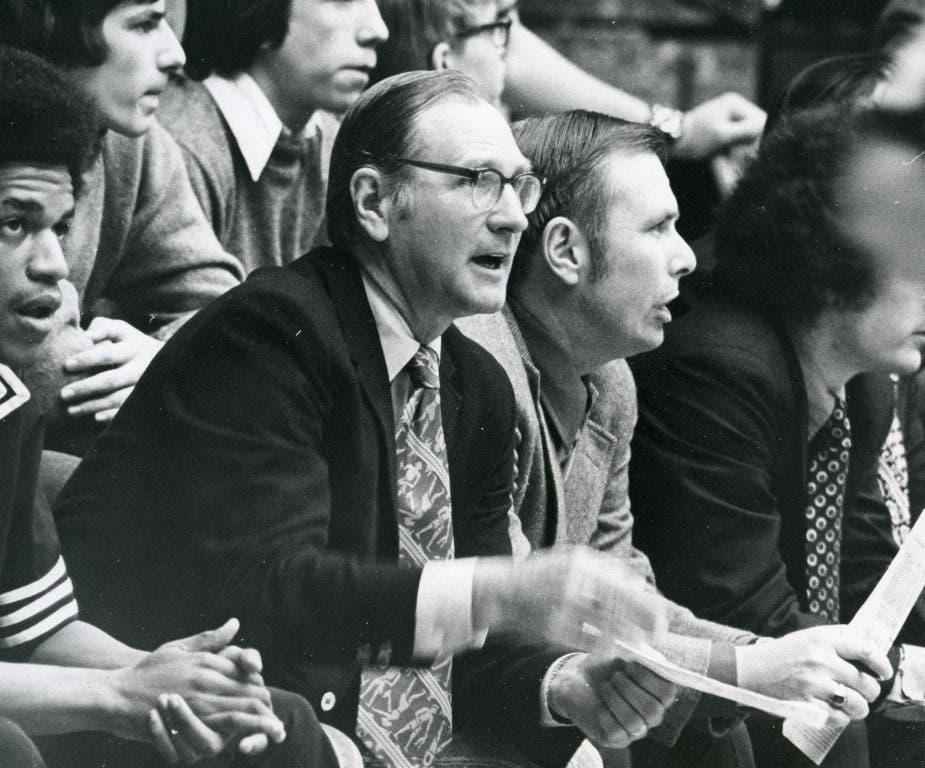
The answer surprised me, for it was a man I knew and had chronicled as a coach – Bridgeport native Joe Vancisin.
Vancisin, now 88, was a starting guard on Dartmouth’s 1943-44 team that defeated Ohio State, 60-53, in the Final Four and then bowed to Utah in overtime, 42-40, in the championship. He scored four points in the finale.
Find out what's happening in Fairfieldfor free with the latest updates from Patch.
As a young sportswriter and sports editor, I covered many of Vancisin’s Yale teams during the 1960s and early ‘70s. He was a scholarly gentleman known for developing the “Shuffle” offense and as the coach of Yale’s last two NCAA tournament teams (1961-62, 1956-57). His 206 career victories are the most among all Bulldog coaches.
Vancisin’s name was in the news just a month ago with the announcement of his election, as a contributor, to the National Collegiate Basketball Hall of Fame in Kansas City, Mo. On Nov. 20, he will be inducted along with players Chris Mullin, Cazzie Russell, Ralph Sampson and James Worthy, coaches Bob Knight and Eddie Sutton, and fellow contributor Eddie Einhorn.
Find out what's happening in Fairfieldfor free with the latest updates from Patch.
He left Yale in 1975 to become the executive director of the National Association of Basketball Coaches (NABC), a position he held for 17 seasons.
Growing up in Bridgeport, Vancisin was the senior captain of Bassick High School’s 1939-40 Class A state and New England championship team.
Some other notable Connecticut products that have played in the Final Four:
- Edmund Saunders (Holy Cross of Waterbury), Rashamel Jones (Trinity Catholic) and E.J. Harrison (Danbury) were members of UConn’s 1998-99 national championship team.
- Harold Jensen (Trumbull) and Harold Pressley (St. Bernard of Uncasville) were among the stars of Villanova’s improbable upset of Georgetown in the 1985 championship game.
- Mike Gminski (Masuk of Monroe) was the sophomore center for Duke when it bowed to Kentucky, 94-88, in the 1978 championship. He scored 49 points in the Final Four.
- Chuck Aleksinas (Wamogo) was a freshman reserve center on Kentucky’s 1977-78 title-winning squad. He would resurface a couple of years later as a powerful force on two UConn teams.
- Marcus Camby (Hartford Public) recorded 25 points and six blocks in Massachusetts’ 81-74 Final Four loss to Kentucky in 1996. John Calipari was the Minutemen’s coach.
- Charles Crawford (Hillhouse) and Gary Bello (Amity Regional) were members of Providence’s 1972-73 team that came up short against Memphis in the Final Four.
- Rod Foster (St. Thomas Aquinas of New Britain) was the UCLA point guard when the Bruins bowed to Louisville, 59-54, in the 1980 championship game. He produced 16 points and six steals that day.
- Craig Austrie (Trinity Catholic) played for UConn in its 2009 Final Four loss to Michigan State.
Only one member of UConn’s 2010-11 squad is about to join this list: Tyler Olander, the 6-foot-9 freshman forward from E.O. Smith in Storrs.
Some basketball purists who also care about education are troubled by Saturday night’s Final Four nightcap that pairs UConn’s Jim Calhoun and Kentucky’s John Calipari. “I hope they both go down,” one knowledgeable observer said. “Since that’s not possible, I won’t watch them.”
These head coaches preside over men’s programs that were among four teams in the NCAA Sweet Sixteen that graduated less than 50 percent of their players. Florida and Arizona were the others in this dubious category.
The study, conducted by the University of Central Florida’s Institute for Diversity and Ethics, was based on the six-year graduation rates of each school’s freshman class that enrolled in 2003-04.
Calipari, 52, is no paragon of virtue. His previous teams’ Final Four appearances (UMass, 1996; Memphis, 2008) were vacated because of NCAA violations. However, he was cleared by the NCAA in the UMass case and the jury is still out on the alleged problems at Memphis.
UConn, however, received NCAA sanctions for violations committed under Calhoun’s watch during the recruiting of Nate Miles (who was booted from school and never played a game for the Huskies). The Hall of Fame coach, now 68, will miss the first three Big East games of next season, the state university has been placed on probation and it will lose one scholarship for each of the next three years.
As a Connecticut taxpayer, I also have a problem with Calhoun’s compensation package at UConn – $2.3 million this year, $2.7 million the following year and $3 million for each of the next two years. When he retires, he also walks away with a $1 million golden parachute unless he opts for a $300,000-a-year job in the Athletic Department.
In an era of huge deficits, budget cuts and people losing their jobs or being forced to work for less money than before, I believe it’s unconscionable to pay this amount of money to a college basketball coach.
Calipari’s $4 million-per-year package? That’s even more obscene, and I trust there are folks living in the Commonwealth of Kentucky who find this figure distasteful.