Politics & Government
Flatto's Evolution in Office
Buying Open Space and Low Taxes Yielded to a Bad Economy, Budget Pressures and Overseeing the Largest Development in Town History

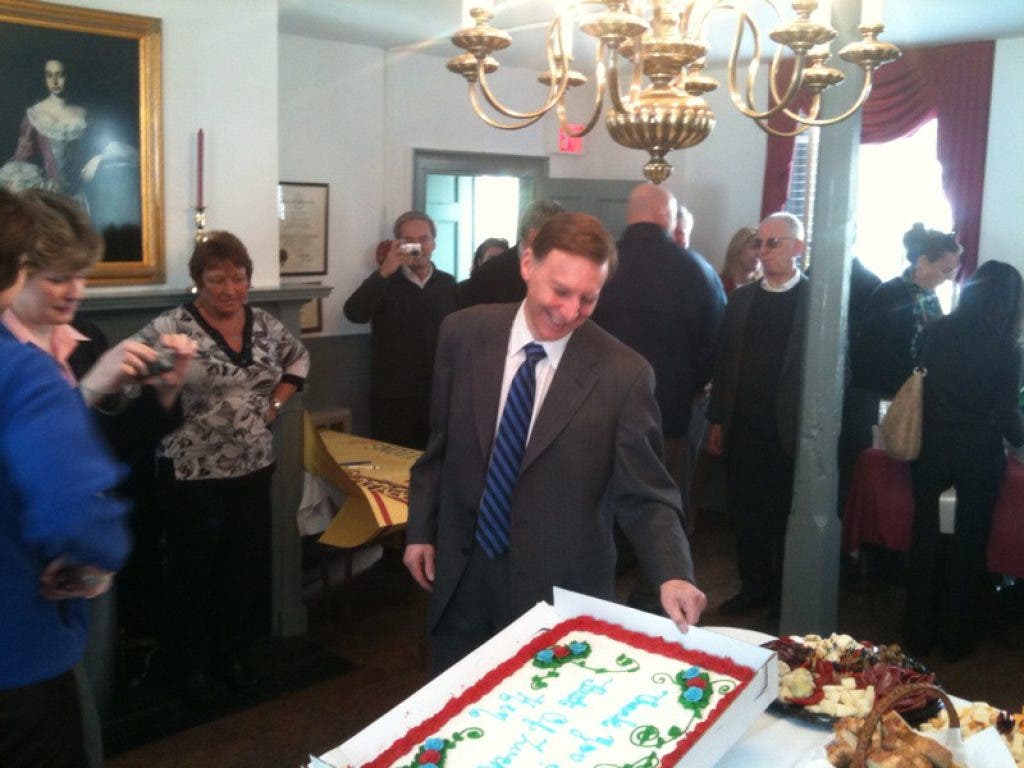


After former First Selectman Ken Flatto first won election to the town's top job in November 1997, he achieved what he would later term a historically low tax increase.
The 0.75 percent tax increase that helped to finance the $138.1 million town budget in 1999-00 was significant enough to Flatto that he had his portrait taken holding a copy of the budget and referred to that tax increase during his last campaign for first selectman in 2007, telling audience members in a League of Women Voters' debate that he would try, if re-elected, to bring in a 0 percent tax increase as he had done during his first term.
But the 2008-09 town budget adopted by the Representative Town Meeting in May 2008 carried a 6.7 percent tax increase, and Flatto was confronted only months later with the crash of the economy and stock market, and the loss of $42 million from the town's pension funds after returns from money that the town had invested with convicted scam artist Bernie Madoff turned out to be worthless.
Find out what's happening in Fairfieldfor free with the latest updates from Patch.
Flatto, a certified public accountant, former comptroller and self-described "finance guy," wasn't able to repeat the historically low tax increase in his first term, but he came close. After the 6.7 percent tax increase in 2008-09, the next two tax increases came in at 1.7 percent and 2 percent, and, unlike in 1999-00, Flatto didn't use money from the town's accumulated surplus to offset the need for a higher tax increase (in 1999-00 he'd used $3.5 million.) Also unlike 1999-00, Flatto was faced with covering an expanded senior tax relief program and significantly higher annual debt payments due to $200 million worth of school and town construction projects that mostly were approved during the two years Flatto was out of office (Flatto lost his first re-election bid in November 1999 to former First Selectman John Metsopoulos), though Flatto, as a selectman, voted in favor of those projects.
The escalation in annual debt payments was signficant - from $7.6 million in 1999-00 to $24.9 million in Flatto's final budget of 2011-12 - and, as a percentage of the town's operating budget, from 5.5 percent in 1999-00 to 9.5 percent in 2011-12.
Find out what's happening in Fairfieldfor free with the latest updates from Patch.
Flatto's final tax increase, the one that will take effect July 1, varies by homeowner due to the townwide revaluation, but overall tax revenue needed to finance the 2011-12 town budget rises 5.4 percent from overall tax revenue needed to finance this fiscal year's budget.
When Flatto left office last week for a job in Gov. Dannel Malloy's administration, the town had unsettled labor contracts with six of seven unions that represent municipal employees, which account for most of the expenses in the town's operating budget; underfunded reserve accounts (on an accrual basis) for town and Board of Education employees' medical insurance and workers' compensation claims; underfunded pension plans for town employees and police officers and firefighters; an accumulated surplus that was holding steady at bond rating agencies' recommended level of 5 percent of a municipality's operating budget; and Board of Finance members openly questioning whether the town's highly-prized AAA credit rating, obtained in the mid-1970s, was in jeopardy.
But Flatto, 58, managed much more than town budgets during his years in office from 1997 to 1999 and from 2001 to May 2011.
During Flatto's initial term in office, he led the way in reviving what had been a hallmark of former First Selectman John Sullivan's record 24 years in office from 1959 to 1983 - the town acquisition of open space.
Sullivan had acquired about 1,000 acres of open space during his years in office, but Flatto didn't have the availability of state and federal grants that financed most of Sullivan's purchases. Nevertheless, Flatto acquired significant parcels of undeveloped property - from 30 acres by Redding Road and Cross Highway, 38 acres by Mill Hill Road in Fairfield's Southport neighborhood, and 20 acres on Congress Street that became known as Haydu Farm to half an acre at the mouth of Southport Harbor (partly financed by neighborhood contributions) and less than an acre on Black Rock Turnpike, which provides a respite on one of the busiest roads in town.
But not all of Flatto's open-space purchases came easily. The town had to implement eminent domain to acquire about five acres on Burroughs Road where Zoltan Toth, a Fairfield developer, wanted to build a dense condominium development, and some Fairfield officials complained about the cost to acquire the land and build soccer fields on it.
The Representative Town Meeting, the last town body to vote on funding requests, backed Flatto's open-space acquisitions by large majorities, but, by the time of Flatto's last open-space purchase in December 2007 - 9.4 acres on Hoyden's Lane - the RTM had grown weary of buying open space for hiking and bird watching. The RTM agreed to buy the 9.4 acres, though many wanted the land to be used for active recreation.
The attempt to convert part of the 9.4 acres into a girls' Little League field survived a town referendum last August, but, when Flatto left office last week, the project was in litigation due to a lawsuit against the Town Plan and Zoning Commission by Hoyden's Hill residents.
Flatto's relationship with outspoken environmentalists in Fairfield deteriorated over his years in office, with the biggest break coming as Flatto championed the largest development in town history in his final term - a public/private venture that is slated to include the town's third train station, about 1,400 parking spaces for train commuters and nearly 1 million square feet of commercial development.
Town Conservation Director Thomas Steinke's oversight of the project - to environmentalists, Steinke was diligent and uncompromising; to Blackrock Realty, LLC, the commercial developer, he was an obstructionist - resulted in Blackrock threatening to sue the town and Flatto removing the town's Conservation Department from the project in December 2007.
When Flatto left office last week, the public portion of the Fairfield Metro Center, which includes the train station, parking lot, bridge and an interior road connecting the bridge to Black Rock Turnpike - was on track to open in late fall, though a lawsuit filed by environmentalists who wanted the Conservation Department put back on the job was pending before the state Supreme Court after a Bridgeport Superior Court judge ruled in the environmentalists' favor.
The 35.5 acres of former industrial land on lower Black Rock Turnpike (across from BJ's Wholesale Club) where the Fairfield Metro Center will be built wasn't the only industrial parcel to see changes during Flatto's time in office.
One of Flatto's most significant accomplishments - one that bedeviled his predecessors - was demolition of the former Exide Battery Plant on a highly-visible section of the Post Road, and Flatto also helped to convert the former Fairprene factory on Mill Plain Road into a recreational center that includes the town's Parks and Recreation Department, town Fitness Center and a privately-run Sportsplex that includes gymnastics and cheerleading, ice hockey, indoor climbing, yoga and cross-training. The redevelopment of another former industrial property in town, nearly 11 acres on Grasmere Avenue, from a factory that processed precious metals into a retail development with Whole Foods as its anchor tenant also was initiated during Flatto's time in office.
When Flatto left office last week, the state Department of Environmental Protection and Exide Inc., owner of the 6.25 acres where the battery plant was demolished about 25 years after it closed in 1981, were still disagreeing over how much lead had to be removed from the adjacent Mill River. Exide has to remove lead from the river before that vacant property can be built upon. While redevelopment of that property has stalled, the retail development on Grasmere Avenue is moving forward, with Whole Foods expected to open within months.
Moving offices for the Parks and Recreation Department to the old Fairprene factory property on Mill Plain Road initiated what Flatto would call a revival of the arts in downtown Fairfield.
The old home of the rec offices on Sanford Street was leased to the Fairfield Theatre Company, which began as a venue for off, off-Broadway plays but which more recently has been a venue for nationally-known musicians, and the Fairfield Arts Center, which opened next door, also achieved more visibility and influence.
The stretch of the Post Road from the demolished Exide factory to the Brick Walk Shopping Center underwent a significant transformation under both Flatto's and Metsopoulos' leadership.
One of the largest commercial properties in Fairfield Center was demolished after the Fairfield Store, a family-owned department store, closed in July 1996, and an 80,000-square-foot, two-story building was erected in its place and became home to national retailers that included Victoria's Secret, Ann Taylor, Chico's, Banana Republic and Borders Books.
But the largest space in that building was on the verge of vacancy when Flatto left office last week, and Fairfield developer Al Kleban, who bought the 80,000-square-foot commercial building from developer Louis L. Ceruzzi, Jr. in 2004, was negotiating for tenants to take over Borders' 28,000 square feet of space. Kleban, during Flatto's time in office, was credited with redeveloping the Brick Walk Shopping Center, as well as a commercial property on Black Rock Turnpike after Steinbach's department store closed. The Black Rock Turnpike property was slated to become a discount store until Kleban stepped into a bankruptcy hearing, acquired Steinbach's lease and landed The Gap and Old Navy as tenants.
Flatto's clash with environmentalists over the Fairfield Metro Center came around the time that he, with the grant-securing help of Ed Boman, assistant director of the town's Department of Public Works, were converting town vehicles to run on natural gas, reducing diesel emissions from school buses through installation of diesel particulate filters, and cutting energy costs, partly through a fuel cell on the town's wastewater treatment plant on One Rod Highway, which also was overhauled during Flatto's time in office to reduce nitrogen emissions into Long Island Sound.
And while Flatto and Hoyden's Hill residents clashed over the girls' Little League field, Flatto earlier had won favor from Fairfield Woods' residents by preventing Toth's development, and he reacted to residents' concerns about McMansions cropping up south of the Post Road by supporting amendments to the town's Zoning Regulations that were designed to limit the mass of new homes. The town's Zoning regulations also were amended during Flatto's time in office to prevent chain stores from opening in neighborhood business districts, which was a reaction to Stratfield residents' objections to Walgreens' attempt to take over space once occupied by a small supermarket.
Flatto's accomplishments in office didn't go unrecognized by Fairfield voters or the broader public.
After defeating Metsopoulos in a rematch in November 2001, Flatto didn't face a significant challenge at the polls in his next three bids for re-election, though town officials said the Republican Party in Fairfield didn't field strong candidates against him.
In 2006, Money Magazine judged Fairfield as the ninth best town to live in the country and first in the Northeast, citing as pros its "vibrant downtown" and "great beaches" and, as cons, its "pricey homes" and "lack of diversity," and Connecticut Magazine in October 2009 picked Fairfield as the best town in the state, giving especially high marks to the town's public safety departments and schools.
The town's growth during Flatto's time in office can mostly be seen in its budgets as its population was pretty much set in the mid- to high-50,000 range when Flatto was first elected in November 1997.
Flatto's first budget, in 1998-99, totaled $133.7 million, with $70.5 million for the Board of Education, $55.1 million for townside operations and $8 million in annual debt service.
Flatto's final budget, in 2011-12, totals $263 million, with $145.68 million for the Board of Education, $92.4 million for townside operations and $24.9 million in annual debt service. The two town budgets under Metsopoulos' term in office increased by 6.3 percent and by 5.8 percent, while Flatto's budget increases, after he defeated Metsopoulos in November 2001, ranged from highs of 9.1 percent in 2002-03 and 8 percent in 2004-05 to lows of 0.7 percent in 2009-10 and 1.74 percent in 2010-11.
But the recent budget cutting by Flatto and town boards has had an effect.
On the day Flatto left office last week for a job as executive director of the state's Division of Special Revenue, residents pulled petitions in the Town Clerk's Office to have a referendum on the Board of Education's budget for 2011-12, seeking to increase it by $800,000, or, as an alternative, by $500,000 over the amount approved by the RTM.
Get more local news delivered straight to your inbox. Sign up for free Patch newsletters and alerts.