Politics & Government
Hostility, Accusations Dominate Fairfield BOS Contamination Talks
Mere minutes into the discussion, First Selectman Mike Tetreau was citing Robert's Rules of Order.


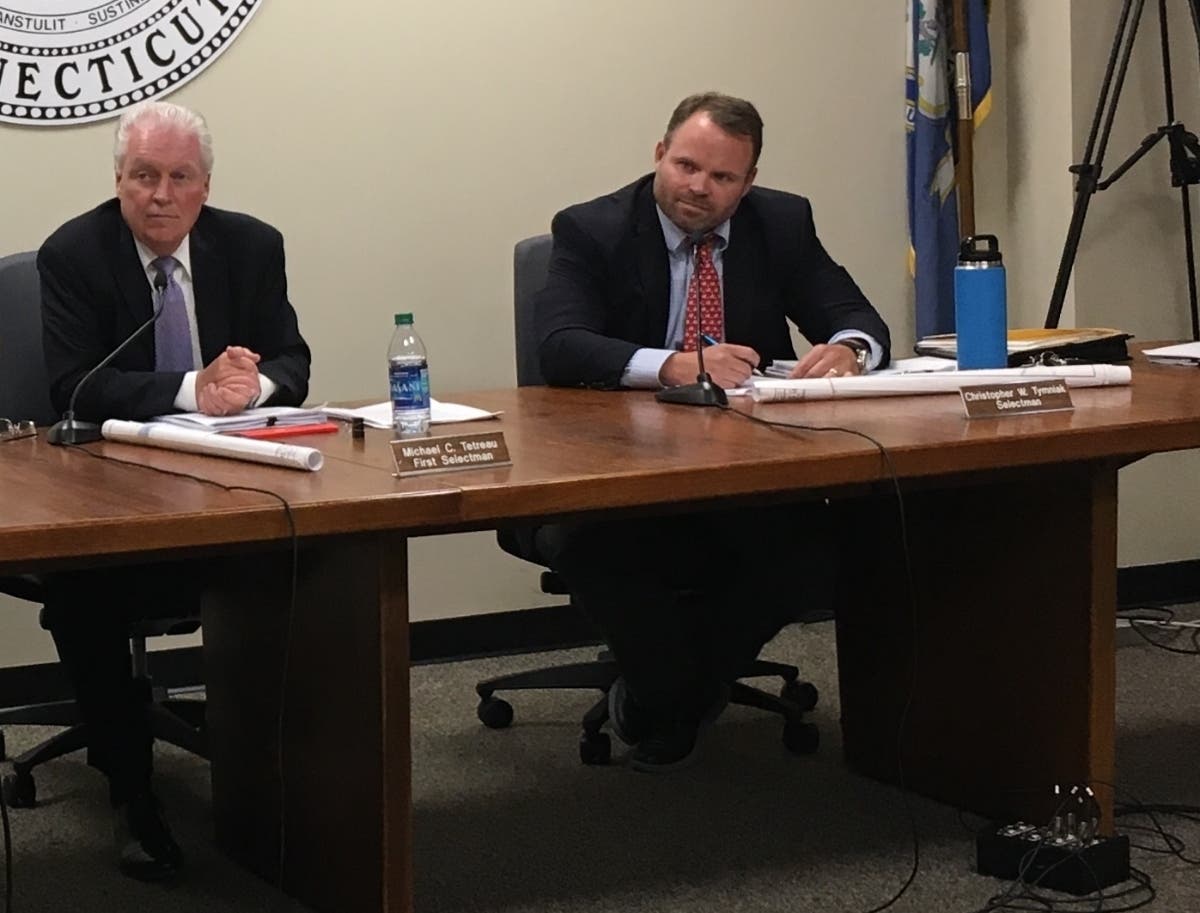
FAIRFIELD, CT — Weeks of tension between Fairfield's selectmen escalated to outright hostility at the board's meeting Wednesday, as officials continued to address the fallout after two town employees and a contractor were arrested and contamination was uncovered at public sites all over town.
Mere minutes into a discussion recorded by FairTV and posted to YouTube on the latest developments surrounding illegal dumping at the town public works yard, First Selectman Mike Tetreau was citing Robert's Rules of Order.
"I absolutely believe this is a complete lack of leadership on your part from the beginning," Selectman Christopher Tymniak, a Republican, said.
Find out what's happening in Fairfieldfor free with the latest updates from Patch.
Tetreau, a Democrat, responded that making such comments about a fellow board member was not allowed under the rules.
"It's your job performance," countered Selectman Ed Bateson, a Republican. "I'm allowed to criticize that."
Find out what's happening in Fairfieldfor free with the latest updates from Patch.
Tetreau again referenced Robert's Rules of Order.
"Not while you're sitting in a Board of Selectmen meeting, sir," Tetreau said.
As the meeting proceeded, selectmen continued to trade barbs, with Tetreau at one point saying to Tymniak, "I just can't correct you every time you're wrong."
Tetreau also checked the behavior of those in the audience, telling Fairfield Republican Town Committee chair and police commissioner Jamie Millington to, "hold your tongue, please." Tetreau's rebuke came in the midst of a discussion of how the arrest warrant documents for former public works director Joe Michelangelo, former public works superintendent Scott Bartlett and Julian Companies Owner Jason Julian should be interpreted.
As Tymniak read from the warrant, Town Attorney Stanton Lesser interjected, saying the allegations detailed in the warrants must be proven in court.
"These people that are in that warrant are not public figures. They can be slandered," Lesser said. "... Don't indicate that what's in there is necessarily true."
Although Millington was silenced earlier in the meeting, he took the microphone during public comment, saying that when police sign a warrant affidavit they are vouching that its contents are "true and accurate to the best of their knowledge."
Millington also spoke at the meeting about a public corruption investigation of Bartlett that spanned from 2009 to 2011 and was conducted by the chief state's attorney's office, referencing a warrant for two charges of larceny and a charge of tampering with a witness.
"That warrant was never signed and nobody knows what happened to it," Millington said to the board.
A state investigator wanted to meet with Tetreau in December 2011 to discuss the case and the charges, but a law firm communicated to the investigator that Tetreau would not meet with him, Millington said during public comment.
In a phone interview Friday, Tetreau said that if Millington wanted to know why a warrant didn't move forward, he should follow up with the agency that conducted the investigation.
"He seemed to have some information. I'm not sure where he got that from," Tetreau said.
Former First Selectman Ken Flatto, who ceded the role to Tetreau in mid-2011, has said previously that his impression of the 2009 investigation was that the state couldn't substantiate allegations. Bartlett's attorney has previously noted that nothing came of the investigation.
When asked about the state investigator's request for a meeting in 2011, Tetreau said he didn't remember it, but added that if Millington were to provide him with the name of the investigator or the attorney who sent the communication, he would be willing to look back and review his records.
"It's eight years back on a meeting that didn't take place. That's not the most memorable dynamic," Tetreau said.
Millington wasn't the only person to bring up communications from Tetreau's past at the Wednesday meeting. Tymniak read into the record an email from April 2015 to Tetreau from Michelangelo.
In the email, Michelangelo discussed problems with the quality of the topsoil at the Oldfield, Burroughs and McKinley soccer fields and connected the issue to a similar complaint made in 2014 regarding Gould Manor Park, about which Tetreau was also notified. In his reply email, Tetreau said the situation "appeared to be a very significant issue," Tymniak read into the record.
Recent testing at all four of those locations revealed contaminants at the Burroughs and Gould Manor sites.
In response to questions from Tymniak about why Tetreau didn't identify a pattern of contamination, Tetreau said no one knew the material at the fields or at Gould Manor was from the public works yard. He said the issues were resolved by two separate departments and appeared to have been caused by two different issues.
At one point during the discussion, Lesser interrupted, saying, "What's done is done." That statement yielded a rebuke from Bateson.
"How dare you say that?" Bateson asked. "... That's a cavalier attitude."
Tetreau began Wednesday's discussion with a prepared statement, which referenced "information, misinformation and politicized information" and suggested people were politicizing the aftermath of the dumping investigation for personal gain. He also touched on his plans for an environmental safety committee, enhancing the town code of ethics and starting a whistle-blower hotline. The hotline is live and available to town employees and will be made accessible to the public in the coming weeks.
The Wednesday meeting followed more than a month of controversy in Fairfield. In addition to the charges against Michelangelo, Bartlett and Julian, which include larceny, forgery and dumping, sites all over town were tested after receiving potentially contaminated material from the public works yard between 2013 and 2016. During those years, the facility was operated by Julian Development. In August, 10 of 20 sites on a priority testing list released by the town were found to contain contaminants, such as arsenic, asbestos, lead and PCBs.
Fairfield hired Julian to run its public works yard and reduce the size of a pile of leftover project material on the property by 40,000 cubic yards. Over the course of Julian's three-year agreement, the pile more than doubled in size, and days before the agreement was set to end, contamination was discovered on the property. In addition to the criminal case, Fairfield has sued Julian for millions in damages and Julian has sued the town for defamation.
Get more local news delivered straight to your inbox. Sign up for free Patch newsletters and alerts.