Schools
RLMS Design Element Proves Costly
Cedar Wood Siding, Meant to Appease Neighbors, Needs to be Replaced at Cost of $250K; Future Maintenance Will Top $150K

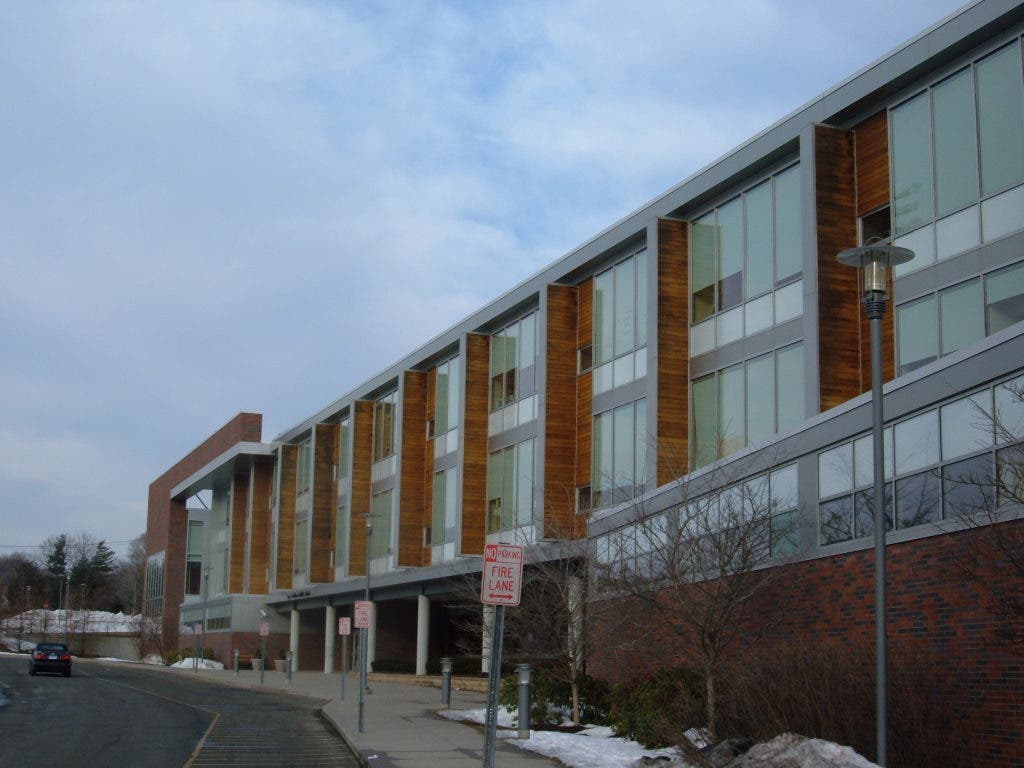
Cedar wood siding on Roger Ludlowe Middle School looked pretty when the school was built, but it's turning into a bottomless pit for taxpayer dollars.
The Board of Education wants $250,000 to replace the siding on the Unquowa Road school after deciding in the past that sealing it against the elements was too costly. That cost exceeded $150,000, according to Tom Cullen, the school district's director of operations. The problem is, if the siding isn't protected with sealant every two years, it will have to be replaced again in the future.
Selectmen James Walsh and Sherri Steeneck were furious at the expense, with Steeneck saying Perkins Eastman Architects of Stamford, which designed the school, should be put on a "Do Not Call" list for future town projects, and Walsh saying the $250,000 expense was "completely ridiculous."
Find out what's happening in Fairfieldfor free with the latest updates from Patch.
"It almost sounds like that's going to have to come down so we can permanently deal with that," Walsh said of the siding.
Cullen said the siding had been attached to make the school look "warm and inviting," an opinion shared by Jeffrey Roseman, a member of the town's High School Building Committee, which had overseen construction of the middle school as well as renovations to school buildings that became Fairfield Ludlowe High School and Fairfield Warde High School about eight years ago.
Find out what's happening in Fairfieldfor free with the latest updates from Patch.
On Friday, Roseman said none of the residents who live nearby the middle school wanted it built next to Fairfield Ludlowe High School and that the wood siding was included to try to appease them. The town at the time also built a $400,000 stone wall between the middle school and Unquowa Road to appease a family on Papermill Lane.
"This isn't an isolated site. It's in the middle of a residential neighborhood," Roseman said.
Roseman said the town owned no other property large enough for the 200,000-square-foot middle school, which has a 875-student capacity, and that the design of the school was "a critical factor" due to neighborhood opposition.
Roseman said all school buildings have elements that have to be maintained and he didn't know whether maintenance of Roger Ludlowe Middle School had been followed. "I could appreciate no one wants to pay the bill after the fact," he said.
Perkins Eastman didn't return a call Friday afternoon to say if architects had specifically mentioned the expense associated with maintaining cedar wood siding on the school.
Cullen said the estimate of applying sealant to the siding kept going up due to the difficulty in positioning scaffolding for the job.
Ludlowe's cedar wood siding isn't the only maintenance project for the town's newest schools to be included in a $4.4 million bonding request for capital improvement projects in the 2011-12 fiscal year.
The school board also wants $150,000 for parapet coping and flashing repair and replacement on McKinley School's roof and $50,000 for work on Roger Ludlowe Middle School's roof.
"Roger Ludlowe and McKinley are brand-new schools. Due to material choices and error on the part of contractors, we're faced with serious costs to fix what wasn't done right in the first place or could have been done differently," said Robert Bellitto Jr., a member of the town's Board of Finance, which reviewed the capital improvement projects on Thursday night in the Education Center, 501 Kings Highway East.
Cullen said McKinley and Roger Ludlowe Middle School opened in 2003. "They're not that brand new," he said.
Cullen added that maintenance needed on Ludlowe's roof wasn't unusual, though he said maintenance required on McKinley's roof was "a bigger issue that shouldn't happen."
But Cullen said the town couldn't go after the contractor to fix the problem on McKinley's roof after so many years had passed. "As far as the statute of limitations, we wouldn't have a leg to stand on to go after them," he said.
Michael Tetreau, a finance board member, questioned whether the shoddy work on McKinley's roof amounted to negligence and if town officials had recourse via that avenue.
School board Chairman John Mitola, an attorney, said a case of negligence would typically expire after two years. He said it could be considered a breach of contract, but a case on that would typically expire after six years.
Get more local news delivered straight to your inbox. Sign up for free Patch newsletters and alerts.