Community Corner
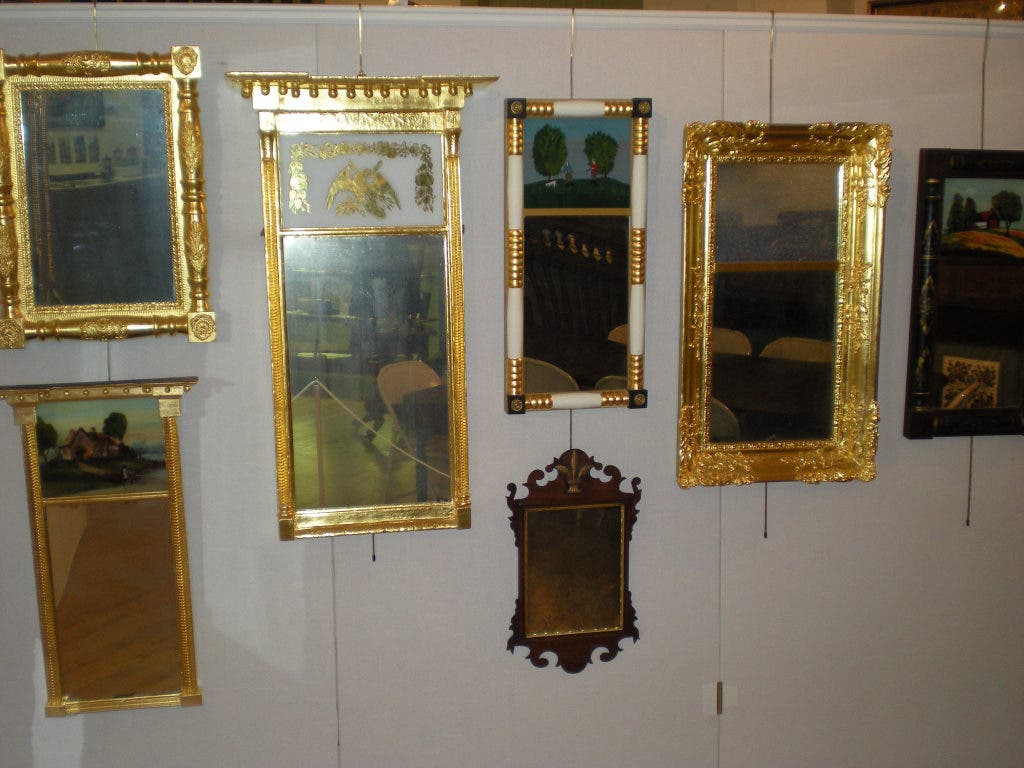
NEW HISTORICAL SOCIETY OF GLASTONBURY MUSEUM ON THE GREEN EXHIBIT: 19TH CENTURY AMERICAN LOOKING GLASSES
Reflecting on the World of Early America
Alice, the white rabbit, Humpty Dumpty, the Queen of Hearts and other Lewis Carroll characters are nowhere to be found at the Historical Society of Glastonbury’s (HSG) Museum on the Green. But you will find a glamorous collection of 19th Century American Looking Glasses.
The Historical Society of Glastonbury’s newest exhibit is a glimpse into early American culture. This new display features 14 looking glasses, part of a personal collection of 60 which come to the museum from James Cooke and Anita Hochstein of Glastonbury, who have collected them for over 30 years.
Find out what's happening in Glastonburyfor free with the latest updates from Patch.
A story and history of early America can be told from this selection of different size, shape and style vintage mirrors, or looking glasses, as mirrors were commonly referred to. These ornate looking glasses were a very important 18th and 19th century household furnishing. They had a practical purpose of reflecting light to help brighten the pre-electrically powered colonial home. And they also were a status symbol. Looking glasses were luxury items that could be the single most expensive piece of furniture, next to the clock, in the inventory of an estate. Prior to the Industrial Revolution, Americans could create the frames but still had to import the glass from England or Europe, making glass the glass (usually) the most expensive part of the whole piece.
It can be difficult to distinguish between English and American frames since very few surviving mirror frames bear labels. Even though mirror glass may be mottled or scratched, old looking glasses with the original (usually very thin) mirror glass (and backboard) are the most sought-after. The earliest looking glasses were round and convex, because the glass was blown and metal mirrors were used before glass. In the late 17th century Venetian glassmakers discovered how to make flat looking glasses by pouring molten glass into a flat mold; this new technology was kept secret for many ears.
This eclectic array of vintage early American mirrors is only on display until May 1st. Museum hours are Monday, Tuesday, and Thursdays 9:00am – 4:00pm, and the third Sunday of every month 1:00pm to 4:00pm. Admission to the Museum on the Green is free. If weekends work best for you, make sure mark April 21st on your calendar.