Community Corner
Aaron Draper Shattuck- Granby's Incomparable Artist, Inventor
Captured Granby's 19th Century Landscapes


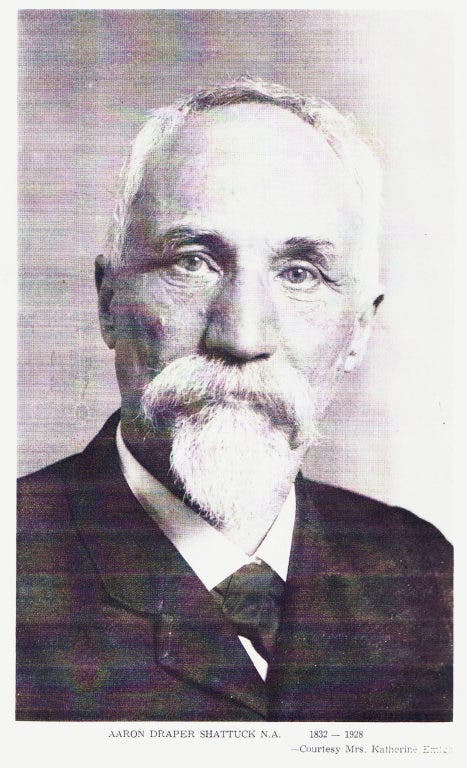


Aaron Draper Shattuck (1832-1928) was born in Francestown, NH. He became a highly respected American painter in the style of the Hudson River School, which was not an institution, but rather an informal group of like-minded painters.
Since the early 1800s, landscape has remained a central preoccupation of American art and the buying public, unlike the colonial period and the early years of the Republic when landscape was rarely considered as a subject of serious art.
With the development of romanticism, early 19th-century artists and their patrons took a greater interest in landscape for its own sake. These early paintings portrayed dramatic scenes with an emphasis on nature and man's insignificance. The meteoric rise of Thomas Cole after 1825 brought new awareness of landscape's potential for conveying symbolic and allegorical meanings.
Find out what's happening in Granby-East Granbyfor free with the latest updates from Patch.
Aaron Draper Shattuck is considered a second-generation artist of the Hudson River School, which emerged to prominence after Cole's premature death in 1848. Young Shattuck became associated with an illustrious group of men including Cole's prize pupils Frederic Edwin Church and John Frederick Kensett. Works by artists of this second generation involved carefully detailed paintings with romantic, almost glowing lighting, sometimes referred to as Luminism.
Shattuck differed from most of his contemporaries in that he never found it necessary to study abroad and was, for the most part, a "self-taught" artist who spent his entire life in New England.
Find out what's happening in Granby-East Granbyfor free with the latest updates from Patch.
In 1851, at the age of 19, Shattuck studied portrait painting with Alexander Ransom in Boston and in 1852 was a student at the National Academy of Design in New York City. By 1854 he painted his first scenes of the White Mountains of New Hampshire and the following year exhibited for the first time at both the National Academy and the Boston Athenaeum.
By 1855, landscape in the Hudson River School mode figured as his primary interest. In 1856 he was elected an associate of the National Academy and was made a full Academician by the year of 1861. He opened a studio in the famous Tenth Street Studio Building in 1859 forming close working relationships with his neighbors Albert Bierstadt, Frederic Church and Samuel Colman. He married Colman’s sister, Marion, the following year.
Although he was primarily a landscapist and became particularly known for his views of the White Mountains, he also painted the Atlantic coast and other locales including many of the pastoral scenes he found in the Farmington Valley and Granby. He discovered the "Valley" in the 1860s when he summered in Simsbury at Samuel Colman's place.
Some of his works also demonstrate his affinity for the clarity, serenity, and attention to atmospheric effects characteristic of luminism. With its detailed trees and foreground rocks, carefully observed light effects, and intimate tone, Stream in a Rocky Gorge (c.1860) recalls the contemporary woodland interiors of his good friend John Kensett. The setting of this painting could possibly be from Enders Falls or the Craggs near Silver Street in North Granby. This painting can be found today on display at the New Britian Museum of American Art.
By 1870, at the age of 42, he and his family bought a home in Granby, which was considered, at the time, "a cattle-raising town steeped in rustic tradition." His farm, livestock and the Salmon Brook provided continual inspiration for his landscape paintings.
While Bierstadt and Church were roaming the world in search of Nature's most spectacular and dramatic wonders, Shattuck was content with the quiet beauty he found in his own back yard. His scenes of Granby may be reminiscent of those used by the famous lithographers Currier and Ives from the 1850s through the 1870s.
Shattuck was remarkably successful throughout the second half of the 19th century. He was named an Associate and Academician of the National Academy of Design and exhibited at all the major venues, including the Boston Athenaeum, the Pennsylvania Academy of the Fine Arts, the Washington Art Association and the Brooklyn Art Association.
Today, his work is featured in the collections of the Wadsworth Athenaeum Museum of Art, The Brooklyn Museum of Art, the High Museum of Art, the Newark Museum, the Hudson River Museum, the Farnsworth Art Museum, and locally at the New Britain Museum of American Art.
In the late 1880s, beset by illness which affected his eye sight and dissatisfaction with the subsequent results of his works, he simply ceased painting.
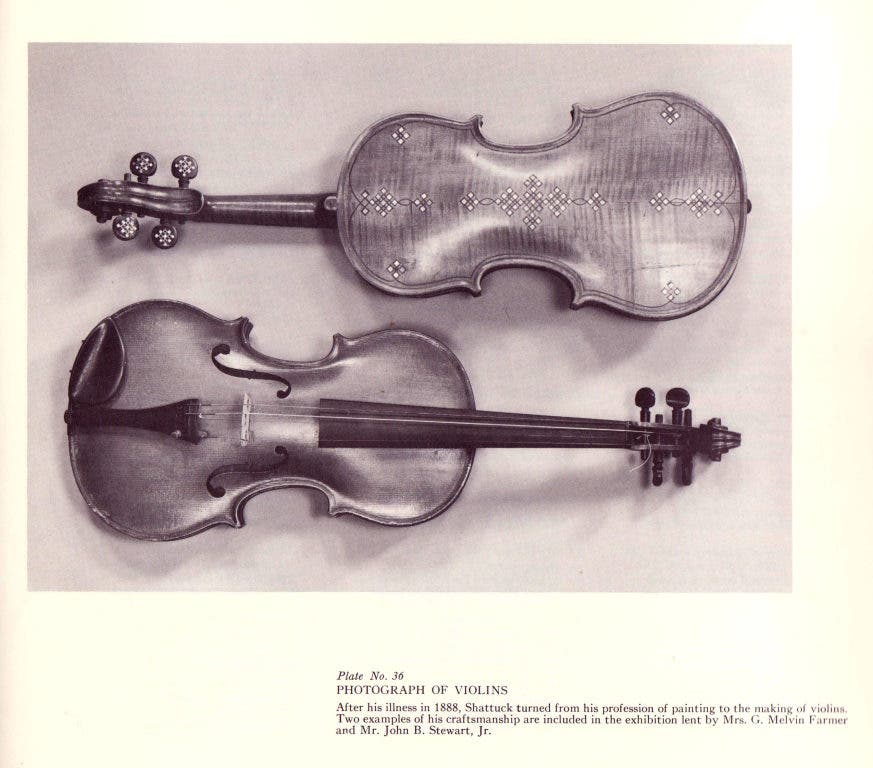
For the next 40 years, he devoted his time to farming, building violins and devising several inventions. In 1885 he patented a stretcher key that was used by the best American artists of the day. The keys were a very successful financial venture for Shattuck and he became one of the wealthiest men in Granby. He also invented a horizontal ventilation system for tobacco barns, which was widely used throughout the 20th century.
When Shattuck died in 1928 he left an estate of over $500,000! His home, located at 108 West Granby Road, remains today and has been beautifully restored by Jon Parker.
Local art gallery owner and restoration specialist David Kimball is considered the foremost expert on the life and work of Aaron Draper Shattuck. He owns many of Shattuck’s oil paintings and is working on a catalogue raissone of over 300 of his works. David recently regaled me with stories of Aaron Draper Shattuck's life and work. It sounds like he would have been a wonderful man to know.