Politics & Government
Granby Charter Commission Presents Report to Selectmen
No automatic referendum, despite pleas, 1,400-signature petition from members of the public.


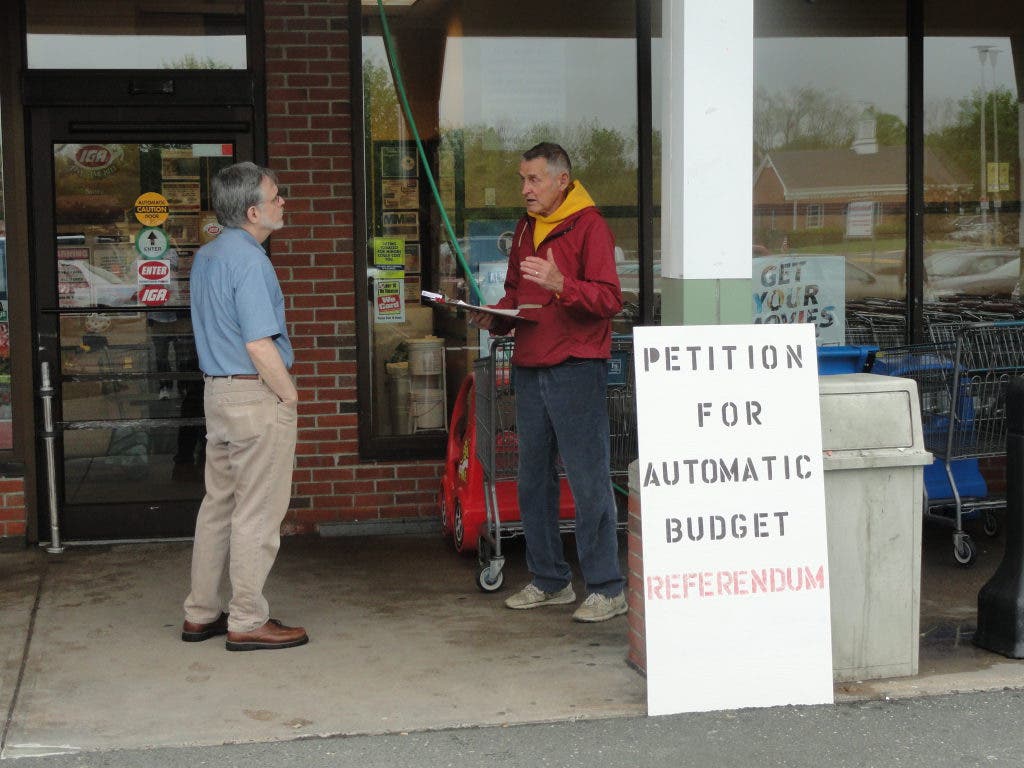
The public hearing on the Charter Revision Commission’s completed draft report isn’t until June 21, but that didn’t stop at least one member of the public from discussing the issue at a the regular meeting of the Board of Selectmen on Monday evening.
“I know many members of the Charter Revision Commission here tonight put a lot of time and effort here,” Granby resident Jim Glenney said. “But it does not satisfy the demands of 1,400 petition signatures.
“The Town Meeting voting process does not work. That process is hemorrhaging. I’m not trying to be sarcastic or denigrate the work of the charter commission, but you cannot stop a hemorrhage with a band aid.”
Glenney was referring to the petition that he, along with several other members of the community, compiled to try and convince the charter commission to have the town adopt the budget through an automatic referendum instead of its current method of enabling the budget to pass at the annual Town Meeting, provided certain thresholds are met.
The charter commission, which met 21 times since November, eventually recommended in its draft report that the budget should still be able to be passed at the Town Meeting unless the proposed tax levy calls for an increase of more than 4 percent. In that case, the budget would automatically be presented to voters at a town-wide, machine vote referendum.
Fran Brady, chairman of the charter commission, presented the draft report to the selectmen Monday evening.
During his presentation, Brady said that the commission reached a consensus on virtually every issue except the automatic referendum. Just five out of the nine commissioners favored the 4 percent trigger mechanism, while four members supported an automatic referendum, Brady said.
Brady dismissed the notion that the current Town Meeting format is not democratic, noting that the three boards — finance, education and selectmen — all of which comprise elected officials, take months to formulate the budget.
The Town Meeting then offers residents an opportunity to let the boards know if they have gone astray. The charter provides that the budget may be passed if 230 people attend the Town Meeting and ⅔ of those in attendance vote in the budget’s favor. The charter commission recommended raising the quorum to 250 in attendance as well as needing 250 voters.
To increase voter participation, the commission initially was going to recommend having a two-session Town Meeting — one on a weekday and one on a Saturday — with voting on both days. Brady said that idea was scrapped as it was too cumbersome, with a majority of the commissioners favoring the trigger mechanism instead.
“We felt that if there was a modest adjustment to the budget, it was not necessary to [have a referendum] on an automatic basis,” said Brady, who added that the 4 percent trigger provided the boards with incentive to keep the budget increase low during difficult economic times.
Glenney, however, disagreed with Brady’s assessment.
“[The Town Meeting format] is totally anti-democratic,” he said. “Less than 300 people decide a budget for 7,000 voters. … Come the November ballot, give voters the opportunity to say yes, they want a referendum or no, they don’t want a referendum. It’s the right way. It’s the popular way. It’s the democratic way. It’s the American way.”
Still others had concerns beyond the abstract.
Terry Wright said outside the meeting that, logistically, the high school cannot properly accommodate a large turnout of Granby voters, if it ever came to that.
Specifically, Wright noted that there are just over 200 parking spaces at the high school and that cars are often parked up and down the school’s entrance leading to Route 189. Without proper lighting, that area can be dark at night, when the Town Meeting is typically held, Wright said.
“I have significant safety concerns,” Wright said.
Wright added that the high school, which has an auditorium capacity of about 730 people, is just being used as a mechanism to “suppress” the number of voters who turnout at the Town Meeting.
“A referendum having the polls open all day similar to election day would fix the problem,” Wright said.
Among the other changes included in the draft report include the following:
- Develop a mechanism allowing for town officials in specific, narrowly tailored emergencies, to access emergency funding for up to 3 percent of the tax levy (which is currently about $900,000). Brady said that while the October storm prompted the discussion, even that situation would not have triggered the emergency provision contemplated in the charter revision.
- Allow the Planning & Zoning Commission to have two alternates to provide it with flexibility to act in a timely manner.
Find out what's happening in Granby-East Granbyfor free with the latest updates from Patch.
- Eliminate a section in the charter that prohibits town employees from holding public office. That section is in contravention to state law.
The public hearing on the draft charter revision report will be held on June 21 at the Senior Center at 7 p.m.
Day Street Traffic Study
After months of studying traffic on Day Street, Chief of Police Carl Rosensweig told the selectmen and those in attendance that there was not a statistically significant enough of an issue to make any significant alterations to the street.
Specifically, Rosensweig said that he would not recommend applying to the state to change the speed limit on sections of Day Street from 35 miles an hour to 25, installing stop signs along the road, or prohibiting thru trucks on the street.
Rosensweig discussed his findings after the police department gathered significant data on the traffic on Day Street.
“Day Street is the most studied street in town,” Rosensweig said.
According to one piece of data compiled by the police department, just over 1 percent of the traffic on Day Street on a given day in February came from buses, small trucks or tractor trailers. The average speed of the 609 vehicles traveling one way during that period was 38 miles per hour.
Rosensweig said that the data in a study in April revealed similar results for the speed of motor vehicles.
Day Street represents an attractive option for those looking for a shortcut between Routes 20 and 10, Rosensweig said. The best way of muting that traffic would be to soften the hairpin turn between Routes 10 and 20 in the town center, Rosensweig said.
The problem with that option, however, is that such a change would take a significant amount of time to implement.
Day Street residents have complained throughout the last several years of heavy traffic on the road, including those from large commercial vehicles.
Several Day Street residents in attendance were not pleased with the data reported by Rosensweig or his conclusions.
Doug Maus wanted to know what stop signs could not be installed along the street.
Rosensweig responded that, according to state guidelines, stop signs should not be used as a method to control speed. In addition, Rosensweig said that, in his experience, using stop signs in places where they traditionally do not belong only create more dangerous situations because drivers roll through them rather than stop.
“I don’t think it’s a good idea,” Rosensweig said.
Carol Reid requested that the speed limit on a portion of Day Street be changed from 35 to 25, something that Rosensweig said was unlikely to be successful as the data he collected showed that people were driving mostly within the speed limit.
Get more local news delivered straight to your inbox. Sign up for free Patch newsletters and alerts.