Politics & Government
Granby Charter Revision Commission: No Automatic Referendum, but a Compromise Recommended
Town Meeting vote still kept in place with some modifications, though a referendum would be triggered if budget levy is more than 4 percent.


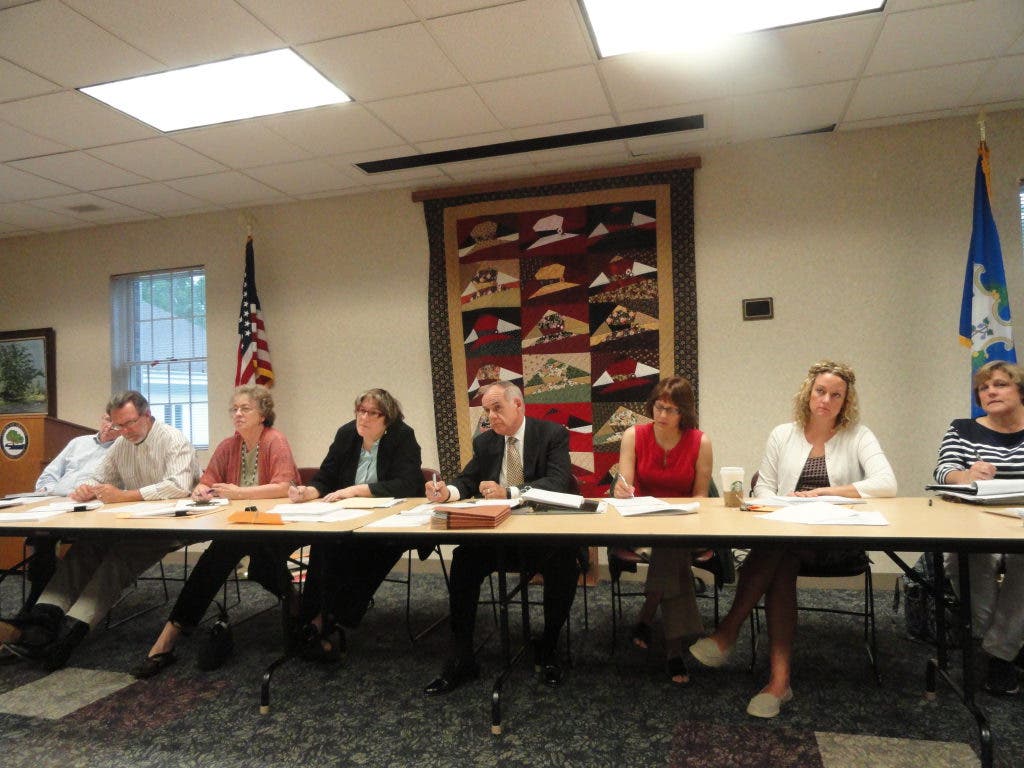

Despite a petition that as of June 1 had 1,400 signatures calling for an automatic machine vote referendum to determine the fate of the town budget, the Charter Revision Commission on Friday opted for what a majority of commissioners said was a compromise.
Indeed, the commission, by a 5-4 vote, decided to recommend modifying the budget approval process contained in the charter, though it still kept the structure of the Town Meeting largely intact.
The charter provides that the budget can be approved by a ⅔ majority at the annual Town Meeting, provided that at least 230 people vote. If the budget fails at the Town Meeting, then the meeting is adjourned to a machine-vote referendum.
The commission’s recommendation, which will be presented along with other changes to the Board of Selectmen tonight [June 4], provides that the budget can still be approved by a ⅔ majority of those present at the annual Town Meeting.
The commission, however, added a requirement that 250 people must attend the meeting and added 20 voters so that at least 250 people must vote on the budget.
There is an exception, however, that the budget will go to an automatic, machine vote referendum following the Town Meeting if the budget levy — the amount of money that taxpayers are accountable for paying — represents more than a 4 percent increase.
The change represented a departure from the commission’s initial draft report, which called for two Town Meetings, one on a weekday and another on a Saturday, at which people could vote at either one. It was a process that was called “cumbersome” by commission Chairman Fran Brady.
“I thought it was a good idea, but we were a group of about six who thought [the two Town Town Meeting structure] was a good idea,” commissioner David Russell said. “Nobody who was for the automatic referendum thought anything good about it.”
Automatic referendum rejected
The commissioners were hardly in accord on the compromise, evidenced by a preceding motion posed by commissioner Jim Lofink to have the annual meeting adjourn to a referendum.
The motion failed 5-4, with Lofink, Terri Ann Hahn, David Russell and Sheri Litchfield all voting in its favor, while Brady, Annie Hornish, Lowell Johnson, Melissa Migliaccio and Diane Neumann Hernsdorf all voting against the measure.
“I don’t see a better path,” said Hahn, who acknowledged the petition by changing her position from earlier in May. “[But] I personally am in favor of the Town Meeting.”
Still, a majority of commissioners were not moved to change the charter back to an automatic referendum.
“I still favor the Town Meeting format,” Hornish said. “[Though] I do sense a lack of trust in our town officials.”
Hornish said that people had the option of voting elected officials out of office if they did not like the job they were doing. What’s more, she called on people to become more active and engage in their town’s government.
Town Meeting ‘packed, rigged, stacked’
At the public hearing prior to the commission’s meeting, some 15 people implored the commission for various reasons to have the annual Town Meeting adjourn to an automatic machine vote referendum at a later date.
“We collected 1,400 signatures demanding an automatic referendum on the November ballot,” said Jim Glenney, who spearheaded the petition drive. “That’s the most important thing. That’s what we want. That’s what 1,400 signatures represent.”
Glenney dismissed the argument that a Town Meeting at which residents would vote means that people would make more informed choices.
“It’s hard for me to link talk and listen, talk and listen and then you have to vote,” Glenney said. “Why vote then? Maybe vote a week later.”
What’s more, Glenney said that the people with whom he met while compiling the petition signatures said that they did not trust the Town Meeting process.
“There is this very strong suspicion that the Town Meeting - whether you want to call it packed, rigged, stacked - that’s their perception of the Town Meeting,” Glenney said.
Robert Flanigan argued that saying that the claim of a traditional Town Meeting didn’t hold up, as the town had a referendum vote on the budget as recently as the 1970s. The move away from the referendum, he said, represented a shift in philosophy as to how the town is run.
“This was an old farming town,” Flanigan said. “The conservativism went down the wayside.”
Other residents called on commissioners to adhere to democratic principles.
“I come from a communist country,” said Elizabeth Pasko, who added that she works long hours and is not able to get to an evening Town Meeting. “The way [the budget is voted on] now, it’s the communist way. … Please give us the opportunity [to vote], not special interest groups.”
Terry Wright was even more forceful in his comments, calling the Town Meeting a “throwback to the government education camps.”
Still others expressed their general distrust with those making the decisions in town.
Jack Powers said that he believed that Brady’s membership on the board of finance and the charter revision commission represented a conflict of interest.
“There’s a small oligarchy that runs this town until we have more people run for office,” Powers said.
Two questions in November?
The next step is for the selectmen to receive the commission’s recommendations. If the selectmen eventually approve the recommendations, then they will be posed to voters in the form of questions during the November elections.
The commission recommended to the selectmen that two questions should be posed to voters: one concerning whether voters accept the change to the budget approval process, the second regarding whether voters approve all the other changes made to the charter.
Those changes, which are mostly grammatical and style issues, also include the following:
- Develop a mechanism allowing for town officials in specific, narrowly tailored emergencies, to access emergency funding for up to 3 percent of the tax levy (which is currently about $900,000). Brady said that while the October storm prompted the discussion, even that situation would not have triggered the emergency provision contemplated in the charter revision.
- Allow the Planning & Zoning Commission to have two alternates to provide it with flexibility to act in a timely manner.
- Eliminate a provision in the charter that prohibits town employees from holding public office. That provision is in contravention to state law.
Find out what's happening in Granby-East Granbyfor free with the latest updates from Patch.
Get more local news delivered straight to your inbox. Sign up for free Patch newsletters and alerts.