Politics & Government
Granby Commission Recommends Two Town Meetings, No Automatic Budget Referendum
Majority of the Charter Revision Commission approves recommending two separate voting sessions - one on Monday, one on Saturday.


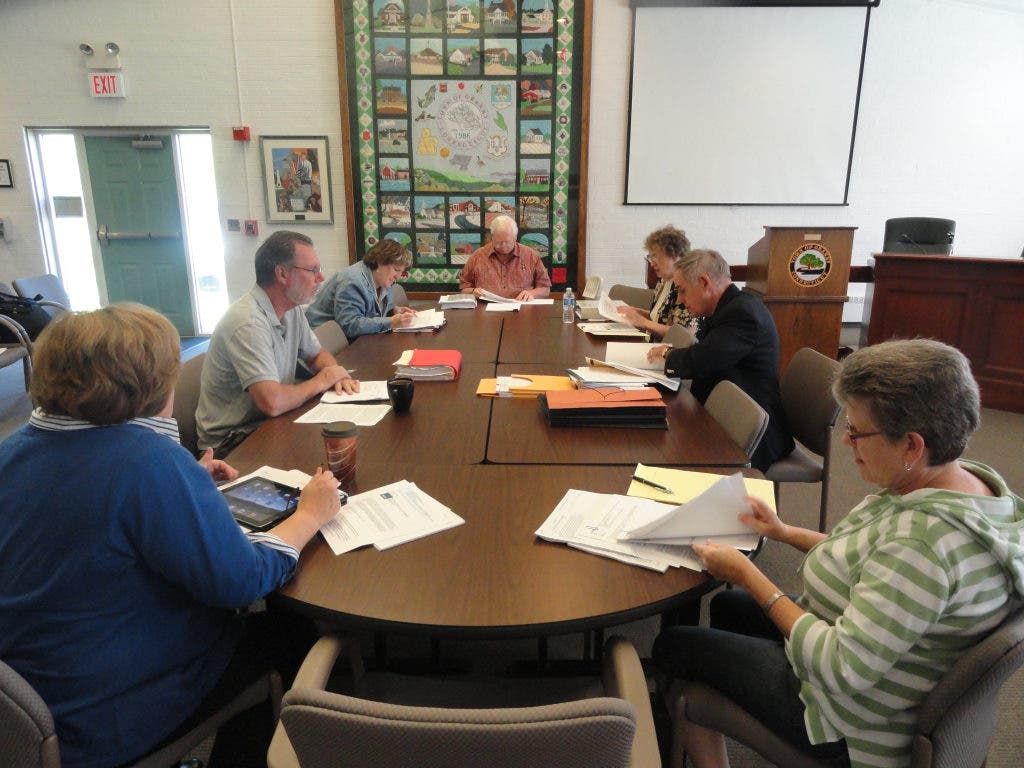
To increase residents' accessibility to the budget process, Granby should hold an additional Town Meeting on a Saturday instead of going to an automatic referendum, according to one of the recommendations made by the Charter Revision Commission.
The commission, in a 5-2 vote on Saturday morning, passed along its recommendations to a draft report, and a public hearing will be held on the matter on June 1. In the meantime, the commission’s draft report will become available at the Town Clerk's office and online either late Monday or early Tuesday.
Among the more controversial proposals that will be included in the report is to essentially double the Town Meeting by holding two voting sessions - one on a Monday evening and one on a Saturday morning. To prevent weighting one session over the other, the votes would not be counted until the end of the second Town Meeting.
Let Patch save you time. Get great local stories like this delivered right to your inbox or smartphone every day with our free newsletter. Simple, fast sign-up here.
The idea is to provide those who cannot normally attend a weekday Town Meeting - people who have trouble driving at night, parents with small children, people who work second shift, etc. - an opportunity to attend a second Town Meeting scheduled on a weekend day.
The final change to the current funding approval process recommended by the commission is to raise the threshold for passing a budget at the Town Meeting.
Currently, the town charter provides that a budget may be passed at the Town Meeting if 230 people are in attendance and ⅔ of voters approve the spending measure. If one of those thresholds is not met, then the budget moves on to a referendum vote.
The commission recommends changing the threshold requirement to 250 voters - not residents in attendance - while still keeping the ⅔ supermajority intact.
Find out what's happening in Granby-East Granbyfor free with the latest updates from Patch.
Declining to follow the petition
In making the recommendation, the majority of the commissioners declined to follow a petition, signed by over 1,000 residents, that called for the Town Meeting, after presentations were made by various controlling boards, to be adjourned to an automatic referendum.
What’s more, Town Attorney Don Holtman wrote in a letter to the commission that the two-session Town Meeting was legal, though not “practical.”
“[Holtman said that] our proposal for two sessions is lawful, but cumbersome,” commission Chairman Francis Brady said.
But Commissioner Terri Ann Hahn, who voted with the majority, said that the Town Meeting and accompanying vote was still a vital component of the budget process.
“It gives a face-to-face understanding of who your elected officials are and what issues there are,” Hahn said. “There is that face-to-face privilege allowed at the Town Meeting, then you’re going to act that night. That is something that is not recaptured once you separate the vote from the discussion.
“It is not exclusive in any fashion. If they choose not to come, then they choose that for personal reasons.”
Still, as Commissioner David Russell said, the decision not to recommend an automatic referendum was not an easy one to reach.
“The strongest argument for an automatic referendum is that people want it,” Russell said. “I don’t think it’s a superior way of deciding a budget.”
Russell said that he still preferred keeping the direct relationship between the Town Meeting and the vote. With that said, Russell said that he was closer to voting for an automatic referendum that he originally thought he would be.
“I don’t want people alienated from their local government,” Russell said. “I get the impression that more people want the referendum than I thought. It has an impact. It’s not just a few people who want to defeat a budget.”
Jim Lofink, who, along with Sheri Litchfield, voted against approving the recommendations forwarded by the commission because he favored an automatic referendum, said that the reason why the Town Meeting approval process is not being supplanted is because of a “built-in efficiency.”
“In periods of low or no controversy, it’s an efficient means to go forward,” Lofink said. “But in periods where there is controversy, people can easily send it to referendum.”
Find out what's happening in Granby-East Granbyfor free with the latest updates from Patch.
1,300 voters 'a low number'
The majority of commissioners also disagreed with another major argument - that automatic referendum would increase participation, evidenced by the $11 bonding referendum in January that got 1,300 registered voters to turnout at the polls versus just 299 at this year’s Town Meeting to approve a $40 million budget.
Hahn said that is akin to comparing apples to oranges. More people would have turned out at the Town Meeting, Hahn said, had the budget been more controversial.
Plus, according to Hahn, “1,300 people for a controversial referendum is a low number.”
Regardless, the commissioners agreed to include in the notes of the draft report the other alternatives to the two-session Town Meeting that were discussed and considered by the commission.
Those include the following:
- An automatic referendum
- Enabling residents to petition for a referendum either before or after the Town Meeting
- A mandatory referendum based on whether there is a certain percentage increase in the budget (undetermined whether it’s tied to a spending or tax increase, or what that threshold should be)
- An increase in the number of voters/attendees at the Town Meeting needed to pass a budget.
The only alternative that has been expressed by members of the public, however, is to have the budget sent to an automatic referendum.
During public comment at the commission’s special meeting on Saturday, Granby resident Jim Glenney articulated his reasons for calling for a referendum, which included reducing the possibility of a faction rejecting or forcing through an unpopular budget.
“The greater the diversity, the less chance of a single pressure group [affecting the vote],” Glenney said.
Also, Glenney said that 300 people was too small a number in a town of over 7,000 registered voters to approve a budget.
“To me it doesn’t seem right that there’s a referendum with $11 million in bonding that has 1,300 votes cast,” Glenney said. “The same should apply to the budget vote.”
Glenney also rejected the notion that, in the age of numerous newspapers and the Internet, that people need the Town Meeting as a means to educate themselves on the budget.
“I don’t know if there is any empirical evidence to back that up,” Glenney said. “It’s an opinion. … If a Town Meeting is essential, why not have a series of workshops?”
Glenney concluded from his conversations with over 400 people as he helped compile signatures for the petition for an automatic referendum, that the perception was that the Town Meeting budget vote was “kind of a rigged situation.”
Other changes recommended
While the means by which a budget is voted on dominated at least three commission meetings, there are other changes that the commission is recommending. Among them are the following:
- Develop a mechanism allowing for town officials in specific, narrowly tailored emergencies, to access emergency funding for up to 3 percent of the tax levy (which is currently about $900,000). Brady said that while the October storm prompted the discussion, even that situation would not have triggered the emergency provision contemplated in the charter revision.
- Allow the Planning & Zoning Commission to have two alternates to provide it with flexibility to act in a timely manner.
- Eliminate a provision in the charter that prohibits town employees from holding public office. That provision is in contravention to state law.
Also relevant is what’s not recommended by the commission. Specifically, the group did not recommend dividing the budget vote into two questions: one for the general government and the other for the schools.
“We felt that was something we should not do because the budget comes from a single source of funding,” Brady said. “The town budget all comes from one source and it ensures the unity of the town.”
For more information on the charter revision process, visit CT Valley Views interview here.
Get more local news delivered straight to your inbox. Sign up for free Patch newsletters and alerts.