

For many years the early settlers of Simsbury and the Salmon Brook Parish had to depend on a visit to Hartford by friends or relatives for their mail.
The United States Postal Service traces its roots to 1775 during the Second Continental Congress, where Benjamin Franklin was appointed the first postmaster general. The cabinet-level Post Office Department was created in 1792 from Franklin's operation and is one of the few government agencies explicitly authorized by the United States Constitution.
It was not until 1798 that the first post office was established in Simsbury, in a section known then as Suffrage. Suffrage was located in what we now know as the Canton Village section of Route 44. In 1802, this post office was moved to Weatogue and most historians believe it was set up in a section of Pettibone's Tavern. More than likely, the residents of Salmon Brook got their mail there.
Find out what's happening in Granby-East Granbyfor free with the latest updates from Patch.
In April of 1805, Hezekiah Goodrich was appointed the first postmaster of Granby. His house, located just north of the at 235 North Granby Road, became the location that mail was handled. No record has ever been found as to how mail got to Granby at that time, but in 1806, Enos Boide of Blandford, Massachusetts, had a contract to carry mail from Hartford to Stockbridge Massachusetts, by way of Simsbury, Granby and Granville on his stagecoach.
How many times a week this route was run is hard to determine, but by 1820, a contract shows only one trip a week. In this old contract his itinerary was something like this: Hartford Ct. by Wintonbury, Simsbury, Granby, Granville, Middle Granville, Blandford, Fallys X Roads, Chester, and Middlefield to Hinsdale once a week and back at the rate of sixty-eight dollars and seventy-five cents for every quarter of a year.
Find out what's happening in Granby-East Granbyfor free with the latest updates from Patch.
By 1832, there were two trips a week being made.
The receipts at early post offices in Granby were, of course, small. The total for the year 1828 when Hezekiah Goodrich was postmaster was $64.22. Postmasters were paid based on the number of stamps they sold. In the early 1850s, this could be a raw deal for some because, although postage was based on the weight of the letter and the distance it was going to travel, not until 1855 did they have to be prepaid. Until then, senders had the option of making the recipients pay the postage, which kept that money out of the sending postmaster's pocket.
The postmaster had to buy his own "official" canceller because small towns seldom had one. The earliest letter with a Granby postmark so far seen was written by the fourth postmaster, Ardon B. Holcomb, sent “Free” on his signature. This has a manuscript Town and Date mark, Granby, Ct. Dec. 28, 1848.
The earliest postmark seen with a circular inked town mark is June 27, 1858; Jairus Case was postmaster. In 1860, the postmaster general ordered that the town mark was no longer to be used to cancel the stamp, so many postmasters made fancy cancellers or “killers” from cork or boxwood. The earliest of these seen from Granby cannot be dated, but is on a stamp issued in 1861. It is apparently just two cuts at right angles across a cork and is known as a “cross roads” cancel. This is the most common of this type of cancel.
Nothing has been determined as to where all the early post offices were located. However, from 1869, when Chester P. Loomis was first appointed postmaster, until 1914, the post office was in Loomis Brothers Store, until the death of Mr. Loomis.
In the early part of the 20th century the location of the post office was dependent on who was appointed postmaster, which was dependent of who was president of the United States. During the Taft administration, a Republican, the location in Granby was the Loomis Brothers general store. When Woodrow Wilson was elected the new postmaster was Harold Cotton who moved the post office to the Beman block. When Warren Harding was elected, Kenneth Avery was appointed in 1922; he moved the post office back to the Loomis Brothers store. When Avery opened his own general store on Park Place (where Tina’s Ice Cream is located) he moved the post office to his store.
In November of 1936, during the depths of the Great Depression, two men entered the Avery building by forcing a window and by the use of explosives, blew open the door of the safe. Although the home next door had a watch dog, which had a reputation for barking at the slightest sound, all slept right through it. The robbers escaped with $335.36 in money, stamps and money orders of which some was later recovered although no one was ever arrested. The post office stayed at Avery’s General Store until the current building was erected in 1967.
Until 1903, all patrons had to go to the post office for their mail. At that time, Rural Free Delivery, which had been in existence in other towns for some time, was finally started here. On March 2nd, 1903, Edward Griffin was employed as rural carrier, covering a twenty-one mile route on his bicycle!
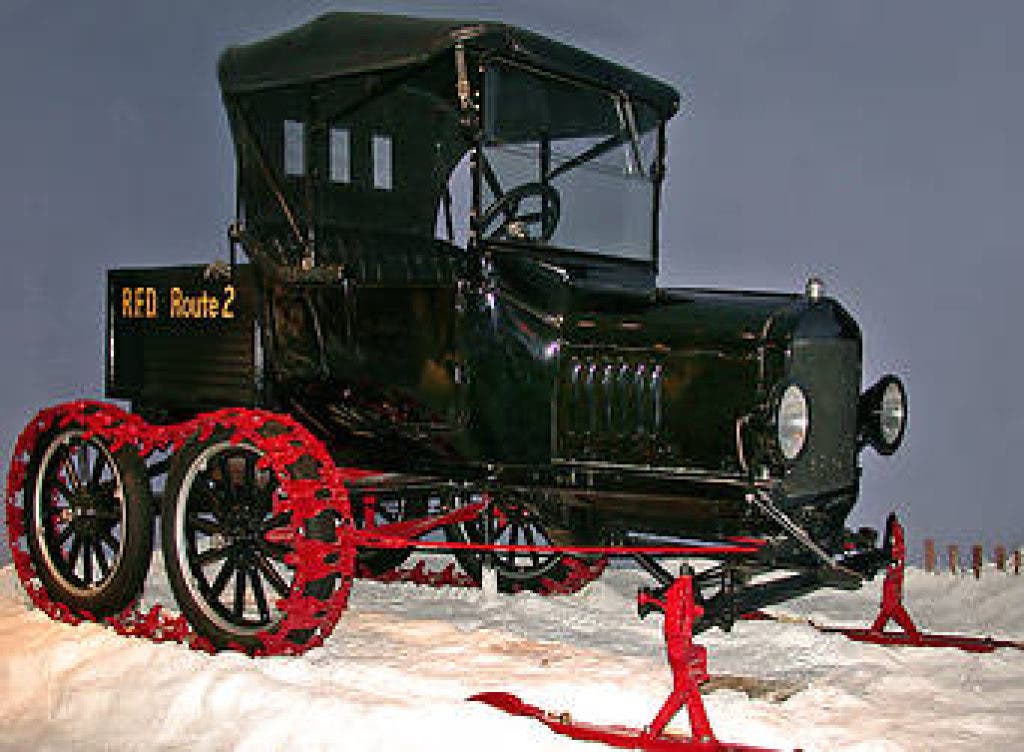
The next RFD man was Bertram Dewey who covered his route, summer and winter, by horse with either a buggy or a sleigh until 1917. After that time he began using his Model T Ford automobile in the summer. At this time in Granby, because there were very few paved roads and in winter the roads were not plowed, he continued to use his horse and cutter sleigh. Some postal carriers even employed the custom Model T "snowbird".
With our dependence today on immediate access to all known information, it is hard to imagine a time when it might take a week or more to hear from your closest friends and relatives.