Politics & Government
Popatunuck Mountain, Granby's Western Frontier
The Tough Life of Mountain Farmers in the 18th and 19th Centuries
Go west young man! In the 18th century, in the town of Granby, that meant settling on Popatunuck Mountain or Poppetunuck, as the early Algonkians called it. This rugged country was, for the early Salmon Brook settlers, the western edge of civilization and bounded by what they referred to as “the wilderness."
The “mountain” is the area bounded roughly by the Moosehorn Brook on the west; the Salmon Brook (west branch) on the south; the Mountain Brook on the east and the Ring Brook to the north.
In the 1700s there were just two roads that traversed over Popatunuck, but the only one still in use today is Silkey Road. The other street was Messenger Road, named for the family that farmed much of the property up there but subsequently saw the road abandoned by the town of Granby in the late 1800s.
Find out what's happening in Granby-East Granbyfor free with the latest updates from Patch.
The Messengers were a poor family that moved to Salmon Brook in the early 18th century and were a part of a group of early English settlers who could not buy land anywhere in New England unless it was exposed to attack from the natives. In 1750, Nathaniel Messenger purchased a mountainous and heavily wooded parcel on Popatunuck that he dreamed of turning into a beautiful and prosperous farm.
Just four years later the French and Indian War broke out in New York and threatened to reach the western parts of Granby which discouraged many from settling west of Bushy Hill. As the war dragged on, many of the young entrepreneurs who had started to build on the west branch of the Salmon Brook began to fear for their businesses.
Find out what's happening in Granby-East Granbyfor free with the latest updates from Patch.
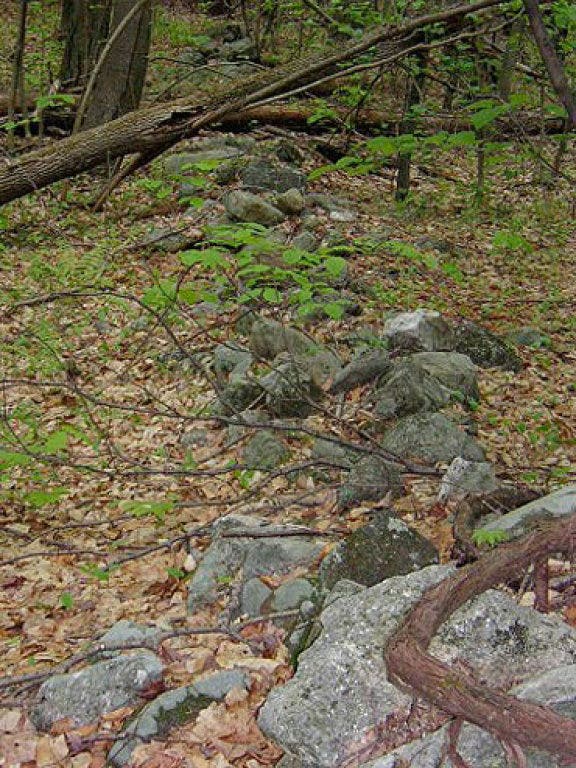
Nathaniel and his wife Eunice, nevertheless, made the most of their property and, while raising a large family deep within the mountain, continued to buy and clear more adjacent parcels of land they hoped would be farmed one day by their future generations. Like so many early settlers, they dug up and somehow moved huge boulders and rocks with which they formed boundary lines and kept their cattle from straying. Today, anyone walking these woods cannot fail to see the testimony of the energy and ambition of these young pioneer families.
By the time of the American Revolution, more folks moved into what is now West Granby, but even still, the Messengers remained relatively isolated within the rugged slopes and ledges of the Popatunuck. Having a relatively thin or non-existent top soil, and no way to easily plow the rocky mountain soil, they found they could do quite well selling timber at a time when New England was in need of good lumber. They also raised sheep and hauled wool and timber to the nearby carding and saw mills on the Salmon Brook.
The one crop that did thrive however in this rocky terrain was the apple. Apples were an amazing product to the early American. They ate them fresh, but also found they could store some varieties most of the winter. Apples could be dried, made into apple butter, made into pies, squeezed into a cider beverage but also, to the horror of the local minister, it could be distilled into the very potent (and tempting) cider brandy.
Getting their products to market was not easy because the road we know today as "Old" Messenger Road was really not a road at all. Early on, the town selectman refused to survey and make the roadway an official town road primarily because of the great time and expense it would take to maintain. So the Messengers had to keep it up themselves and count on the good will of the owners of adjoining parcels to do the same. It was over a mile in any direction to a "town” road and they regularly traveled: east down Creamery Hill Road to the meetinghouse, south to the mills and north to the new that were beginning to appear in the late 18th century.
By the time the third generation came along, there were four families raising children and trying to carve out a living on Popatunuck Mountain. The going was getting rougher and rougher traveling down their little street as more clearing brought torrents of water down the mountain that continually washed out their old road.
But things were improving in other ways as more and more farmers populated the western hills of Granby. Town elections allowed the Messengers and other hill farmers the power to win election to town government, including one for a position that was considered minor and burdensome: Surveyor of Highways. For the Messengers, this office turned out to be the key to their survival.
When the state assembly passed a law that required all taxpayers to work on their town's roads and bridges based on the value of their property, this afforded Daniel Messenger, the new "surveyor of highways," the opportunity to recruit townspeople to work on roads that needed the most work. It never occurred to the men working on Daniel's road to ask if the road was an "official" town road and so for decades the Messengers were able to keep their roadbed passable and in good repair.
However, things never stay the same for long and as the 19th century moved forward, the temperance movement and the refinement of the character of the Granby citizen began to take hold. For the Messengers, their best cash crop, cider brandy, became less popular and much less socially acceptable. At the same time the center of Granby started to be refreshed, upgraded and became a progressive and fashionable place to live.
The fourth generation of Messengers was getting tired of trying to herd their few cows and sheep, logging, hunting, fishing and distilling cider on the rugged Popatunuck Mountain. In the 1890s, when property values in the ”valley” became more affordable, they left their old homes on the mountain and took the opportunity to buy good “brook” land, located on real town roads, which for them and for their families seemed the best thing to do.
In 1899, the town officially abandoned their “non-road” completely which left the remaining Messenger Road residents with no choice but to abandon their old homes. Still they continued to harvest timber for lumber and produced charcoal for the brick kilns of Granby.
Many members of the Messenger family stayed active in town government and the Granby DPW well beyond the middle of the 20th century.
Although a 21st century court judgment deemed many of the Old Messenger Road parcels “build-able," the cost of getting electric power and a good road up the Popatunuck continues to bedevil all who consider building in this location even to this day.
Today much of the Popatunuck property is in open space and is either owned by the town or the Granby Land Trust. These parcels feature amazing water falls and cliffs of pure stone. Large parcels include additions like The Schlict Preserve and the most recent acquisition, The Garmany Preserve.
Hiking this "ghostly" old trace of road today, with its abandoned cellar holes and stone walls that disappear into the thick forest, makes one wonder why anyone would choose to farm land that is so filled with boulders, drenched with surface water and isolated in these remote Popatunuck hills.
Thanks to Mark Williams for the inspiration and research for this story.