Politics & Government
The First Meetinghouse at Turkey Hills
East Granby's first church was built in 1738.


The colonial settlers of Turkey Hills persisted in their request to be allowed to have their own church, which would be more convenient to their settlement, because as their petition in 1729 stated: being remote from public worship of God at the south part of town we can't without great difficulty give our attendance there ...
Finally, in 1736, after 24 years of protesting, this little group of citizens was permitted by the Connecticut General Assembly to become a separate ecclesiastical society within the town of Simsbury. At the same time, both the Salmon Brook and Wintonbury Ecclesiastical Societies were also formed and, from that point forward, the southwestern section that included the center of Simsbury was known as the First Society.
Building a meetinghouse was the first major project for the people of Turkey Hills because colonial law required each ecclesiastical society to provide one. Again, the all-too-familiar question arose: Where should the meetinghouse be built? Once again, the settlers turned to the General Assembly to settle the issue.
Find out what's happening in Granby-East Granbyfor free with the latest updates from Patch.
The special committee chose a central site "in or against Samuel Clark's land." The property is across the street from the present-day School Street south of the shopping mall in East Granby center.
It seems that some things never change, because Samuel Clark strongly objected to having the meetinghouse built so near his newly constructed, high-style mansion home. The proposed building was to be of "rough construction" and Clark likely envisioned horses, oxen, carts and sleighs all over his front yard during church services because the society had no plans for a horse shed.
Find out what's happening in Granby-East Granbyfor free with the latest updates from Patch.
At a town meeting, Samuel Clark was even accused of getting his hands on Turkey Hills' deed of highway from the town clerk by "some unjust means" before it could be recorded. It seems the building was to sit half way on Clark's property and half on the highway! Although it was seen by some as an attempt by Clark to foil the building plans, the society was undeterred.
By October 1738 the frame of the new meetinghouse was raised. In the following year, the roof was shingled and the society purchased siding and nails. Clark still staunchly refused to sell the society the land on which they were building and, by October 1739, Samuel Clark had built a fence around the construction site. Though the society sent committee after committee to appeal to Clark and in spite of the fact that they paid him 20 pounds for damages, the fence remained until his death in 1771. Joel Clark, Samuel's son, finally granted to the land to the society in 1773.
The unpainted wooden meetinghouse had a cut stone foundation which was described in old records as "40 feet in length and 35 feet in breadth; and 20 feet between joints." The gables faced on North and South with the broadside towards the road. The 1793 drawing shown here is a long accepted representation of the first meetinghouse which also shows "the great door" in one of the long sides.
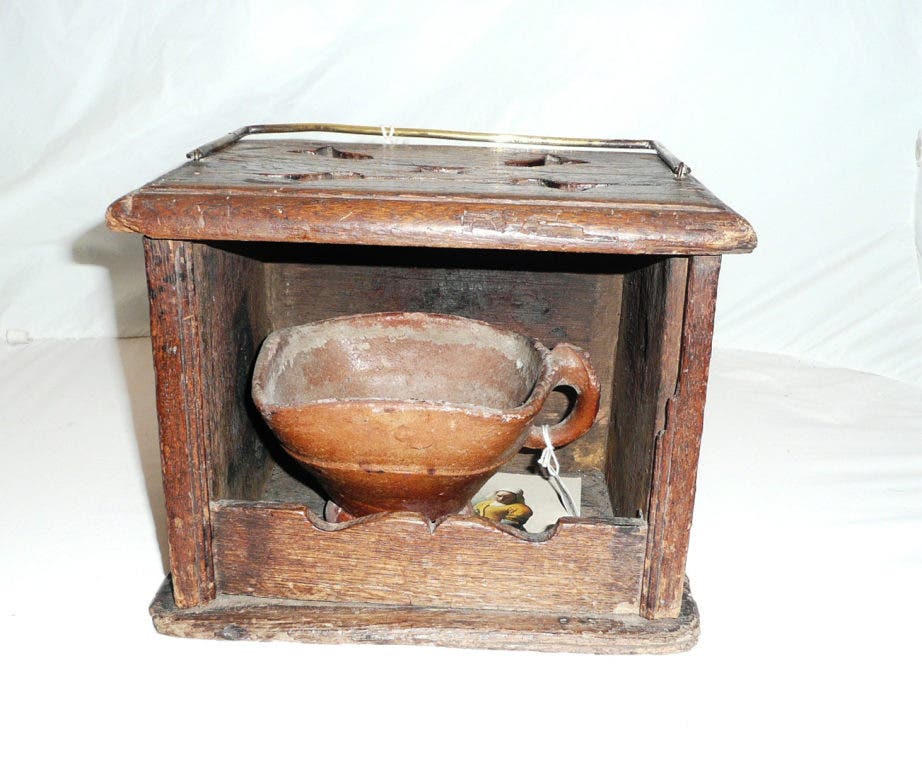
This Great Door is believed by Lee David Hamberg, a local historian, to be one of the renowned Connecticut River Valley Doorways which began to be constructed by itinerate joiner/craftsmen in this part of New England beginning in the mid-18th century. The more dignified seats also were constructed with closable sides that helped keep down drafts and made the hand-carried foot warmers more effective.
The building had no chimney and thus no means to heat until 1828 when a stove was installed with a stovepipe run out a window. The building finally received a steeple in 1798 although no bell was ever hung. It was not uncommon in early New England for townspeople to be summoned to meetings with the use of a or in some cases the raising of the flag.
Just when the building was sufficiently completed to be used for services is uncertain; however, society meetings were being held by 1744, according to historic references. In 1748, the parishioners voted to finish the interior walls "up to the girts," probably with wood sheathing. At the same time they also voted to build a raised pulpit with a canopy, which would help to project the speaker's voice.
In 1749 the seats in the meetinghouse were "dignified," which was a way in which seating was assigned precedence based on distance from the pulpit. A committee was set up to assign seating according to a man's age and amount of taxes he paid. Those who paid no taxes and were 16 years of age or older were seated according to their age alone. In this way, the poor and the young were consigned to sit under the staircase or in the gallery.
The more dignified seats also were constructed with closable sides that helped keep down drafts and the made hand-carried foot warmers more effective. By 1775, the society had grown until there were people regularly standing in the gallery. The gallery probably went along three sides of the second floor under the open ceiling. That year the society voted to allow people to build their own pews if they wished and also voted to have seats built for the black parishioners.
The Turkey Hills Ecclesiastical Society also owned and cared for the parish’s first cemetery. As far back as 1722, the Simsbury town meeting allowed that the people of Turkey Hills "shall have the liberty of a burying place to bury their dead if they purchase a place for the same." The site chosen was John Owen’s sheep pasture near the center of town where to the cemetery today remains. The location was important because men carried the coffin on their shoulders to the gravesite regardless of how great the distance might be. Although the oldest grave is dated 1738, there may be some unmarked graves that were earlier. It was also not uncommon to be buried at home, especially if the person died of a highly contagious disease.
In 1830 the Turkey Hills Society voted to tear down the almost 100-year-old wood structure and build one of stone. The total cost, including the bell, was $3,800.66! It still stands today and welcomes the community every Sunday morning.
Please return to The Granbys Patch next week for a discussion of what church life was like in an 18th century New England community.
Thanks to Mary Jane Springman and Betty Finnell Guinan for material included in today’s article.