Community Corner
The History of the McLean Game Refuge
Sen. George P. McLean gave Granby an extraordinary legacy.


"I want the game refuge to be a place where some of the things God made may be seen by those who love them, as I loved them, and who may find in them the peace of mind and body that I have found." From the will of Sen. McLean.
Upon his death in 1932, Sen. George P. McLean gave to Granby an extraordinary legacy, when he left over 3,200 acres for a game refuge. Starting in the early 1900s, he began acquiring abandoned farms and wild land near the Granby/Simsbury town line. In these woods, he found respite from the pressures of state and national politics which occupied the better part of his adult life. McLean hunted and fished this land, sharing it with presidents Coolidge, Taft and Hoover, along with Gifford Pinchot, first chief of the U.S. Forest Service.
Twenty years earlier, in 1912, McLean met Amos Everett George, a Pequot Indian who became the caretaker of his lands. This man, whom McLean referred to as his watchman, built trails and huts throughout the refuge and very quickly became someone McLean relied upon for his woodcraft and wisdom. Amos George served in this role until 1947, when Amos’ son Henry took over and served the Refuge until the arrival of Steve Paine, who remains as the current watchman.
Find out what's happening in Granby-East Granbyfor free with the latest updates from Patch.
Today we can all enjoy over 20 miles of hiking trails, as well as two horse trails traversing the site. The Refuge is known as a beautiful and prolific bird watching site. Many species of birds, including Pileated Woodpecker, Blue-headed Vireo, Winter Wren, Hermit Thrush and Blackburnian Warbler, are commonly seen.
Vegetation in the area varies with the terrain, but can include chestnut, oak, beech, birch, maple, and hemlock. Shrubs include huckleberry, blueberry, and Mountain laurel. Since this area had been logged for timber and charcoal before McLean purchased it, many of these are stump sprouts.
Find out what's happening in Granby-East Granbyfor free with the latest updates from Patch.
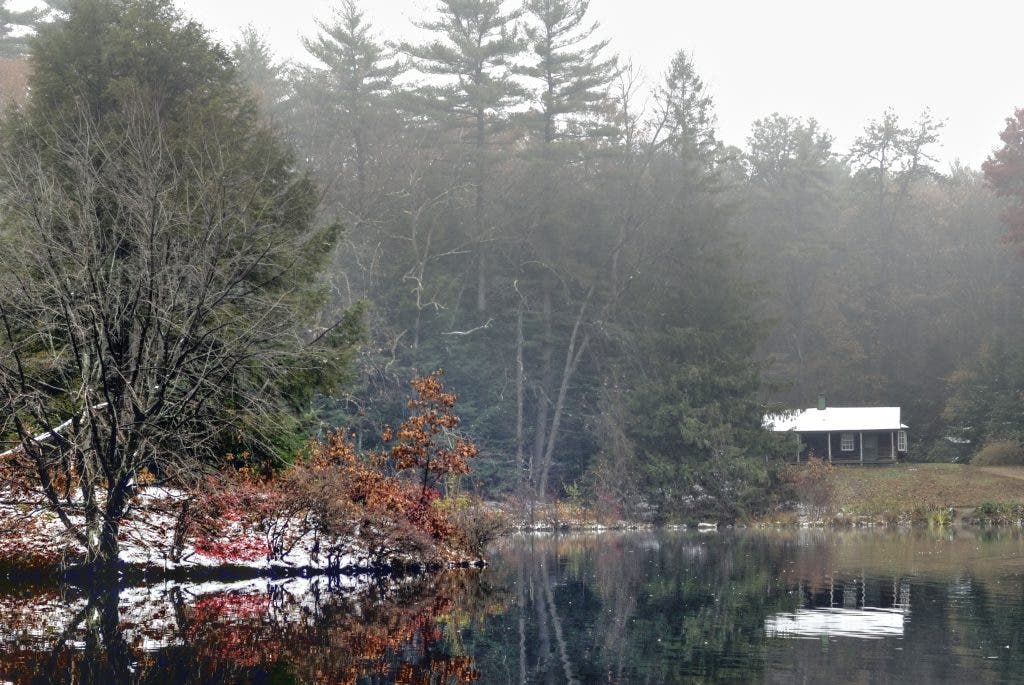
Three stunning bodies of water including Spring Pond, Kettle Pond and Trout Pond are sprinkled throughout the Refuge in addition to the magnificent Bissell Brook with its spectacular waterfalls and cascades. Trout and Spring Ponds were actually created with the help of Amos George by damming parts of the Bissell Brook.
Over the years the Trustees have made it a goal to expand the Refuge to natural boundaries. Using roadways and streams as property lines, limited interfacing with residential development helps preserve the goals of Sen. McLean and provides better protection for the wildlife. With over 1,800 acres designated by the National Park Service as a National Natural Landmark, it is the largest site in the State of Connecticut.
Another major concern has been to maintain the balance of uses that Mr. McLean envisioned for the Refuge. Because over 100 years has passed since the beginnings of the Refuge, a crisis began to challenge the Board around the year 2000. Simply stated, the natural process called forest succession occurs when pastures or hay meadows grow up to weeds and brush after the cows have left or mowing has ceased. When this occurs, certain wildlife like pheasants and quail no longer find habitat suitable to their needs. Habitat restoration to maintain an environment for this mixed habitat was a primary goal left in Senator McLean's will. It seems that without an effort to restore the refuge to it original state, a climax forest situation is inevitable. Thus, a controversy arose in the recent years when the Board voted to begin this habitat restoration which was judged by some as "logging the Refuge"! There already evidence of dramatically more vibrant bird life in the areas where restoration was completed.
Despite the encroachment of “civilization,” in 1981, a Yale study of the Refuge noted 19 fish species, 17 amphibian species, 17 reptiles, 194 species of birds and 42 mammals. Sixteen of these species are considered rare or endangered.
In addition to land, McLean is sustained through the vision and foresight of the endowment from Sen. McLean, and charitable contributions from the community including annual gifts, bequest gifts and memorials.
The Refuge is not a static, but in fact, a growing concern. The Trustees of McLean have actually added over a thousand acres to the Preserve since the senator's death, thanks to individuals, families and the state of Connecticut. In the past few years, new home developers have donated part of the land area to the Refuge as part of the subdivision approval process. The most interesting story, however, is that of a homeless man from Hartford, whose contribution of his life savings helped purchase a large section of property worth over $2 million!
Today the McLean Game Refuge consists of over 4,400 acres of land in Granby and Simsbury (80 percent is in Granby) and is open to the public. The Refuge has always been open to the public for free for passive recreation and photography. Please explore www.mcleangamerefuge.org and enjoy the many trails, picnic areas, and habitat. If you do, take nothing but pictures and leave nothing but footprints!