Politics & Government
CL&P, Towns Have Work to Do, Consultant Found
Document contains 27 recommendations to improve preparedness in the event of another major emergency.


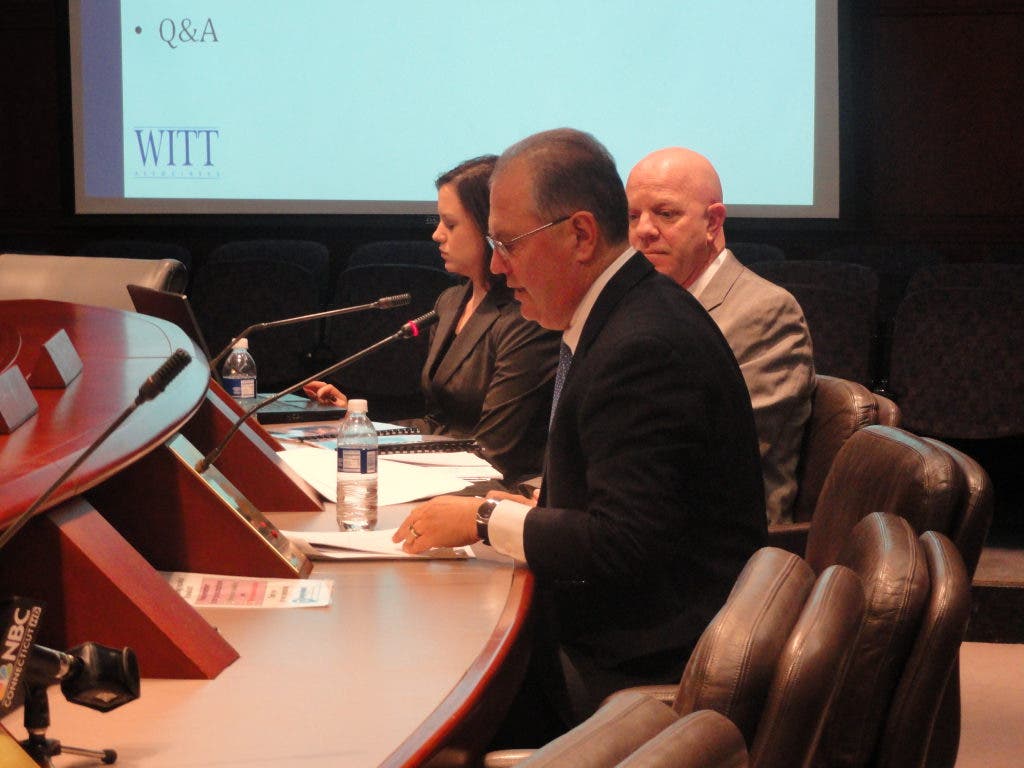


After studying Connecticut Light & Power's response to the October snowstorm, Witt Associates offered 27 recommendations to improve the utility's preparedness and response for the next major emergency.
The emergency-response consulting company, asked by Gov. Dannel Malloy to review the CL&P and United Illuminating response, presented its findings before the governor’s Two Storm Panel at the Legislative Office Building in Hartford Friday. They had recommendations, too, for the state and municipalities.
The report and subsequent presentation by Charlie Fisher, vice president of preparedness operations, and Phillip Webber, project manager for Witt Associates, broke down the recommendations into the following five broad categories in bold that are quoted directly from the report:
CL&P should improve its planning, procedures, training, and pre-staging practices to adequately prepare its crews and resources for the scale of incidents it and its customers potentially face by significantly increasing the scale of planning scenarios.
As an example, Fisher told the Two Storm Panel that the previous worst-case scenario that CL&P had in place was for 10 percent of its customers to lose power. At peak, 809,097 customers — about two-thirds of CL&P’s customer base — lost power as a result of the October snowstorm. The Witt Report recommends that the utility should have a plan in place that considers a 50 percent outage.
In addition, prior to the storm, just 30 crews from New Hampshire were pre-positioned for the snowfall, while CL&P’s in-state field staff were just put on call, Fisher said. In the end, mutual aid — the policy that utilities from other states provide help to other utilities in an emergency — worked, but only up to a point.
“This was a scramble for resources,” Fisher said to the panel.
Also, while the town liaison program, which assigns a CL&P representative to each municipality, is a great concept, more training was necessary to make the program more effective, as liaisons often did not have information or technical expertise necessary to answer questions, which led to “credibility” issues later on, Fisher said.
“The town liaison program has not been fully developed into the culture,” Fisher said.
CL&P needs to develop its management scalability for large-scale incidents by implementing an Incident Command System (ICS) structure that expands with the requirements of the incident.
Fisher said that in the power outages resulting from the October snowstorm, one individual, former CL&P President Jeff Butler, was running the operation to restore power, acting as the liaison to the state Emergency Operations Center and to the governor’s office and serving as the public spokesperson.
“That’s an awful lot to ask one individual to do,” Fisher told the panel. “We recommend the company to delegate the responsibilities to people who have that skill set so people can focus on their major tasks. … We recommend that the company establish an executive group to oversee the restoration effort, not the operations people, so the operations people can focus on the job.”
CL&P needs to improve its processes for information management, including message vetting, communication, and coordination with local governments, and the dissemination of public information to its customers, external partners, stakeholders, and the media. During a large-scale outage, it can be as important to communicate the restoration plan and progress toward implementation of that plan, as it is to restore power itself.
Fisher told the panel that the goal for 99 percent statewide restoration and 99 percent restoration in each town by Sunday, Nov. 6 was an “internal stretch goal” that should not have been made public.
“In our opinion, that caused some unnecessary frustration in the focus of the overall restoration effort,” Fisher said.
In addition, one of the things the Witt Report noted that CL&P did well was to make itself available to customers through a variety of tools and media, such as text messaging. But oftentimes the company did not deliver information that addressed specific towns or customers, but instead offered global assessments of the restoration.
CL&P should more closely coordinate and integrate preparedness activities with state and local governments to include ongoing planning, training, and exercise for utility disruption.
This group of recommendations dovetailed with a global recommendation that “[s]tate and local government planning and preparedness should address major power disruption more comprehensively and inclusively, including coordination with utility providers and procedures for damage assessment teams in power and/or utility outage events.”
“Where it’s good that you have a plan and I have a plan, it’s often better that we share that planning process,” Phillip Webber, Witt’s project manager, told the panel. “Nobody responds in a vacuum. Nobody responds alone. There’s inter-dependencies.”
Webber said that the idea was to “get together when the sun is shining and you share your information and you share your expectations [then] you are going to have a better result in the end.”
The trick, according to Webber, was coordinating the 149 towns that CL&P serves with the utility to approach the issue in a scalable, regional fashion.
“The success will come from the preparedness activities,” Webber said. “And preparedness is three quarters of the battle.”
“It starts with a training exercise program,” Webber said. “It doesn’t start with the agreement that we’re going to have an exercise.”
Webber cited Florida, Georgia, New York and New Jersey as states that engage in best practices in terms of state, local and utility emergency preparation.
In addition to those recommendations, the Witt Report also recommended mitigation — such as vegetation management and CL&P system hardening — to reduce the impact of the next disaster.
During the presentation, panel co-chair Joe McGee pointedly asked Fisher to grade CL&P’s performance.
“Their own internal model predicted that they would get back by Wednesday [Nov. 9],” Fisher said.
“Then why did they say we’d be back by Sunday?” McGee asked.
“They said 99 percent by Sunday,” Fisher replied. “Our point is that internal stretch goal became the public goal.”
McGee pressed further, asking for a proper “benchmark” for how many homes are restored per day.
“The answer to your question is going to be a function of the type of event,” Fisher said. “There’s no one who is going to tell you a specific number should be done.”
After the presentation, Al Lara, a spokesman for Northeast Utilities, CL&P’s parent company, told reporters that his company was reviewing the Witt Report and that some of the recommendations — such as creating positions to specifically deal with emergency preparedness — have already been implemented.
“We’re looking forward to partnering with the state and the towns as we work to be better prepared for the next event,” Lara said. “We’re looking at the recommendations as opportunities to enhance and strengthen the emergency preparedness of our company and for our customers. … There are a number of issues we need to look at. The Witt report was very comprehensive looking at that. We share many of the findings that they have, but we need some time to digest that and take a look at that.”
Lara said that among the major issues that CL&P was examining was expanding its worst-case scenario model as well as managing customer expectations as to when power can be expected to be restored in the event of a major outage.
“We know we let our customers down,” Lara said. “And especially the towns down by not being able to give them enough information to prepare for their shelters, to prepare for their own services. That’s going to be a major thing that we take a look at.”
Lara said that he knows the company has a lot of work to do.
“With the last storm, we had two months between Irene and the October snowstorm, so we know we have very little time to work with,” Lara said.
Get more local news delivered straight to your inbox. Sign up for free Patch newsletters and alerts.