Politics & Government
36th State Senate Candidates Debate At Greenwich Town Hall
The candidates took part in a debate hosted by the League of Women Voters of Greenwich, Stamford and New Canaan at Greenwich Town Hall.


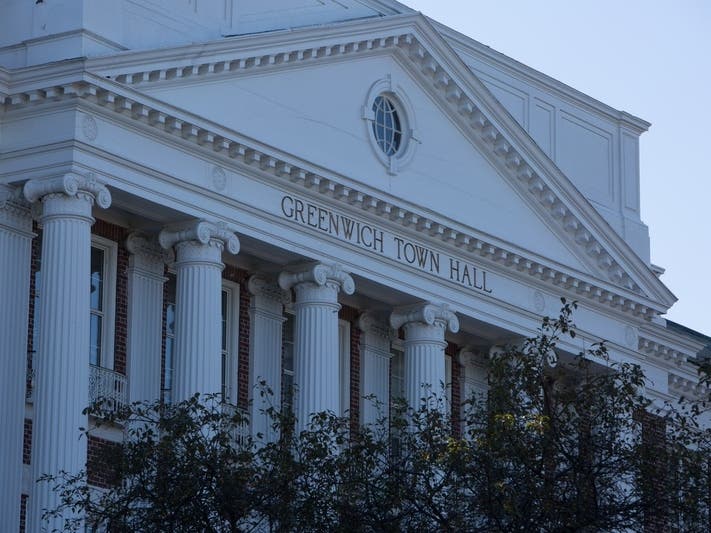
GREENWICH, CT — Candidates for the 36th State Senate seat squared-off last week before the Aug. 17 special election. The position, which covers all of Greenwich and a portion of Stamford and New Canaan, opened up unexpectedly in June when Democrat Alex Kasser resigned.
John Blankley (petition candidate, Independant), Ryan Fazio (Republican) and Alexis Gevanter (Democrat) took part in a debate hosted by the League of Women Voters of Greenwich, Stamford and New Canaan at Greenwich Town Hall. The debate was broadcast to an audience via Zoom. The trio also participated in a debate last Tuesday.
The candidates touched on a variety of topics, namely traffic and congestion, utilities and infrastructure issues, and the unfunded pension and debt liability in Connecticut.
Find out what's happening in Greenwichfor free with the latest updates from Patch.
When asked how to address transportation issues and snarled traffic on local roads and highways, Fazio said noise and traffic studies should be conducted by the Connecticut Department of Transportation. He said traffic is one of the issues he hears most from voters.
"From exit 2-9 on I-95 in the daytime is almost persistently a parking lot. That's totally unacceptable. I've lived in this district for almost my entire life, and it seems like traffic only gets worse and worse in one direction," he said.
Find out what's happening in Greenwichfor free with the latest updates from Patch.
Fazio also said the DOT should focus its resources on Metro North Railroad, rather than upstate on other projects. He called Metro North "probably the most important railway in the country.
Blankley said he'd champion an initiative that would take trucks off the road by putting them on ships that would go into various ports on the coast.
"It's a shipping solution that involves port development in Bridgeport and New London, Rhode Island and Massachusetts. All the trucks and containers we see going over our roads are mostly coming from New Jersey where they land from international sources and they come up to destinations in our state and beyond our state," Blankley said. "What we should be doing is putting those trucks on roll-on and roll-off vessels that would take the trucks on and they'd come to our ports."
Blankley suggested the construction of a new railroad bridge across the Hudson River would help as well.
Gevanter said traffic "impacts quality of life, health and the environment." She said investing in infrastructure would attract businesses and residents to Connecticut and create good paying jobs.
She said money coming into the state from the federal infrastructure bill could be put to use in the 36th District.
"I have a wonderful relationship with our federal delegation and also with our state delegation, and so I'm going to make sure from day one to direct as much money from there as possible for our trains and for our roads," she said.
Gevanter stated she wants to invest in the Stamford Transportation Center, and bring more frequent direct Metro North service to New Canaan.
"I will do all of this without raiding our rainy day fund or borrowing our way out of this," she said.
On the issue of water shortages and prolonged power outages because of storms around the state, Blankley said he'd look towards investing in alternative sources of energy, such as wind and solar.
"We unfortunately have one of the highest costs of electricity in the country. Part of that is because we rely on natural gas and the price of natural gas fluctuates in terms of electricity generation," he said. Blankley noted that he supports Gov. Ned Lamont and his approach to dealing with utilities and holding them accountable for reliable service.
Gevanter spoke about climate change and called it "an existential crisis for our planet."
"Every Connecticut resident and business is incurring the cost from it because of ongoing inaction in our government. There's rising health care costs, soaring childhood asthma rates, flood damage to our homes, flood insurance is going through the roof, and there are unreliable global supply chains and soaring electricity bills. It's absolutely a nightmare," she said.
Gevanter said she supports exploring the Transportation Climate Initiative, or TCI.
"This would be working with neighboring states, a regional approach, which I think is really important, to levy fees on oil companies to fund climate change action," she said, noting that it would raise gas prices by five cents per gallon but cost drivers $32.80 a year.
Fazio called it a "gas tax on Connecticut motorists and the middle class", and argued that the increase could be anywhere between five cents and 26 cents.
Fazio blamed Democrats for permitting Eversource to expand its monopoly power vertically into power generation.
"Just a couple of years ago, the Democratic state legislature voted a new power contract that was 50 percent owned by Eversource into law, the cost of which, outside of New London, was three times as high as the average electricity generation cost in the state," Fazio said. "We need an all of the above energy approach in order to reduce costs, improve reliability of the electricity grid, and make it easier to do business here, to live here and to afford to be in Connecticut. We need an open and competitive bidding system for all electricity contracts. Currently too much is done behind closed doors."
Blankley said as an independent candidate, he's not "beholden to either party or the ideologies of either party" and that he agreed with points made by his opponents.
"It is an existential matter that we're dealing with," Blankley added. "One small step is what TCI is, and I say let's take it."
On the unfunded pension and debt liability in Connecticut, Gevanter said the issue was "caused by 40 years of mismanagement by both parties." But she explained Connecticut is "on the right path to recovery."
"Gov. Lamont, along with our legislature, passed a bipartisan, no-tax increase budget that also goes to pay down our pensions, and also contribute to our rainy day fund," she said, pointing to a helpful volatility cap. "We need to continue to be fiscally responsible so that we can continue to bring companies and new, good paying jobs into Connecticut, and having a financially stable economic environment is what's going to be really important for that."
Fazio said Gevanter was right in that the problem is a manifestation of 40 years of mismanagement.
"What she doesn't mention is that 36 of 40 of those years, the Democrats have had complete control of the state legislature in Connecticut," he said. "This is a consequence entirely of the failed leadership of the party in power in Connecticut. It goes to show that when governments go too far in the extreme of either direction, that you have corruption and you have bad government."
Fazio said the volatility cap was a product of a Republican budget that was passed into law in 2017 when the State Senate was split 18 to 18.
"When the numbers are such we had a split in the state legislature, it forced compromise. We need close to those numbers again in order to make positive reform so that the middle class can thrive in the state, we can stop tax increases, and we can reform our debt and unfunded pension liabilities," Fazio said.
Blankley criticised Fazio for not addressing the question, calling his answer "all politics."
"I just don't think your rhetoric matches reality," Gevanter added.
Blankley said he'd increase economic growth by investing in infrastructure, and get a higher rate of return on assets by investing privately.
Get more local news delivered straight to your inbox. Sign up for free Patch newsletters and alerts.