It takes a more than just wishing to make your goal a reality.
If you’ve ever told yourself you wanted to make a change in your life, you know that your best intentions alone aren’t enough to make it happen.
SETTING GOALS
Find out what's happening in Greenwichfor free with the latest updates from Patch.
Setting goals is a powerful process of:
· Thinking about what you’d like to be different in your life
Find out what's happening in Greenwichfor free with the latest updates from Patch.
· Providing yourself with the tools and skills to take action
· Motivating yourself to turn your desired change into a reality
CASE MANAGEMENT & GOAL SETTING
As a Board Certified Case Manager, one of my key roles is to help assess a client’s abilities and needs; and develop a written care plan. A care plan serves as a road map to address the client’s unique needs and desired changes.
A successful care plan is designed to link the client’s needs that were identified during the initial assessment with specific measurable, realistic, strength based and actionable / achievable goals.
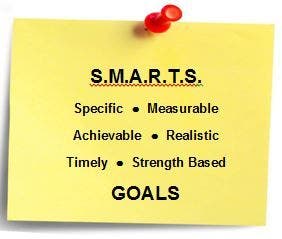
A helpful tool in the development of a client’s care plan is what is referred to as “SMARTS - Goals, Objectives and Tasks”.
SMARTS – GOALS, OBJECTIVES AND TASKS
SMARTS is an acronym that stands for:
S = Specific
M = Measurable
A = Achievable
R = Realistic
T = Timely
S = Strength Based.
Here is an outline of the six step process used for SMARTS Goals, Objectives and Tasks
I’ve included an example of how SMARTS would be used for a person who has a goal of losing weight.
1. SPECIFC - Goals, Objectives and tasks should specifically identify what the person wants to achieve
- A goal is ultimately the outcome you want to achieve.
An example
Susie wants to lose 5 lbs. before my son’s wedding, which is in ten weeks.
- An objective breaks each goal down into smaller steps, and identifies the specific actions that must be completed in order to achieve the goal.
An example
Susie plans to stop baking deserts every week, will substitute fruit for her usual evening desert, and she will take a walk every evening.
- A task is a specific set of steps taken to achieve the stated objective.
An example:
Susie will buy fruit each week when she goes to the grocery store, to have in place of my usual desert.
Susie has asked her husband to walk with her every night after dinner, to which he’s agreed.
Susie also arranged for her friend Mary to walk with her, on those occasions when her husband may have another commitment.
Susie will weigh herself each morning and record the information on her chart.
2. MEASURABLE - A person should be able to measure whether the goals, objectives and tasks are being achieved.
An example:
Susie will create a chart that keeps daily track of her fruit vs. previous desert choice, nightly time spent walking, and daily morning weight.
3. ACHIEVABLE - Are the goals, objectives and tasks achievable and attainable?
The example I am using here is achievable; in that it is possible to lose 1 lb. every two weeks, or a total of 5 lbs. over the course of ten weeks; with specific changes in behavior.
The important thing to look at here is Susie’s level of determination, commitment, and willingness to focus on and complete her daily tasks.
An example:
Susie has asked her husband to join her in evening walks, which will help provide her with support and encouragement. In addition, Susie will keep track of her progress on a daily basis, which will keep her goal, objective and tasks in the forefront of her mind.
4. REALISTIC - Can the person realistically achieve the goals, objectives and tasks with the resources he or she has?
It is more realistic to set a goal of losing 5 lbs, in 10 weeks, than it is to set your sights on losing 30 lbs. in that same time frame..
It would be important for Susie to ask herself, how badly does she want to achieve her goal?
In other words, what are the potential rewards or consequences of not achieving or not achieving her goal in a 10 week time frame?
It will also be important for Susie to identify any potential distractions or special occasions that may occur that might cause Susie to lose focus, and determine how Susie will make adjustments to stay on track. An example may be that Susie has a birthday party on Friday evening, but she plans to walk in the afternoon, and Susie will bring a fruit salad to the party to eat and share with others.
5. TIMELY- Is there a specific timeframe set for each goal, objective and task?
In this particular example, there is a clearly mapped out timeframe of 10 weeks, with specific objectives and tasks to be completed on a daily basis.
6. STRENGTH BASED - Were the person’s strengths and resources used in developing the goals objectives and tasks?
In the example of Susie, she made a point of sharing her goal with her husband and friends, and building in a support network to help her stay focused on her goal, objectives and tasks.
GOAL SETTING & MOTIVATION
In the late 1960s, Edwin Locke conducted pioneering research into goal setting and motivation, which lead to our modern understanding of goal setting.
Mr. Locke’s research findings have shown that there is a direct correlation between the articulation of SMART goals and the successful accomplishment of tasks.
Photo modified from Microsoft
The information in this article is provided as an information resource only, and is not to be used or relied on for any diagnostic or treatment purposes. This information is not intended to be patient education, does not create any patient provider relationship, and should not be used as a substitute for professional diagnosis and treatment.
Please consult your health care provider for an appointment, before making any healthcare decisions or for guidance about a specific medical condition.
___________________________________________________________________________
The information in this article is provided as an information resource only, and is not to be used or relied on for any diagnostic or treatment purposes. This information is not intended to be patient education, does not create any patient provider relationship, and should not be used as a substitute for professional diagnosis and treatment.
Please consult your health care provider for an appointment, before making any healthcare decisions or for guidance about a specific medical condition.
___________________________________________________________________________
Linda Ziac is the owner and founder of The Caregiver Resource Center. The Caregiver Resource Center is a division of Employee Assistance Professionals, Inc. which Linda founded in October 1990. The Caregiver Resource Center provides a spectrum of concierge case management and advocacy services for seniors, people with special needs and families.
Linda’s professional career spans more than 40 years in the health and mental health field as a CT Licensed Professional Counselor, CT Licensed Alcohol and Drug Counselor, Board Certified Employee Assistance Professional, Board Certified Case Manager, and Board Certified Dementia Practitioner. In addition, Ms. Ziac has 15 years of experience coordinating care for her own parents.
Linda assists seniors, people with special needs and their families; in planning for and implementing ways to allow for the greatest degree of health, safety, independence, and quality of life. Linda meets with individuals and family members to assess their needs, and develop a Care Team, while working with members of the Team to formulate a comprehensive Care Plan (a road map). Once a plan is in place, Linda is available to serve as the point person to monitor and coordinate services, and revise the plan as needed. This role is similar to the conductor of an orchestra; ensuring that there is good communication, teamwork, and that everyone remains focused on the desired goal.