Health & Fitness
The Night Sky: Perseus, Algol and the California Nebula
The Constellation Perseus and the blinking star Algol are high in the west after dark.


This picture of Perseus is a 33-minute exposure taken in September 2012 with a Canon T2i camera.
The constellation Perseus can be found high in the west this time of year. Perseus has star clusters and the California nebula inside its borders, but is most famous for the variable star Algol. Algol is labeled in the Perseus picture.
Find out what's happening in Greenwichfor free with the latest updates from Patch.
Algol is 90 light years away, and has a companion star that orbits Algol every 69 hours. By coincidence, their orbital plane is lined up with the Earth, so every 69 hours the companion star passes in front of Algol, and the total light we see from the two stars is reduced. This type of stellar pair is called an eclipsing binary; the total brightness of the two stars varies in a predictable time period. You might think that this sort of alignment is rare, but many eclipsing binaries have been discovered.
Algol was known to vary its light output for hundreds of years, as it can be seen to vary without optical aid. Countless studies of Algol and other variable star systems have taught us many things about how binary stars interact with each other, and how they evolve over time. For example: material is sometimes ripped from one star and transferred to the other in binary systems. This can cause strange changes to the life cycle of either star in a binary system.
Find out what's happening in Greenwichfor free with the latest updates from Patch.
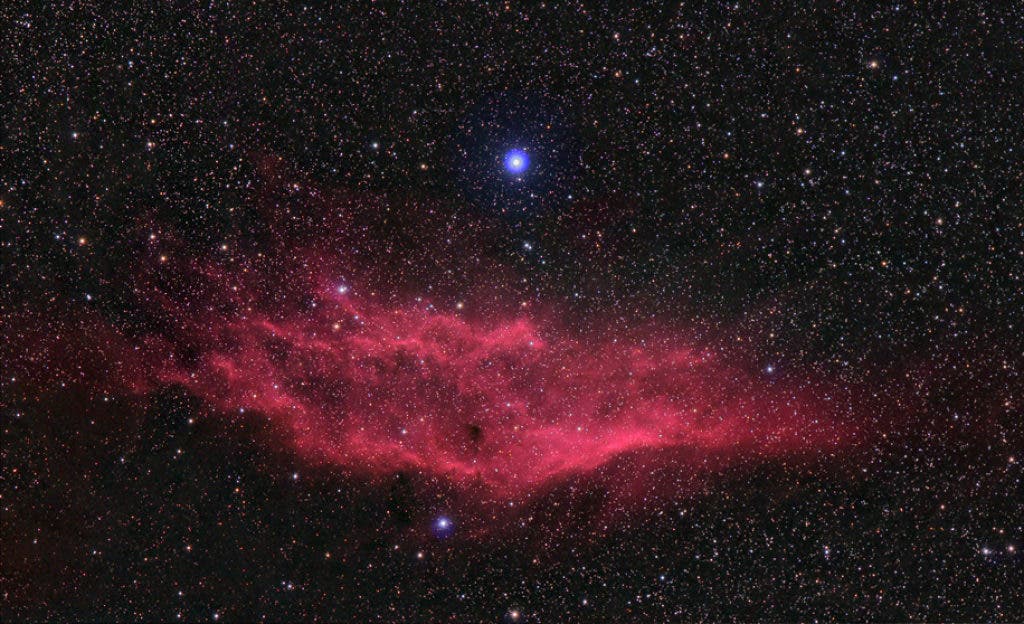
The California nebula is the red cloud located in the lower right of the Perseus picture. Refer to the second attached picture for a close up view of the California Nebula I took through a telescope. It is called the California nebula because its shape is said to look like the state of California. It is a huge cloud of gas 1,500 light-years away and about 110 light-years across. Made mostly of Hydrogen, the California nebula glows red from hydrogen being energized by the incredibly bright nearby star Xi Persei.
Xi Persei is the bright bluish star just above center in the California nebula telescope image. It is a Blue giant star 30 times more massive and over 12,000 times brighter that our Sun. If Earth were orbiting Xi Persei at the distance it orbits our Sun, the Earth would vaporize from the heat. Xi Persei formed long ago from the gravitational collapse of gases in the California nebula. Many more stars will form from this nebula in the future.
Starry Nights!