Health & Fitness
Are you a parent wanting to incorporate Montessori at home, or a parent trying to decide whether or not to send your child to a Montessori preschool or kindergarten, and want to learn more about the Montessori approach to education?


Here is a brief overview of the philosophy, learning environment, physical environment, and behavioral expectations in a Montessori program.
Introduction
Early childhood education should not be just about colors, numbers, and alphabets, but also about giving children the tools to become self sufficient, and independent individuals who are driven by a natural curiosity for knowledge. Montessori philosophy focuses on creating powerful learning environments to help children reach their fullest potential. The Montessori curriculum and teaching is developed by paying attention to the nature of the child at each stage of development. The goal of Montessori early childhood education is to help children cultivate a natural desire to learn, and to develop learning tools to apply in future learning situations.
Find out what's happening in Grotonfor free with the latest updates from Patch.
Physical Classroom Environment
In a Montessori classroom, emphasis is given to making the classroom beautiful and inviting to children. Clutter is minimized to help children be focused and calm. Even the walls are not filled with busy artwork and posters. All materials required to complete a learning activity are placed in a tray. Trays for different learning activities are placed on easily accessible shelves fostering independence and order. The classroom will have open spaces for "rug work"(child can roll out a rug, and bring an activity from the shelf to work on the defined space of the rug), small tables with one or two chairs so children have the choice of working alone or with a friend, separate curriculum areas such as math, language, geography, practical skills (also known as practical life area), sensory development (also known as sensorial area), cultural area, and a cozy library area. All materials required for children to care for themselves and the classroom environment (child sized watering can for plants, brooms, mops, etc.) are made accessible to children through out the day.
Find out what's happening in Grotonfor free with the latest updates from Patch.
Curriculum
Not what is taught, but how it is taught!
In Montessori, the curriculum is integrated. No subject is taught in isolation. Instruction is individualized. It is tailored to each child's learning style and developmental readiness and interest. Children do not have to wait for the rest of the class to move ahead or hurry to catch up if others move too fast. The classroom is equipped with different levels of learning materials to allow children to progress through the curriculum as their skills develop. All the activities are set up so that the children can independently work with them. They learn through discovery and demonstration. The teacher presents the lesson to an individual child (or a small group of children) to teach the vocabulary and the purpose behind an activity. The children can then work with the activity independently.
Reading and writing
In Montessori, great importance is given to vocabulary, sounds, communication and expression, and development of thought. Children are first introduced to sand paper letters. It is a multi sensory way of learning phonetic sounds and symbols of letters. Once all the sounds are learned, children then learn to put the sounds together to read words, and then sentences. To write, they turn the sounds in to letters (symbols).
Practical life activities, and the metal inset activities help them develop the fine motor skills, and co ordination required for writing. There are also many activities that will help with reading and writing even if children are not ready with the required motor skills. Some of these are: Constructing words, sentences, and even stories with Movable alphabets; activities such as matching objects to words; and games such as sight word bingo, and memory game of words.
Math
In Montessori, sensorial education lays a foundation to mathematics and arithmetic learning. Children from birth to five are in a sensitive period of refinement of senses and movement. Math concepts are presented in concrete form combined with an activity. This way, children understand that the number three is not just the symbol "3", but it represents the quantity attached to it. Children work with concrete quantities, then symbols are introduced, and then the symbols are linked with the quantity. It is a step-by-step process. Children work with the concrete material till the rule of the operation (concept) sinks in and the insight of abstraction comes from within. Children, as young as 4 years old, are introduced to large numbers of the decimal system. The concrete math material makes addition, subtraction, multiplication, division, squaring, cubing, and many other advanced math concepts easy and reasonable to children. All of these activities are always available and presented to children when they are ready.
Discipline and Motivation
In a Montessori classroom, everything has a place and easily accessible to children. All activities are setup in individual trays so that every thing needed to complete the activity is available. In the beginning of the school year, teachers spend a lot of time modeling to children how to carefully take an activity to a work space, work with it, set it up so it is ready for another child to use, and place it back on the shelf where it was first found. Eventually, this process becomes second nature to children in a Montessori classroom. This helps children develop a trust in their environment. Children are allowed to select activities that attract them, to relate to it without interruptions or limitations, and to discover ideas and solutions on their own. They are granted freedom, but within limits. Ground rules are established right from the beginning of the school year. When children exercise their will when doing self-chosen activities, and work intently towards the end of the activities, they develop self-discipline. Montessori teacher’s duty is to provide enticing and enriching activities by understanding the developmental stages of the children in the classroom. As they work with these activities and the self correcting Montessori material*, they boost their confidence as they experience success. This feeling of pride from discovering new information is the intrinsic reward that drives children to learn and discover more.
Movement and Cognition
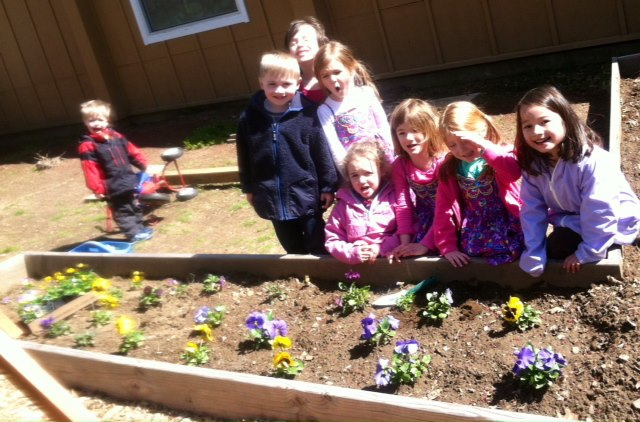
A Montessori classroom is alive with movement. Movement is incorporated into every activity in the classroom. Children move about the classroom to take things off shelves, to discuss with a classmate, to put things away, to pour a glass of water, to water the classroom plants, and to wash a table. Children also spend ample amount of time outside playing, gardening and exploring. Research shows that movement and cognition are closely related and movement can improve thinking and learning
Social development
The multi-age grouping in a Montessori classroom allows children to work at their own pace without feeling ahead or behind in relation to peers. Since children of different age groups have varying abilities, it becomes a community in which everyone learns from one another and everyone contributes. Younger children are motivated observing the activities of older peers, and the older children develop confidence and leadership by teaching younger peers. Special attention is given to teaching grace and courtesy, conflict resolution, and peace education. These skills are taught through constant modeling and role-play.