Schools
Quinnipiac University Professors Receive NASA Connecticut Space Grant Awards
The funding will be used to create new courses that will prepare students for careers in emerging fields of computing and engineering.
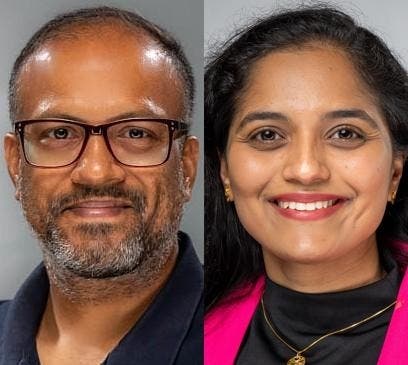
Two Quinnipiac University professors have received NASA Connecticut Space Grant Consortium Faculty Curriculum Development Awards to create new courses that will prepare students for careers in emerging fields of computing and engineering.
Chetan Jaiswal, professor of computer science, and Kruti Shah, assistant professor of software engineering, each received funding for independent curriculum development projects that align with NASA’s priorities and strengthen STEM education.
Jaiswal's project, “Scientific Computing for Modern Science and the Quantum Era,” will develop an interdisciplinary course that teaches students to use computation as a practical tool for scientific discovery. The course will emphasize computational thinking, modeling, simulation and data-driven problem solving while introducing the mathematical foundations that support emerging quantum computing applications.
Find out what's happening in Hamdenfor free with the latest updates from Patch.
Shah's project, “AI-Driven Software Engineering for Intelligent and Autonomous Systems,” will establish a new special topics course that gives undergraduate and graduate students hands-on experience applying artificial intelligence throughout the software engineering lifecycle. Students will work on project-based learning focused on intelligent and autonomous systems, real-time data processing, responsible AI and system reliability.
"These awards reflect the growing strength of interdisciplinary work at the School of Computing & Engineering," Jaiswal said. "They demonstrate Quinnipiac's commitment to developing forward-looking curriculum that brings together computation, mathematics, physics and emerging technologies in meaningful and applied ways."
Find out what's happening in Hamdenfor free with the latest updates from Patch.
Shah said the new course is designed to prepare students for a rapidly changing technology landscape.
"At Quinnipiac, this grant provides an opportunity to create innovative, hands-on learning experiences that connect theory with practice," Shah said. "It reinforces our commitment to preparing students for careers in rapidly evolving technical fields while encouraging them to think critically about the systems they build and the people those systems serve."
She said the funding represents an investment in students' technical, problem-solving and ethical decision-making skills.
"For me, this grant is about ensuring that our students are prepared for a world where artificial intelligence is becoming an integral part of how software is designed, developed and maintained," Shah said. "As educators, we have a responsibility not only to teach current technologies but also to help students adapt to emerging ones and understand their broader impact on society."
Jaiswal said his course will help students bridge the gap between scientific theory and practical application by translating scientific concepts into working code.
"The grant supports the development of a course that helps students move from learning equations and concepts in the abstract to actually building models, writing code, running simulations and interpreting results in ways that mirror how science and engineering are practiced today," he said.
He added that the course is intended to provide students with practical computational skills while laying the groundwork for future growth in quantum and scientific computing at Quinnipiac.
Both faculty members expressed appreciation to the NASA Connecticut Space Grant Consortium for supporting curriculum innovation.
"I am grateful to the NASA Connecticut Space Grant Consortium for supporting this work and for investing in the future of computing education," Shah said.