Community Corner
Scientology Flap Recalls Ledyard's Own 'Prophetess'
Scholars Debate Wilkinson's Ledyard Connection, But Not Her Remarkable Career
In a recent New Yorker exposé, writer Lawrence Wright made some shocking claims about Scientology founder L. Ron Hubbard. Wright wrote the article after researching the religious leader’s military records at the National Archives in St. Louis.
In his book Dianetics, published in 1950, Hubbard gives an account of how he healed battle wounds he supposedly received while serving in the Navy during World War II. The book would later form the basis of Scientology.
But Wright reported there is no mention in Hubbard’s records that he had ever been wounded during his war service.
Find out what's happening in Ledyardfor free with the latest updates from Patch.
Whether Scientology can survive this and other seeming contradictions unearthed by Wright from Hubbard’s past remains to be seen. What is certain is that history is littered with charismatic personalities who founded so-called “religions” based on miraculous claims.
Ledyard's own Prophetess?
Find out what's happening in Ledyardfor free with the latest updates from Patch.
One such personality, Jemima Wilkinson, began her ecclesiastical career in Rhode Island in the latter half of the 1700s. For a time, according to several historical sources, Ledyard was home to this remarkable woman, who drew followers with her claim of having risen from the dead.
In his 1992 book, Legendary Connecticut, author David Phillips notes that Wilkinson was born in 1752 to a Quaker family in Rhode Island.
“Sometime between her teens, when her mother died, and her mid-twenties, Jemima made her way to Connecticut – no one knows why or under what circumstances – and came to live in the town of Ledyard,” he writes.
Phillips’ narrative describes a strange woman who was devoutly religious. She had committed to memory large portions of Scripture, and her speech was sprinkled with biblical phrases.
At 24, Wilkinson caught fever and “died” – or so the story goes. But before she was lowered into the grave, they lifted the lid on her coffin so that the people could see her for a final time.
To everyone’s astonishment, she was not dead, but sat bolt upright in the casket.
Publick Universal Friend
After she recovered, Wilkinson told listeners that she had in fact died from her illness and had seen the mysteries of death. Also, the old Jemima Wilkinson was now dead, and God had replaced her spirit with a new entity: the “Publick Universal Friend.”
News of this strange woman and her “resurrection” won her believers from around the region, who would go to her for healing or listen to her preach. After the American Revolution, she traveled throughout Massachusetts and Rhode Island, delivering sermons.
In Puritan New England, many suspected that she was a fraud and accused her of doing the Devil’s work. This lack of faith served to keep Wilkinson on the move, as her early ministry extended from Rhode Island to Pennsylvania.
Walk on water
One popular anecdote about Wilkinson, recounted by Phillips, recalls the suspected chicanery of some latter-day televangelists. Facing down detractors, who were skeptical about her claims, Wilkinson told her followers that she would walk on water.
A crowd gathered at the edge of a lake to watch the miracle. Before her demonstration, however, Wilkinson delivered a sermon on faith and religious belief. She asked her followers rhetorically if they had faith in her. When everyone shouted that they did, the preacher replied, “If ye have faith, ye need no other evidence,” and left.
Wilkinson was to have another vision in a dream, in which she said she was instructed to found a new settlement in what then was considered the Northwest. The faithful built her a wagon, initialed P.U.F. (Publick Universal Friend) and she traveled to a new spot, located in the Finger Lakes Region of New York.
The new settlement was called Jerusalem, and years later it was where Wilkinson died in 1819—permanently. Later the town became known as Penn-Yan. The abbreviation reflected the fact that they had traveled from Pennsylvania, but were originally Yankees.
More doubt
Setting aside questions of whether Wilkinson rose from the dead, or could actually walk on water, one scholar writes that it is doubtful the religious leader ever settled in Ledyard.
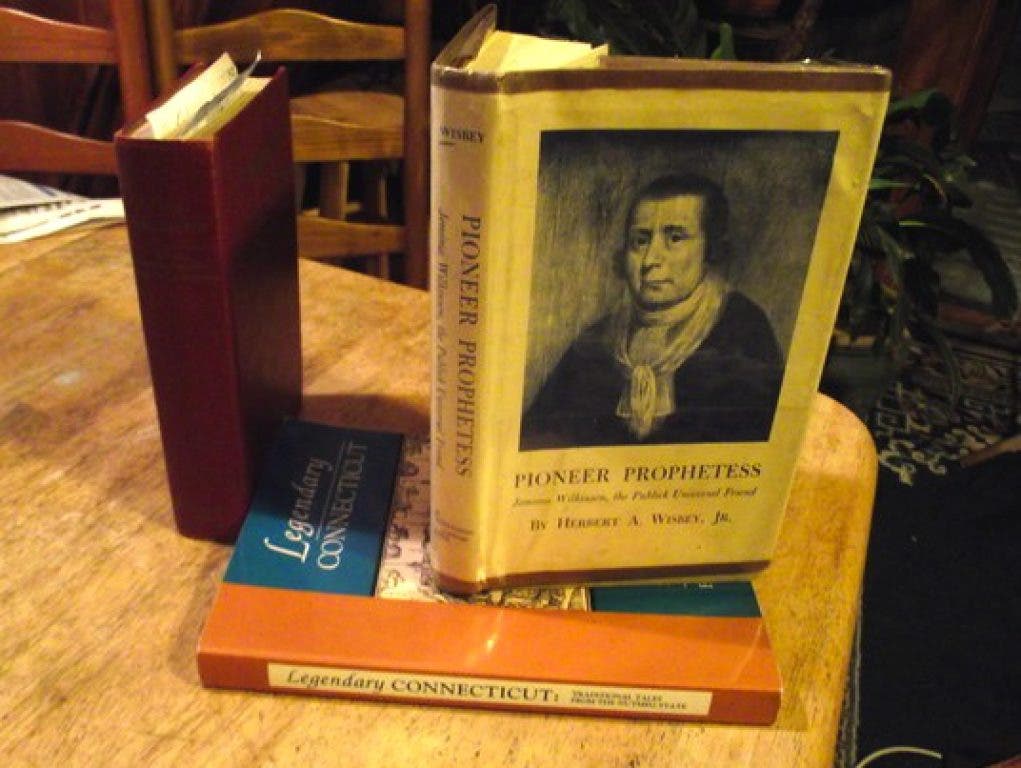
Herbert Wisby, who wrote the 1964 biography Pioneer Prophetess, claims that Wilkinson had indeed been sick and had recovered on her own (as L. Ron Hubbard claims to have done). But Wisby called the account of her lying in a coffin and pretending to be resurrected “another ridiculous story.”
According to Wisby, the religious leader had preached in Narragansett during the American Revolution, ministering to American and British soldiers alike. As to whether she had made it to Ledyard, he says it is doubtful, breaking with three scholars who say that she had.
A sticking point for Wisby is that Ledyard was actually the North Parish of Groton. He notes that most of her followers in the region were in south Groton.
“The details about her career in the last of the three books are so completely different from any other sources of information that they could only have originated in the authors’ imaginations,” he writes. “The Ledyard association must have some explanation, although none has come to light.”
Sources for this article include “Pioneer Prophetess,” by Herbert Wisby Jr, and “Legendary Connecticut,” by David E. Phillips. Thanks to Bill Fossum of the Ledyard Historical Society for supplying the books and the story idea.