Crime & Safety
Connecticut Link Rekindles Interest in $500M Historic Art Heist
Masterpiece paintings went missing from a Boston museum 26 years ago and this week the FBI came to Connecticut searching for clues.




MANCHESTER, CT - It’s been five days since agents from the Federal Bureau of Investigation came and left the Manchester home of Robert Gentile.
Gentile is a 78-year-old reputed mobster who the FBI acknowledges is a person of interest in the daring theft of classic paintings stolen from Boston's Isabella Stewart Gardner Museum in 1990, a heist valued at $500 million by authorities.
One art historian at the University of Connecticut, when asked this week what the value might be, hinted that the paintings are priceless in some respects.
Find out what's happening in Manchesterfor free with the latest updates from Patch.
The latest segment of the investigation was a blur - agents were in-and-out that day. In two separate e-mail exchanges this week, FBI spokesman Charles Grady politely declined comment when asked what agents might be looking for, asking for indulgence over “an ongoing investigation.”
He reiterated what the FBI previously said - that the search of Gentile’s home was a "court-authorized activity in connection with an ongoing federal investigation."
Find out what's happening in Manchesterfor free with the latest updates from Patch.
Manchester Police Department spokesman Capt. Christopher Davis kind of shrugged at the matter, saying it was the FBI’s gig and local cops were there simply for "crowd control." He added that Gentile’s presence in town is almost an afterthought because he has caused no problems locally.
When asked what kind of guy Gentile is, Davis said he honestly didn’t know. Gentile’s Hartford-based lawyer, A. Ryan McGuigan, did not return a call from Patch this week. Published reports including one from Fox 61, have said that Gentile supposedly received two of the stolen works and that guns were taken from his home.
But the whole thing, no matter how hush-hush the feds have been, has rekindled interest in the heist.
Michael Orwicz, an associate professor of art history and a scholar in 19th century French works at UConn, said the goings-on lit a spark.
"It’s been some time since I had a chance to talk about the incident," he said.
The FBI has a web page dedicated to the heist. It tells the tale of March 19, 1990, the day two men, dressed as police officers, were able to get access into the Gardner museum, overpower and tie up security guards and steal 13 masterpieces by artists like Rembrandt, Degas and Vermeer.
The FBI also details the works on its Web site.
Rembrandt’s “The Storm in The Sea Of Galilee” not only depicts a Biblical event in which Jesus eventually calms stormy seas in the midst of his disciples, but is considered the artist’s only seascape.
The Vermeer work, “The concert,” was one of only 36 in existence, the FBI and the museum point out.
"They are two examples of paintings that are irreplaceable to society," said Kathy Sharpless, the museum’s director of marketing and communications. "Society was robbed and the public is being prevented from experiencing these works. This is a crime against humanity."
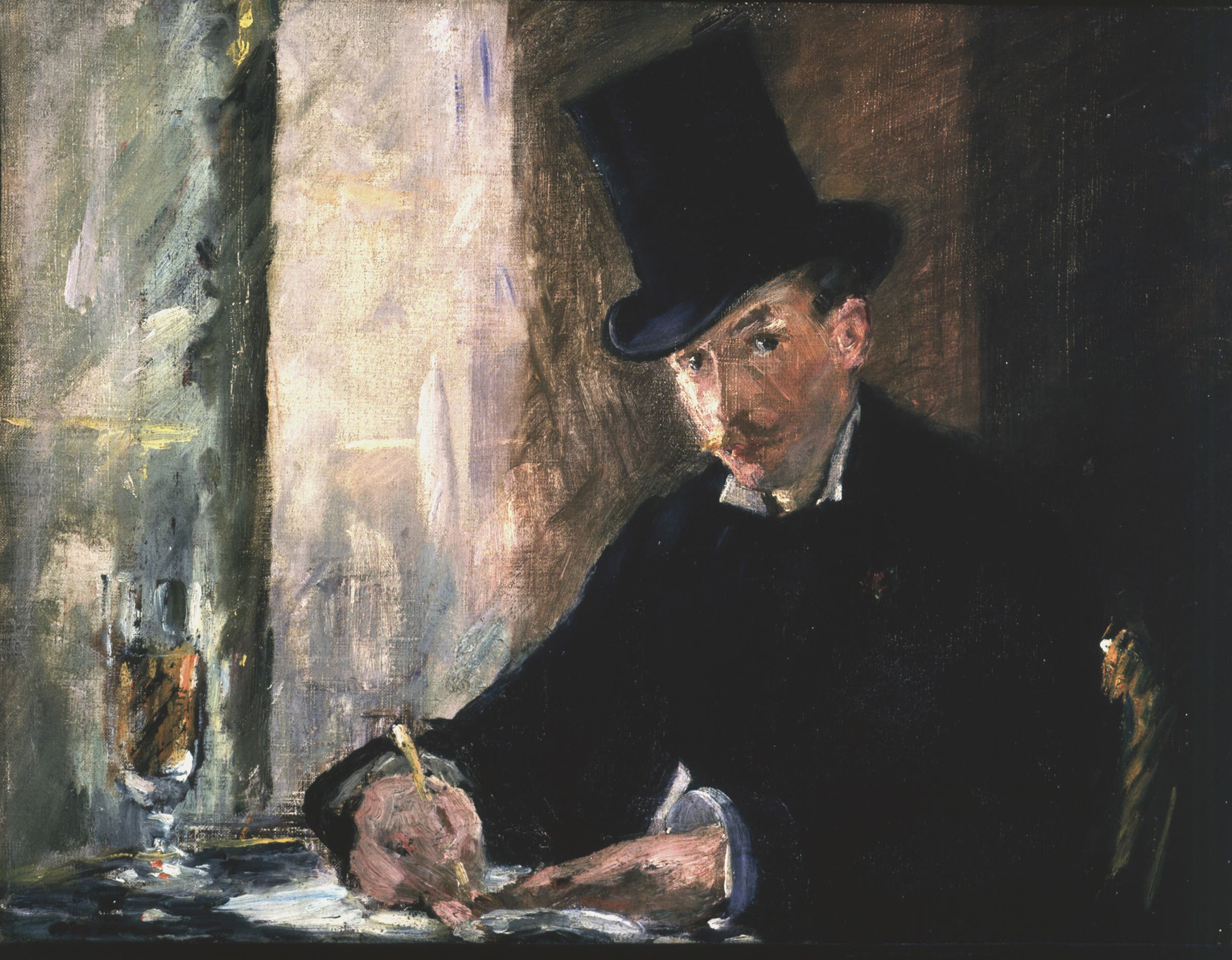
UConn’s Orwicz said he is continually mesmerized by Manet’s "Chez Tortoni," a reference to a visitor to a cafe in Paris. An unidentified man sits at a table in a black coat and top hat with a glass of beer, a writing instrument and a tablet. He appears to stare right at the viewer, something Orwicz said he cannot ignore.
“He is a member of the bourgeoisie, but as he draws on the notepad, his stare is cold and he appears detached,” Orwicz said. “We cannot guess what is on his mind. Manet could intentionally be touching on the quality of life in Paris at that time - 1880 - and changing social reactions, alienation.”
Sharpless explained the works were placed by Isabella Stewart Gardner herself, whom she described as “a preeminent Gilded Age collector.” When she established the museum, Gardner did so with the stipulation that the paintings, which she placed herself, not be altered positionally, museum officials said.
Thus, empty frames hang where the paintings used to be. In the case of the Manet, a painting of the artist’s stern-looking mother looks even more lonely without her top-hatted neighbor. She is, after all, wearing mourning clothes after the death of her husband.
"It is significant on so many different levels," Sharpless said. "The theft left a hole in the heart of Isabella’s installation, but this is an ongoing, active investigation involving the museum and the FBI and we are optimistic the painting will be returned. This is a way to keep the places warm for the time when they return."
But where could the paintings be?
"It’s an incalculable theft because they are rare pieces, How do you put them on the market?" Orwicz said. "It is not easy fencing them."
One speculative theory, he said, is that, "the art thieves were commissioned by high-paying patrons." The Asian market, particularly Japan and China, is quite lucrative for that type of acquisition, he said.
"Asian collectors would pay huge amounts," he said.
Orwicz said that sometimes, after being tucked away in storage for years, stolen art can just show up somewhere.
Thus, the empty frames, though eerie and disturbing on some levels, are symbolic, he said.
"The paintings deserve to be there," Orwicz said.
The FBI’s Grady would not address when the Feds might show back up at Gentile’s house. He just said the investigation would forge ahead. The $5 million reward for efforts leading directly to the recovery of the art as part of the joint FBI-Gardner Museum investigation, stands.
"The empty frames are place-holders," Sharpless said, "because we are optimistic the paintings will be returned."
Added Orwicz, “The case continues to fascinate us. I can speak for the 19th century pieces … They are important pieces."
Photo Credit: From left, Manet, the empty frame in the Gardner Museum, Rembrandt and Vermeer courtesy of the FBI.
Get more local news delivered straight to your inbox. Sign up for free Patch newsletters and alerts.