Arts & Entertainment
Manchester Shakespeare Fans ... UConn Program Could Be Music to Your Ears
Music from Shakespeare's plays celebrates the 'First Folio' at the Benton Museum.


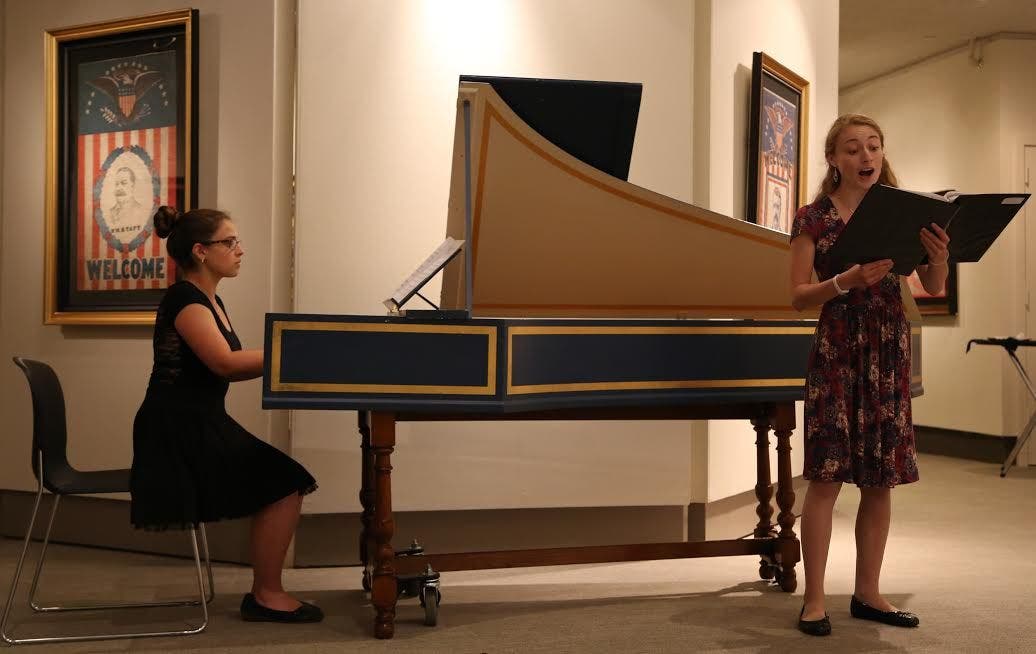
STORRS, CT — Vocal and instrumental music included in Shakespeare’s plays, as well as other music he would have heard composed by his artistic contemporaries will be part of “Shakespeare’s Songbook,” performed by the UConn Collegium Musicum on Friday, Sept. 23 at 8 p.m. in the William Benton Museum of Art.
The performance is part of the Shakespeare First Folio exhibit, which runs through Sept. 25.
While the plays of William Shakespeare are best known for their language and themes, the Bard also included songs and dance as elements in many of his productions, often to enhance key moments in his dramatic narrative, UConn scholars said.
Find out what's happening in Manchesterfor free with the latest updates from Patch.
In fact, the two theaters where Shakespeare’s plays were performed in London – The Globe and Blackfriars – each had space to accommodate the musicians who performed during productions in the playwright’s lifetime, UConn scholars said.
“Music was a relatively large part of Shakespeare’s plays,” says Eric Rice, head of the UConn Department of Music and a scholar of music composed and performed before 1750 who will conduct the group of student musicians. “Listening to music that was most likely heard in the context of Shakespeare’s plays is one of the strains of evidence we can use to establish what the plays’ texts meant, both to Shakespeare and the people who saw them.”
Find out what's happening in Manchesterfor free with the latest updates from Patch.
Rice said characters in Shakespeare’s plays frequently mention popular songs and dances in dialogue, and incidental music also was included in his productions.
For example, in the comedy, “The Merry Wives of Windsor,” the character Falstaff, who appears in several of Shakespeare’s plays, makes references to “Greensleeves,” a popular instrumental song of the Elizabethan era, according to UConn scholars.
Stage direction at times points to characters doing a jig, which sometimes was the cue for “Kemp’s Jig” to be played, a piece named for its composer Will Kemp, an original member of Shakespeare’s acting company who performed as Falstaff many times, according to UConn scholars.
The Collegium Musicum is comprised of singers and instrumentalists who perform the music of the late Middle Ages, Renaissance and Baroque periods each semester using the University’s collection of early instruments.
For “Shakespeare’s Songbook,” the primary performers will include 25 singers and 12 instrumentalists using several instruments used during the playwright’s lifetime. They include a viola da gamba, a six string bowed instrument held between the legs and played like a cello; wooden recorders; a brass instrument that is the forerunner of the trombone, known as a sackbut; a cornetto, which is a wooden lip-vibrated wind instrument with wind holes, and percussion instruments.
“These are instruments people today don’t hear as often unless they come to concerts like ours,” Rice said.
Songs that are specific to Shakespeare’s plays will include the use of dialogue that lead to the performance of a particular song, such as “The Willow Song,” which appears toward the end of “Othello.” At that point in the drama, Desdemona is with her attendant and is very sad. She sings the song, which was an existing popular song of the time.
Other songs from the plays will include “Full fathom five” and “Where the bee sucks, there suck I,” both by Robert Johnson, from “The Tempest;” “It was a lover and his lass” by Thomas Morley, from “As You Like It;” and “O mistress mine” by William Byrd from “Twelfth Night.” There will also be several anonymous instrumental works performed, including “Greensleeves.”
A highlight of the program will be “Spem in alium,” a 40-part vocal composition known as a motet by Thomas Tallis. During the performance, student singers will be positioned on the Balcony Gallery of the Benton Museum, high above the main exhibition gallery.
“This is an incredibly impressive piece. It’s rarely performed because you need a lot of singers and performing it in the right space is critical to its success,” Rice said. “The first documented performance of this piece occurred during Shakespeare’s lifetime. We wanted to perform it in the Benton to celebrate the presence of the First Folio on the UConn campus, and because the Benton has this fantastic three-sided balcony it seemed like a perfect opportunity to perform it.”
For more information, go to shakespeare.uconn.edu.
Photo Credit: UConn (Christine Goss, Class of 2018, playing the harpsichord, and soprano Sarah Himmelstein, Class of 2017, — members of UConn’s Collegium Musicum)
Get more local news delivered straight to your inbox. Sign up for free Patch newsletters and alerts.