Back when I used to teach literature, I used to wrangle with my students over that oft (too oft!) quoted line from Robert Frost’s poem, “Mending Wall.” (You know the one about fences and neighbors. You can find the poem at http://writing.upenn.edu/~afilreis/88/frost-mending.html if you need to review.) It’s a line the narrator quotes, uttered from his neighbor with whom he is repairing a stone wall that divides their properties. While the narrator is a thoughtful man with a lyrical, poetic voice, the neighbor is, well, a bit of a one-note clod, implying that his aphorism, “Good fences make good neighbors,” is completely idiotic.
On the other hand, I would point out that the classically trained poet behind both voices (Frost) was, according to critic George Montiera, likely aware of an ancient ritual called the festival of Terminalia, in honor of Terminus, the Roman god of boundaries. At Terminalia, communities on either side of a boundary would gather for a shared feast.[i] Can it be that the “simpleton” is wise? Or is the narrator the one to layer on the meaning? Regardless, the annual ritual of mending the wall brings together two individuals who might otherwise avoid one another. Thus the saying is paradoxical, if not a bit daft, but forged through a raw understanding of humanity that the poet aches (literally as he heaves rocks) to understand.
I’ve never been one for boundaries myself. In this way, I am not unlike the narrator in Frost’s poem who asks why there needs to be a wall in the first place: “My apple trees will never get across and eat the cones under his pines.” I don’t know why so many yards have these physical boundaries. It reminds me of that inevitable age when kids grab the masking tape to keep siblings out of their “stuff.” I understand the occasional boundary dispute when construction is involved, but the altar of Terminus sits these days in the Town Clerk’s office in the shape of a filing cabinet, with surveyors serving as clergy to decipher the holy maps within.
Find out what's happening in Mansfield-Storrsfor free with the latest updates from Patch.
The house next door is for sale since our neighbors moved north to exciting prospects. When they were around, however, we would visit back and forth by cutting through the slender strip of woods between our yards. I heard from another neighbor who previously occupied the house next door that his son beat down a trail visiting the pretty young girl who used to live in my house. The trail is no longer visible, but cutting through is easy enough. The slender strip of wood broadens out into an adjacent forest lovingly preserved by the town of Mansfield. Must there be a barrier to between us and the rest of the world?
Alas, we do have an actual need since we adopted our puppies who happen to love eating the neighbors pine cones (along with chasing squirrels and following the scent of deer). In my heart, I wish we could do without. What if a charming young lady, say, the age of one of my sons, moves in next door? On the other hand, perhaps we should look into brick and razor wire.
Find out what's happening in Mansfield-Storrsfor free with the latest updates from Patch.
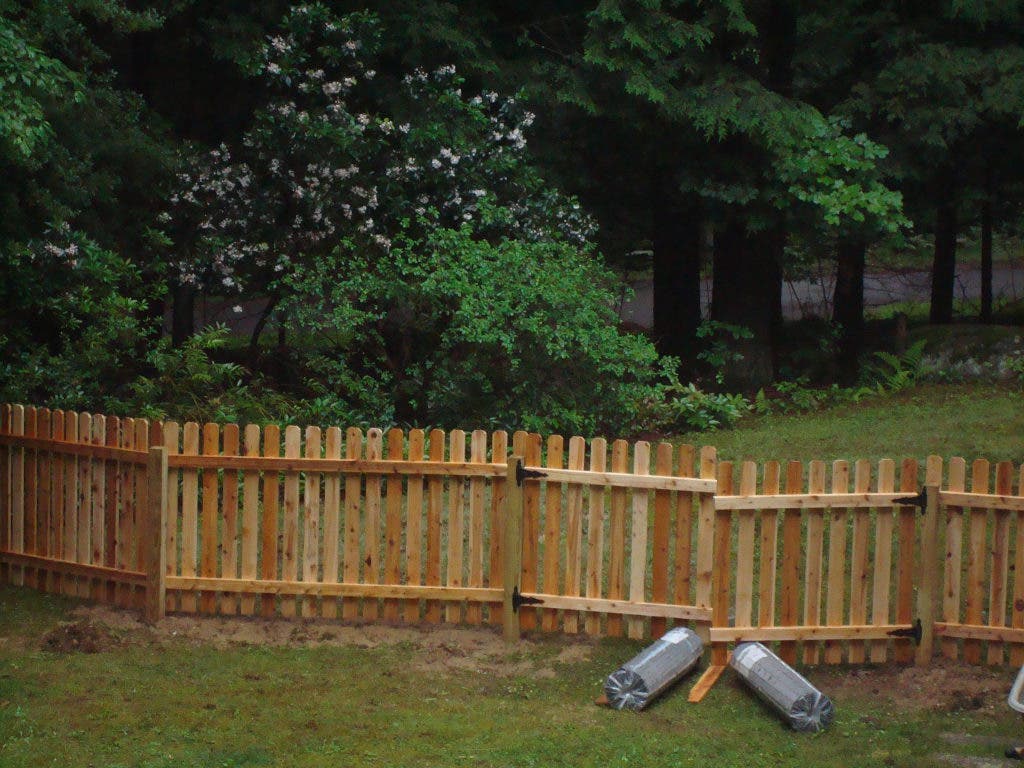
I reminded my husband that we should consult the “holy map” before we install our fence; otherwise, it would be a “bad fence” and we would be “bad neighbors.” We are also trying to make our fence as unobtrusive as cedar and welded wire (our actual choice of materials) can be. I wonder, though, if I am I fencing out the neighbors even more so with no need for joint-maintenance or reason for complaint? I think again of Frost and his narrator’s wry suggestion that perhaps elves are responsible for the annual stone wall damage. Maybe some other mischievous forces of nature will conspire to unite me with my neighbors. Maybe tree fairies will hurl branches across our yards and goblins will nibble holes in our road. We will inevitably wave as we pick up sticks and gripe in agreement about potholes.
Either way, we will forge a connection, I’m sure, despite this fence. Of course, the saying is about fences, and the poem is about a wall (a fact I would invariably point out toward the end of class, making my students groan.) Frankly, if it keeps the dogs in and the deer out – a rose by any other name, right? Well, that’s a different cliche altogether.
[i] Montiera analyzes the casual use of this and other oblique references in his article, “Unlinked Myth in Frost’s ‘Mending Wall.’” Concerning Poetry 7:2 (Fall 1974).