Kids & Family
Dec 25, 1914: WWI Enemies exchange Christmas greetings
Dec 25, 1776: Washington crosses the Delaware



Enemies exchange Christmas greetings!
On and around Christmas Day 1914, the sounds of rifles firing and shells exploding fade in a number of places along the Western Front in favor of holiday celebrations in the trenches and gestures of goodwill between enemies.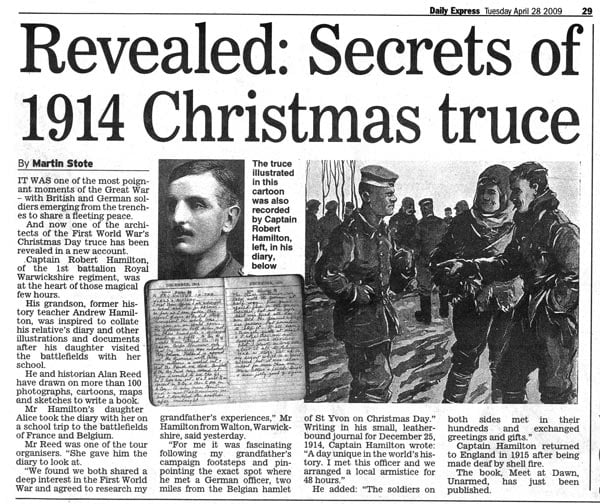
Starting on Christmas Eve, many German and British troops sang Christmas carols to each other across the lines, and at certain points the Allied soldiers even heard brass bands joining the Germans in their joyous singing.
At the first light of dawn on Christmas Day, some German soldiers emerged from their trenches and approached the Allied lines across no-man’s-land, calling out “Merry Christmas” in their enemies’ native tongues. At first, the Allied soldiers feared it was a trick, but seeing the Germans unarmed they climbed out of their trenches and shook hands with the enemy soldiers. The men exchanged presents of cigarettes and plum puddings and sang carols and songs. There was even a documented case of soldiers from opposing sides playing a good-natured game of soccer.
Find out what's happening in Middletownfor free with the latest updates from Patch.
Some soldiers used this short-lived ceasefire for a more somber task: the retrieval of the bodies of fellow combatants who had fallen within the no-man’s land between the lines.
The so-called Christmas Truce of 1914 came only five months after the outbreak of war in Europe and was one of the last examples of the outdated notion of chivalry between enemies in warfare. It was never repeated—future attempts at holiday ceasefires were quashed by officers’ threats of disciplinary action—but it served as heartening proof, however brief, that beneath the brutal clash of weapons, the soldiers’ essential humanity endured.
Find out what's happening in Middletownfor free with the latest updates from Patch.
Dec 25, 1776: Washington crosses the Delaware

During the American Revolution, Patriot General George Washington crosses the Delaware River with 5,400 troops, hoping to surprise a Hessian force celebrating Christmas at their winter quarters in Trenton, New Jersey. The unconventional attack came after several months of substantial defeats for Washington’s army that had resulted in the loss of New York City and other strategic points in the region.
At about 11 p.m. on Christmas, Washington’s army commenced its crossing of the half-frozen river at three locations. The 2,400 soldiers led by Washington successfully braved the icy and freezing river and reached the New Jersey side of the Delaware just before dawn. The other two divisions, made up of some 3,000 men and crucial artillery, failed to reach the meeting point at the appointed time.
At approximately 8 a.m. on the morning of December 26, Washington’s remaining force, separated into two columns, reached the outskirts of Trenton and descended on the unsuspecting Hessians. Trenton’s 1,400 Hessian defenders were groggy from the previous evening’s festivities and underestimated the Patriot threat after months of decisive British victories throughout New York. Washington’s men quickly overwhelmed the Germans’ defenses, and by 9:30 a.m. the town was surrounded. Although several hundred Hessians escaped, nearly 1,000 were captured at the cost of only four American lives. However, because most of Washington’s army had failed to cross the Delaware, he was without adequate artillery or men and was forced to withdraw from the town.
The victory was not particularly significant from a strategic point of view, but news of Washington’s initiative raised the spirits of the American colonists, who previously feared that the Continental Army was incapable of victory.
Have a news tip? Email Bill Maune. You can also post your own news, events and announcements on Patch by following these directions. Curious about how our new commenting platform, Disqus, works? Learn more about it here and start interacting with your neighbors on Patch.