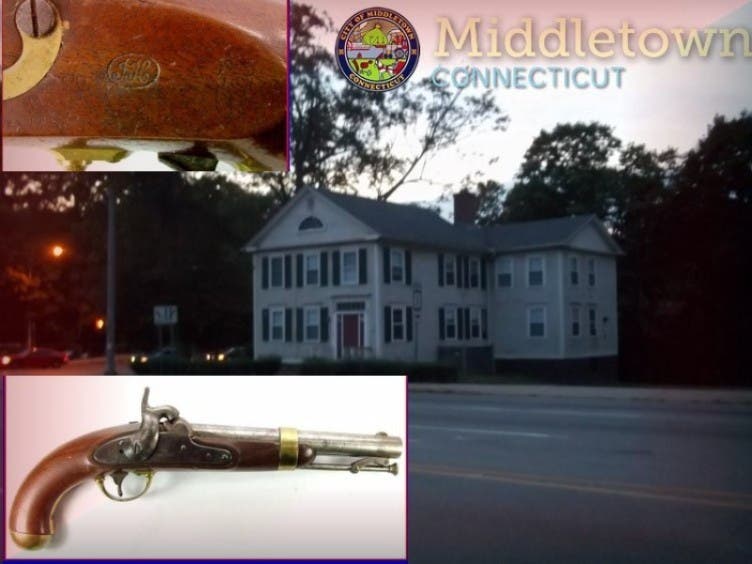

Henry Aston House (1835):
The house at 324 Washington Street in Middletown was built around 1835. Transitional in style between the Federal and Greek Revival, the house was probably built by Henry Aston. The History of Middlesex County (1884) states that, “H. Aston & Co., pistol factory, in the employ of the United States, have fifty hands, and make six thousand pistols a year, worth $35,000.” Above Information from Historic Buildings Of Ct.
The house remained in the Aston family until 1942 and is now owned by Wesleyan University.
Find out what's happening in Middletownfor free with the latest updates from Patch.
NEXT FROM: The American Society Of Arms Collectors
ARMY PISTOLS: THE ASTON MODEL 1842:
On 25th February, 1845, Aston received a contract from the Ordnance Department which called for thirty thousand percussion pistols at a cost of $6.50 each, to be produced on a pattern which had been approved in 1842.
Find out what's happening in Middletownfor free with the latest updates from Patch.
All Model 1842 Army pistols were produced under contract. Specifications for the Model 1842 pistol stipulated, essentially, that with the exception of the percussion lock and the use of brass furniture, the arm was to be made on the same dimensions as the present model, i.e., The Model 1836 flintlock pistol. The design in the side plate and the two-piece trigger guard assembly are the only other changes. The pistol is .54 caliber, smoothbore, fourteen inches in length and weighs two pounds, twelve ounces, has a black walnut stock which extends threefourths the length of the pistol, and an 8% inch barrel which was finished bright, with a brass blade front sight. All have swivel ramrods and brass mountings finished bright.
There are two lock markings: the first beginning in 1846 and continuing through 1850, was “U.S.” over “H. Aston” in the center of the lockplate and to the rear, in three vertical lines, “MIDDm” over “Conn” over the date. The second beginning in 1851, and through 1852, was “U.S.” over “H. Aston & Co.” in the center of the lockplate, and the rear of the lockplate identical to the earlier version. Barrel markings are the same except for the different inspectors and dates. Also there should be inspector marks on the stock: these will be stamped on the side opposite the lock. There are usually two inspector marks, one the final inspection at the factory, the other probably the acceptance inspection at the delivery destination.
THE ASTON NAVY PISTOLS: The Navy purchased three thousand H. Aston pistols from the Army in May, 1850, and all were probably marked with the standard Army markings. Fifteen hundred percussion lock pistols of the Army make and caliber could be furnished immediately and would be shipped from the New York Arsenal to the Navy Yard at Brooklyn, and the remaining fifteen hundred would be shipped from the New York Arsenal to the Navy Yard at Brooklyn, New York, when completed.
All Aston pistols were marked “U.S.” over “H. Aston” in front of the hammer and at the rear of the lockplate in three vertical lines, “MIDDm” over “Conn”, over the date. The barrel was also marked with the appropriate markings, “U.S.” over inspector’s initials over “P“.
There are several Aston pistols marked with an anchor on the barrel and “P” over “GG” on the bolster of the lock. These pistols were purchased by Guert Gansevoort, when he was purchasing arms for the “Union Defense” in 1861 and was assigned to the Brooklyn Navy Yard as inspector of the Navy Ordnance, or after the Civil War, in 1865, when the Navy was regulating the Navy-purchased arms subsequent to storage and utilization. The 1865 date is also the appropriate time frame for the anchor stamping.
Occasionally an Aston pistol that has been either tinned or nickel plated will turn up and be identified as a Navy pistol.
Visit their website: http://americansocietyofarmscollectors.org/

Information Above From Historic Properties List: From Middletown’s Planning and Zoning
ALSO: The Starr Mill Was On Staddle Hill As Well