Community Corner
Volunteers Search Out Homeless in Middletown For Annual Count
Turns out, finding the homeless when they don't want to be found is a problem itself.
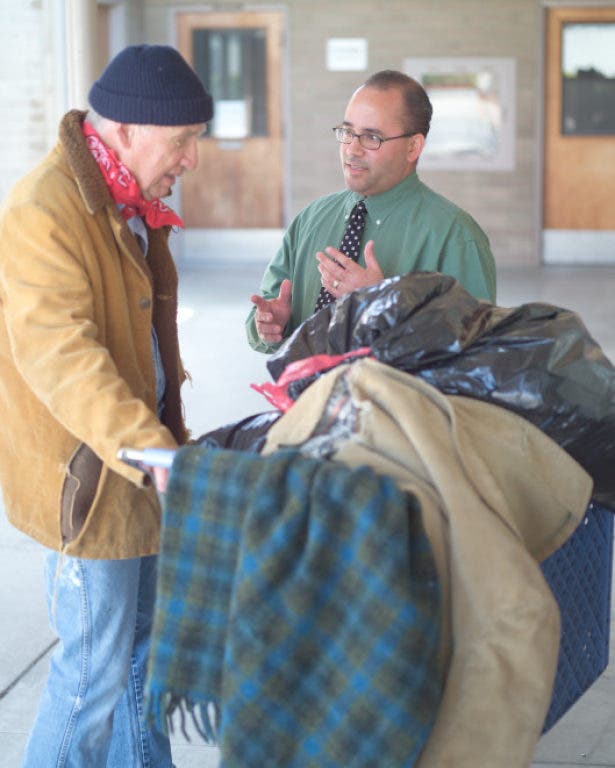
A thin sheet of snow glittered in the beam of my flashlight as I trudged up River Road Tuesday evening with my colleague and friend, Brad, and a pastor from Haddam named Michael.
The three of us had volunteered to participate in the annual Point-in-Time Homeless Count to determine the number people living without stable housing in Middlesex County.
Find out what's happening in Middletownfor free with the latest updates from Patch.
With the temperature near freezing and a light mist in the air, we embarked on our mission after a brief training session at the Northern Middlesex YMCA. In all, about 40 volunteers participated in Tuesday night’s effort, moving in groups of two and three along the shadowy streets of Middletown, looking for people who — for the most part — would rather not be found. Our goal: to create a statistical snapshot of homelessness in the region.
“Is there anybody in there,” Michael shouted into an empty trailer behind a factory on River Road. “I have cookies, a warm blanket.” Nothing. From inside a nearby building we heard only the muffled barking of a dog — a big, clearly agitated dog.
Find out what's happening in Middletownfor free with the latest updates from Patch.
“Seems like the kind of place, a homeless person might want to spend the night,” Brad said, shining his flashlight to get a better look inside the trailer. “Thankfully, it’s not as cold tonight as it was last week.”
That’s the way it went for a couple of hours or so. We peered into abandoned houses, sheds and stairwells, poked along bridge abutments and railroad tracks. The people who ran the training session, community volunteers from the Middlesex County Coalition on Housing and Homelessness, told us to expect this sort of thing.
Oddly enough, I thought as I was walked my rounds, the intense desire for privacy is one trait that people on the lower end of the economic spectrum share with people on the upper end of the economic spectrum. That’s why fantastically rich people, the kind who live in mansions in Greenwich’s “backcountry,” all have three-mile long driveways.
During the training we were told not to ask the homeless for their names. Our goal was to get a statistical sample only, numbers that would later be compiled and analyzed by federal Housing and Urban Development officials.
Counts like the one in Middletown Tuesday were going on all across the country the same night.
“Collecting reliable baseline data is essential to understanding the causes of homelessness and designing effective interventions to help homeless people rebuild their lives,” said Lisa Callahan, Middlesex County PIT Coordinator and Associate Executive Director of Mercy Housing and Shelter.
Lydia Brewster, coordinator of the soup kitchen operated by St. Vincent DePaul of Middletown, described the count as an “extremely useful tool” in quantifying the extent of homelessness and in developing programs to end homelessness in Middletown and its surrounding communities.
HUD says on its website that answers to survey questions taken on the night of the Point-In-Time count, will be broken down into subpopulation categories, including counts of persons who are chronically homeless, persons with severe mental illness, chronic substance abusers, veterans, persons with HIV/AIDS, victims of domestic violence and unaccompanied children.
In late 2007, a coalition of groups introduced a Ten Year Plan to End Homelessness in the region by 2018. That plan includes proposals to bolster supportive housing, the establishment of a homelessness prevention fund and initiatives to help those at risk of becoming homeless find and retain jobs.
The architects of the plan said in their initial report that their proposals, if fully implemented, would have multiple benefits, including:
- A 58-percent reduction in emergency room visits
- An 85-percent reduction in emergency detoxification services
- A 50-percent decrease in incarceration rate
- A 50-percent increase in earned income
- A 40-percent rise in rate of employment when employment services are provided and a significant decrease in dependence on entitlements — a $1,448 decrease per tenant each year.
“The first step in addressing the problem is getting good data,” said Richard Stillson, PhD, director of admissions, education and homeless prevention services at River Valley Services, in his remarks to volunteers Tuesday night. “The homeless are out there — we have to find them.”
Turns out, finding the homeless when they don’t want to be found is a problem itself.