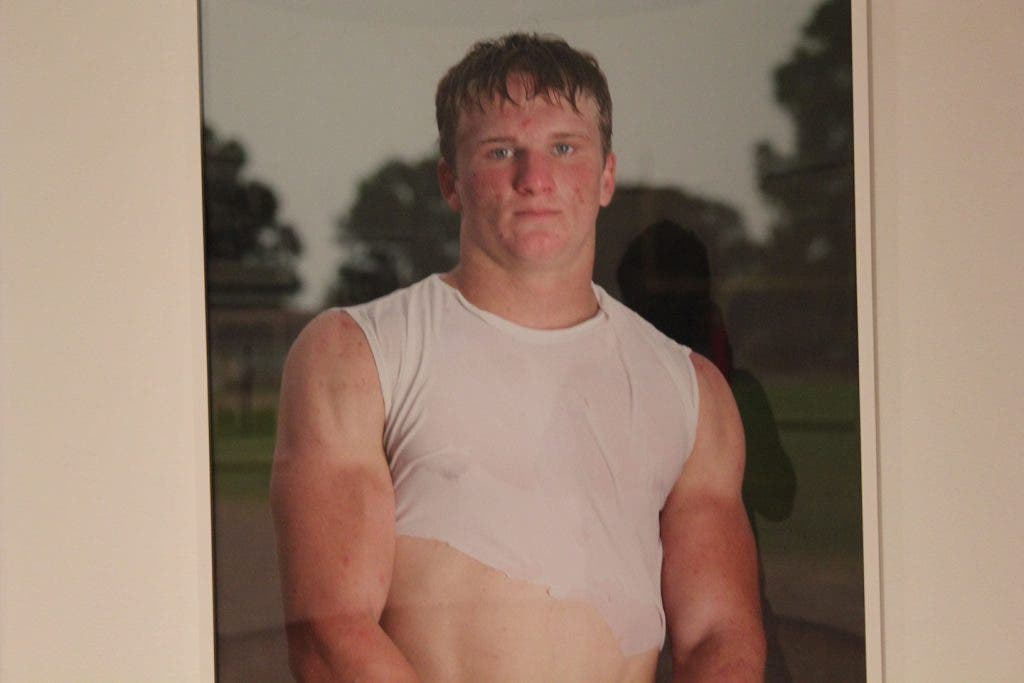


On Friday evening, the fascinating traveling exhibit "Mixed Signals: Artists Consider Masculinity in Sports," premiered in the Ezra and Cecile Zilkha Gallery at the Wesleyan Center for the Arts with an opening reception. The reception, hoisted by CFA director Pamela Tatge, featured a talk by contributing artist Shaun El C. Leonardo.
Mixed Signals, which has been on tour since 2009, is a traveling exhibition organized by Independent Curators International and supported by such organizations as the Goldsmith Federation. It is being co-sponsored by Wesleyan’s Art History Program, Physical Education Department and the Center for Film Studies, and captures the most provocative works in the last decade that have masculinity and sports as central themes.
The exhibit, as it makes clear in its mission statement, is dedicated to examining the time honored images of male athletes as aggressive, hyper-competitive, remote subjects which are still entrenched in the public consciousness.
Find out what's happening in Middletownfor free with the latest updates from Patch.
"We look for exhibitions that bring the student body and the larger
community together. Mixed Signals is able to bring our athletics and
art programs together," said Tatge. "The artwork featured in Mixed Signals is really diverse. It provides an opportunity for many types of studio art to interact opposite film and performance art in the same show."
The artists involved in Mixed Signals take alternate views of masculinity and sport by capturing the stereotypes and rituals of the sports world and by suggesting there are more complex feelings underlying our love for sports and the athletes who play them. Mixes Signals brings to light the constant contradictions male athletes have to live with.
Find out what's happening in Middletownfor free with the latest updates from Patch.
So what does the exhibit actually look like on canvas (in addition to many other surfaces)? It is brazen, alluring and high entertaining. The works of art in Mixed Signals directly address a number of scintillating subjects. Catherine Opie’s landscapes of high school football action and portraits of football players gearing up for games zero in on the anticipation, determination and even fear young players have before game action occurs, while also highlighting or cultures sexulization of male athletes and their bodies.
Hank Willis Thomas’s photographs “Something to Stand On” and “Basketball and Chain” (maybe my personal favorite), which show the outline of a basketball player relying on a “third leg to jump” and a player dragging a chain behind him as he jumps, deconstruct the ways in which race and sexuality are used to market athletes, and demonstrate how athletes are controlled by their teams and sponsors.
Finally, Shaun El. C. Leonardo’s “Bull in the Ring”, a piece with football helmets facing off towards one another in a circle that is accompanied by a video of players hitting one another in practice, illustrates the violence and brutality that many sports, particularly football, demand from male athletes. Bull in the Ring starkly captures how the masculinity sports demands of athletes can sometimes remove their individual identities. It is a guarantee that the artwork featured in Mixed Signals will cause viewers to think and to consider their perspective on masculinity and sports in modern American culture.
The opening talk by Leonardo was entertaining and witty. Leonardo did an excellent job of highlighting the purpose of the show and the experiences of its subjects, due to his history as both an artist and a college football player. He discussed how the exhibition was attempting to investigate sports and how it intersects with issues of manhood and violence in the larger culture.
"We had 160 people at the opening night, and rougly 85 percent were
students," Tatge said. "I'm hoping Mixed Signals can be a point of entry to the CFA sports fans. A lot of them may not know about us, and if we can get them visiting, that would be great."
For the artist, many of the exhibit’s pieces of art, especially the ones focusing on violence, were “beautiful metaphors for how we conduct masculinity in or daily lives.” Leonardo spent a lot of time discussing his football career, and the effect it had on him and has on other individuals.
He discussed how for many players the sports at once aggressive and innocent cultures creates a “duality of self” which the exhibition captures, a duality which is defeatist and difficult for many to reconcile. He focused on describing the now-outlawed drill Bull in the Ring, which was the inspiration for Leonardo’s piece, where a group of players all charge a single player and try to hit him as hard as possible. Leonardo stated that the drill frequently felt like “an exhilarating dreamlike state,” and he tried to capture both this feeling and how the drill could also be a nightmare.
The artist ended his talk b addressing questions from the audience on the sexulization of male athletes, the similarity being sports and war, and the lack of open homosexual athletes in popular sports.
Mixed Signals will be on display at the Center for the Arts from now until Oct. 23. Screenings of Matthew Barney’s films Cremaster 4 and Drawing Restraint 10 will occur as part of the exhibition on Sept. 27.