Community Corner
The History of Middletown's One-Time Romanesque Revival Town Hall
The Old Municipal Building ... was it grotesquely ugly or local gem? The debate rages on.

If I ever have the urge to start a rumble, I can simply go to a local diner and engage some old timers (like me) in a conversation about the old Municipal Building in Middletown.
There are those who will insist it should never have been torn down back in 1961 and those who will say it was about to fall down anyway.
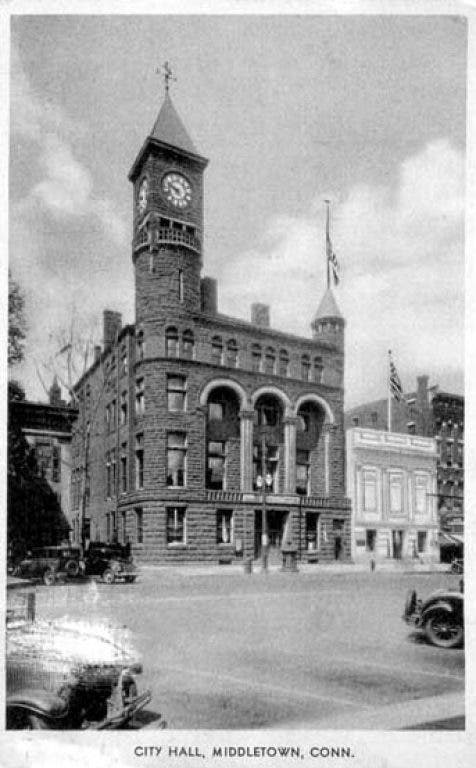
Everyone, however, can agree that it had a spectacular presence on Main Street. Its clock tower rose from the east side of the street, and its distinctive hulking brownstone façade, in many ways, defined the city for a long time.
Find out what's happening in Middletownfor free with the latest updates from Patch.
It wouldn’t be hard to write a book on the history of the Municipal Building from its construction in 1895 until its demise in 1960. The Middletown Press archives will yield hundreds, if not thousands, of articles, positive and negative, about the old structure. This short column can only give a taste of its history and be enough to rile up the locals.
Construction began on the Municipal Building in the spring/summer of 1894. The Romanesque Revival-style building was erected to house city offices, the county court, the police department, and later, even the motor vehicle department. Prior to this, records for the city were kept in the Courthouse, which was torn down in 1893 to make room for the new Municipal Building.
Find out what's happening in Middletownfor free with the latest updates from Patch.
Its three stories were built of Portland brownstone and a tall tower reached up another three stories with clocks on four sides. Each day at 6 a.m. and 6 p.m., the clock struck 18 times to announce the beginning and end of the workday.
Even before it was completed, Middletown residents and public officials were complaining about the building. In June of 1894, it was discovered that the water table on the building’s façade was too low and the steps leading to the main entrance fell 3½ inches “below the floor of the corridor.”
The architects, Hapgood & Hapgood, laid blame with the city engineer, and back and forth it went. The solution was to tear down the front wall above the water table at an expense of $200.
Two months later, a worker fell from the second story, saving himself from certain death by grabbing a rope.
As the city departments moved in during December of 1895, town officials were “forced to heat their rooms by gas stoves and grates.” The Judge of Probate decided not to move in at all because the building was “too cold for comfort.” The heating contractor was called to come fix the furnace.
A year later, the heating contractor was required to pay the city $2,700 for their shoddy work, which allowed the city to award another company the steam heating contract.
It can safely be said that heating continued to be a nagging issue. A Hartford Courant article in 1959 reported that when the offices were opened on a frigid Tuesday morning, the temperature in north-facing offices was 35 degrees. Workers were sent home, and those who stayed, kept their coats on while they worked.
In 1905, 10 years after the building was completed, the slate roof was repaired due to leaks into the top floor offices.
Middletown city personnel were running out of space by 1939. It was proposed to build an entire new floor between the second and third stories, an idea made possible due to the 20-foot-high ceilings. The tall rooms also made the place very expensive to heat. During the discussion between the mayor and other town representatives, someone spoke up and suggested they just tear the Municipal Building down! This idea was rejected because the mayor claimed the main structure was still sturdy and solid.
By the 1950s, however, this was debatable. The structural issues with the building were common knowledge. Plaster walls collapsed, ceilings cracked and fell, and the roof leaked. In 1957 a window fell from the second floor and narrowly missed pedestrians on the sidewalk below.
By this time, however, plans were already completed for a new City Hall. When the Municipal Building Committee was formed in 1953, they considered a site at Pearl and Washington Street, behind the Russell House, for the new City Hall. Later the Court Street Project Area was selected for the new city offices. Many from the public urged the city to keep the old Municipal Building and convert it to office space. This was seriously considered and in 1953 there were even offers to purchase it. Renovations were estimated at $200,000.
The old Municipal Building was put up for sale in September 1959 as workers moved departments into the new city offices on Court Street overlooking the river. In a less public way, the Municipal Building had actually been on the market for about three years and there had been little interest shown.
It was doomed to the wrecking ball in 1960. “Few towns can boast and uglier, more interesting building than Middlesex County’s old Municipal building,” claimed a Hartford Courant reporter in 1961 as plans were made to raze the structure.
The reporter asserted that the building’s saving grace was the “Town Clock, whose four big, brightly lighted faces could be seen up and down the Connecticut River for miles.”
As workers emptied the place, many local people saved town records and historic photographs that were headed for the dump. Joseph Fava, who had the demolition contract, rescued the old weathervane and bell as salvage from atop the tower. The fountain was saved by Salvatore Adorno and later donated by him back to the city. Today it can be seen on the South Green.
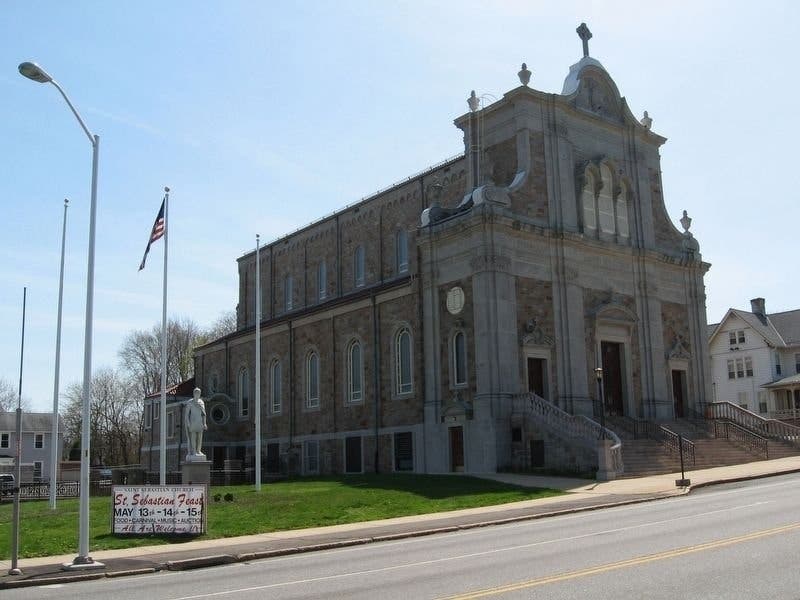
The beautiful brownstone building began to come down in August 1961. Local people mourned; some locals celebrated. Either way, almost everyone in town had an opinion about the old Municipal Building. I am not old enough to remember the Main Street structure, but I grew up hearing the debates. The discussions continued long enough for the architects of the new Middletown Police Station to base its design on guidelines from the old Municipal Building, particularly the tower at the northern end. Compare for yourself in the two photographs shown here.
The site of the Old Municipal Building is now a parking lot that serves the Bank of America.
What are your thoughts about its demise? Was it the ugliest building around? Was it in as bad a condition as the proponents of replacing it claimed? Let’s hear from the readers.
We love you. Reciprocate! Follow us on Twitter or like us on Facebook.