Politics & Government
Chalk Hill Can be a Community Center, Daycare, YMCA ...
Officials discussed the future of the 42-year-old building at a joint meeting at Masuk High School Monday night


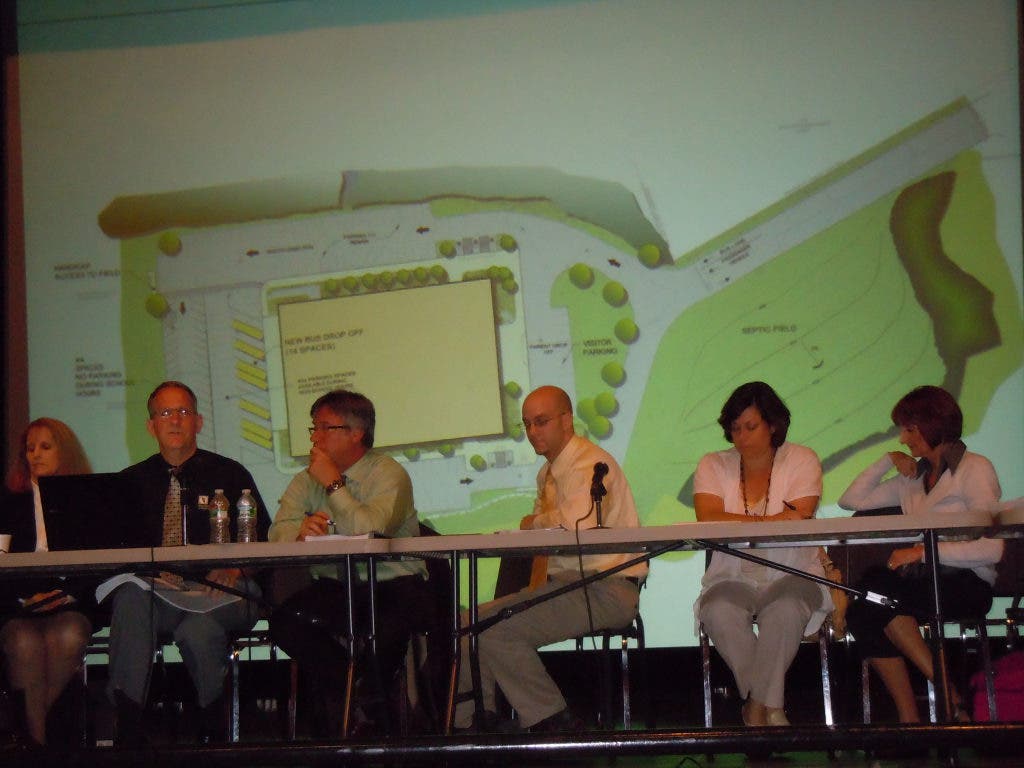
Chalk Hill can be a community center, a daycare center or a YMCA. Some want to close Monroe and Stepney elementary schools and renovate Chalk Hill, so Monroe can have all of its schools — with the exception of Masuk — on one campus. In yet another scenario, a building expert says Town Hall offices could even be housed there.
Bill Silver of Silver Petrucelli & Associates architects, engineers and interior design, a Hamden firm that had done a study of Chalk Hill, said the building has the capability for a number of diverse uses.
"It's a great investment," Silver said at the First Selectman's Joint Meeting on Chalk Hill's Future Monday night. "Don't give it up."
Find out what's happening in Monroefor free with the latest updates from Patch.
First Selectman Steve Vavrek. Supt. of Schools Dr. Colleen Palmer and representatives of the Planning & Zoning Commission, Town Council, Board of Finance and Board of Education sat on a panel with two consultants from Silver Petrucelli & Associates before about 20 people inside Masuk High School's auditorium.
After close to two hours of brainstorming and debate, most agreed on one thing, that a facilities study should be done on Chalk Hill's building regardless of the use the town chooses for it.
Find out what's happening in Monroefor free with the latest updates from Patch.
Vavrek said the YMCA has already shown interest in Chalk Hill's 375 Fan Hill Road property.
"The YMCA actually loved the building," he said. "They liked the fact that the cafeteria was upstairs. They liked that it had a gymnasium."
Town Council Vice Chairman Tony Unger said, "I think the school should be used as a school. I think having a complex for all of the schools like Weston ... is the right use for that building."
Town Council Chairwoman Enid Lipeles prefers a mixed use with the Parks & Recreation Department that is currently on the first floor and the YMCA, with the potential for a daycare center for teachers and town employees being added in the following year when there is time to plan for it.
"I see this as the cart before the horse," Town Councilwoman Dee Dee Martin said.
Martin suggested building off of a study of the building that took place when the late first selectman, Thomas Buzi, was in office to determine what can be done with Chalk Hill's building, before throwing out ideas on how it should be used.
Unger agreed with Martin.
The Board of Education had recently voted not to use Chalk Hill for education purposes next fall and to turn it over to the town by Oct. 1.
Michael Manjos, a member of the Board of Finance, said if there is no need for the building, the town should consider selling it.
"We need to look at every building in town and figure out what our needs are in town, rather than shoehorning something into a building just because it exists," he said.
Why not keep it as a school?
Planning & Zoning Chairman Richard Zini asked Palmer about student enrollment projections and whether she foresaw a time when the Board of Education may need the space at Chalk Hill again.
Palmer said statistics for the next five years shows the population declining, but said it is difficult to predict beyond that with as much certainty. She added student enrollment is also down statewide.
During the public comment portion of the meeting, Steve Ballok of Wheeler Road, who wants to see Chalk Hill remain a school, questioned why the Board of Education made the decision to close it, a decision he believed should have been made by the town as a whole. Ballok contended that Monroe Elementary School, which is in a commercial area, should be the one that's closing.
Steve Schapiro, who serves on the Economic Development Commission, was among those who want one education campus on Fan Hill Road. He said some commercial developers would find the Monroe Elementary School property attractive.
Board of Education Chairman Darrell Trump read from a Monroe Public Schools' study on closing Monroe Elementary School, which cited among its reasons for keeping it open that Fawn Hollow and Stepney elementary schools would lose 81 percent of classroom space for mandated intervention, special education and student support services after absorbing the displaced Monroe Elementary student population.
Trump added that enrollment projections determined that Chalk Hill should be closed by 2014-15, but that annual budgetary constraints forced the school board's hand earlier.
"We're not closing Chalk Hill because of enrollment," Trump said. "We're closing it because of years of budget cuts."
Vavrek said he did not want to argue about the last budget voters passed, but mentioned there were schools in other communities whose districts had made concessions to keep open.
Mark Antinozzi, a Board of Education member, said the closing of Chalk Hill as a school is a "done deal," so the town should move on and decide upon a future use for the building. He believes a community center is the best possible use.
Steve Kirsch, a town resident, said state statutes dictate that the Board of Education decides what schools operate and which ones close, adding that anyone could have attended the board's meetings to discuss Chalk Hill's future before the decision was made.
"The decision was not made in a vacuum," he said. "You may not like it, but please deal with reality."
Donna Lane, a Board of Education member, criticized suggestions of selling Monroe Elementary School to a commercial developer. She said the town has a poor track record of preserving its historic properties and noted how Monroe Elementary was the town's first consolidated school.
Lee Hossler, who is chairman of the Economic Development Commission, asked why the Board of Education allowed its building to deteriorate. Chalk Hill needs new boilers, windows and code upgrades for ventilation and for the entire building to comply with the Americans with Disabilities Act.
Silver said a 92,000 square foot building should have approximately $1 million a year set aside for maintenance, but noted whenever there are budget constraints maintenance and facilities are usually the first thing that is cut.
But Silver said Chalk Hill's building is in relatively good shape and that its problems could be addressed at a lower cost than the $28 million estimate in a 2007 study of what it would take to bring it back to "like-new" status.
The Capital Infrastructure facility Asset Planning Study Sub-Committee (CIFAP) will now evaluate what to do with Chalk Hill. Its next meeting is tonight at 7 o'clock in the land use area of Town Hall.
Get more local news delivered straight to your inbox. Sign up for free Patch newsletters and alerts.